Union Minister Sonowal Inaugurates Port Projects Worth Rs 15 Billion
POWER & RENEWABLE ENERGY

Union Minister Sonowal Inaugurates Port Projects Worth Rs 15 Billion

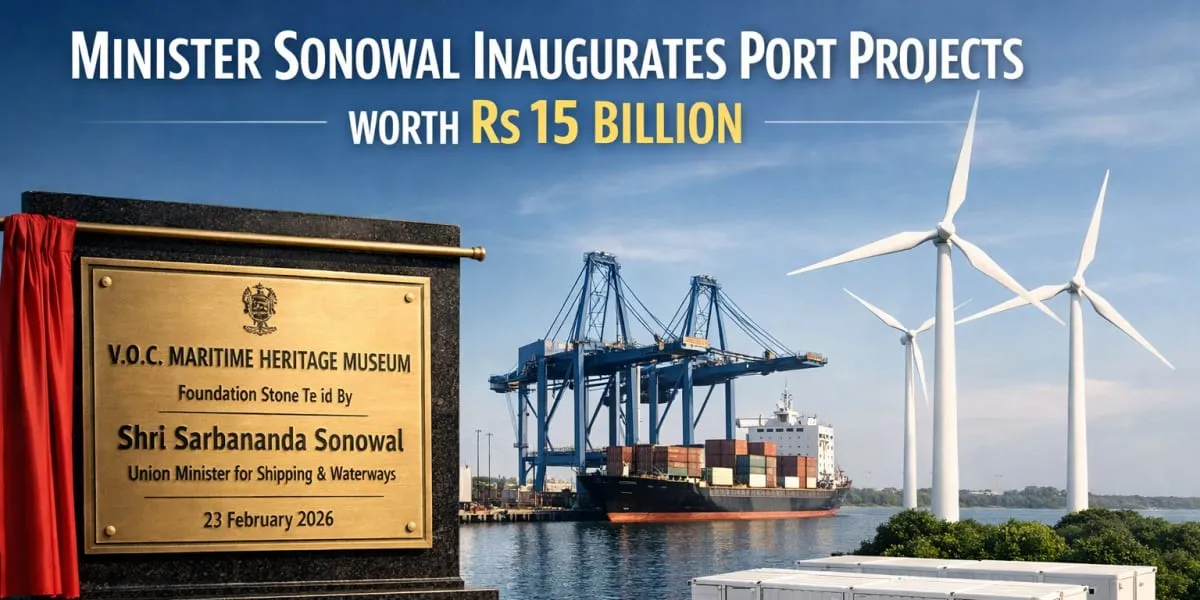
Union Minister for Shipping and Waterways Sarbananda Sonowal inaugurated and laid the foundation for a set of port projects worth Rs 15 billion (bn) at Tuticorin port in Tamil Nadu on 23 February 2026. Works inaugurated included the VOC Maritime Heritage Museum, the laying of the foundation stone for an eight megawatt (MW) wind farm and the establishment of a five megawatt-hour (MWh) battery energy storage system. The minister also launched corporate social responsibility projects at the port.

He said that the ancient history of Tamil culture and its maritime traditions command a national aspiration and that symbols such as the Sengol in the new parliament reflect respect for deep rooted tradition and timeless wisdom. The minister noted that more than Rs three trillion (tn) has been spent on infrastructure expansion, sustainability and technological advancement across the sector. He indicated that the present interventions are intended to strengthen regional connectivity and economic activity.

Officials said the eight megawatt wind installation and the five megawatt-hour battery system are aimed at enhancing the port's renewable energy capacity and improving grid stability for operational loads. The maritime museum is expected to document and display the port's historical role and to support cultural tourism and educational outreach. Corporate social responsibility initiatives were described as focusing on community welfare, skills development and local infrastructure improvements.

The projects form part of a wider agenda to modernise port infrastructure and to align investment with environmental sustainability and heritage conservation goals. Port authorities and the ministry said that similar investments will continue as part of efforts to boost trade efficiency, seaport competitiveness and employment opportunities in the region. Officials emphasised ongoing commitment to integrating technology and capacity building while ensuring benefits for coastal communities.

Union Minister for Shipping and Waterways Sarbananda Sonowal inaugurated and laid the foundation for a set of port projects worth Rs 15 billion (bn) at Tuticorin port in Tamil Nadu on 23 February 2026. Works inaugurated included the VOC Maritime Heritage Museum, the laying of the foundation stone for an eight megawatt (MW) wind farm and the establishment of a five megawatt-hour (MWh) battery energy storage system. The minister also launched corporate social responsibility projects at the port. He said that the ancient history of Tamil culture and its maritime traditions command a national aspiration and that symbols such as the Sengol in the new parliament reflect respect for deep rooted tradition and timeless wisdom. The minister noted that more than Rs three trillion (tn) has been spent on infrastructure expansion, sustainability and technological advancement across the sector. He indicated that the present interventions are intended to strengthen regional connectivity and economic activity. Officials said the eight megawatt wind installation and the five megawatt-hour battery system are aimed at enhancing the port's renewable energy capacity and improving grid stability for operational loads. The maritime museum is expected to document and display the port's historical role and to support cultural tourism and educational outreach. Corporate social responsibility initiatives were described as focusing on community welfare, skills development and local infrastructure improvements. The projects form part of a wider agenda to modernise port infrastructure and to align investment with environmental sustainability and heritage conservation goals. Port authorities and the ministry said that similar investments will continue as part of efforts to boost trade efficiency, seaport competitiveness and employment opportunities in the region. Officials emphasised ongoing commitment to integrating technology and capacity building while ensuring benefits for coastal communities.

Next Story
Infrastructure Transport

Sector 51-52 Metro skywalk in Noida remains shut despite being ready for over a year

Thousands of commuters travelling between Delhi Metro Rail Corporation’s (DMRC) Sector 52 station and Noida Metro Rail Corporation’s (NMRC) Sector 51 station continue to face daily inconvenience as the 300-metre air-conditioned skywalk connecting the two stations remains closed, despite being completed over a year ago, according to a report.The Noida Metro Rail Corporation built the foot overbridge to enable a seamless interchange between the Delhi Metro and Noida Metro networks. However, pending finishing work and a structural obstruction have delayed its opening.Krishna Karunesh, Chief E..

Next Story
Infrastructure Transport

Maharashtra clears Metro Line 5A, expansion of Mumbai Metro Line 5

The Maharashtra government has approved the expansion of Mumbai Metro Line 5 along with a new integrated corridor, Metro Line 5A, forming a combined 34.2-km metro network across the Thane-Bhiwandi-Kalyan-Ulhasnagar belt. The integrated project has been cleared at an estimated cost of ₹18,130.55 crore, according to a government resolution (GR).Metro Line 5 was originally approved in October 2017 as a 24.9-km fully elevated corridor with 17 stations connecting Thane, Bhiwandi and Kalyan, with an initial project cost of ₹8,416.51 crore. The corridor is being developed in two phases.The first ..

Next Story
Infrastructure Transport

Bengaluru Metro expansion seen driving office demand

Bengaluru’s expanding metro network is expected to emerge as a major catalyst for real estate growth, with the Yellow and Pink Lines likely to boost both office demand and residential prices across key micro-markets, according to a report by Colliers India.The report estimates that over the next two years, Bengaluru could witness an additional 5–7 million sq ft of Grade A office space demand across the Central Business District (CBD), Secondary Business District (SBD) and Electronic City. Improved metro connectivity and reduced commute times are expected to drive higher occupier interest a..

Advertisement

Subscribe to Our Newsletter

Get daily newsletters around different themes from Construction world.

STAY CONNECTED

Advertisement

Advertisement

Advertisement