

Wolffkran Deploys Five Cranes At London Site
Equipment

Wolffkran Deploys Five Cranes At London Site

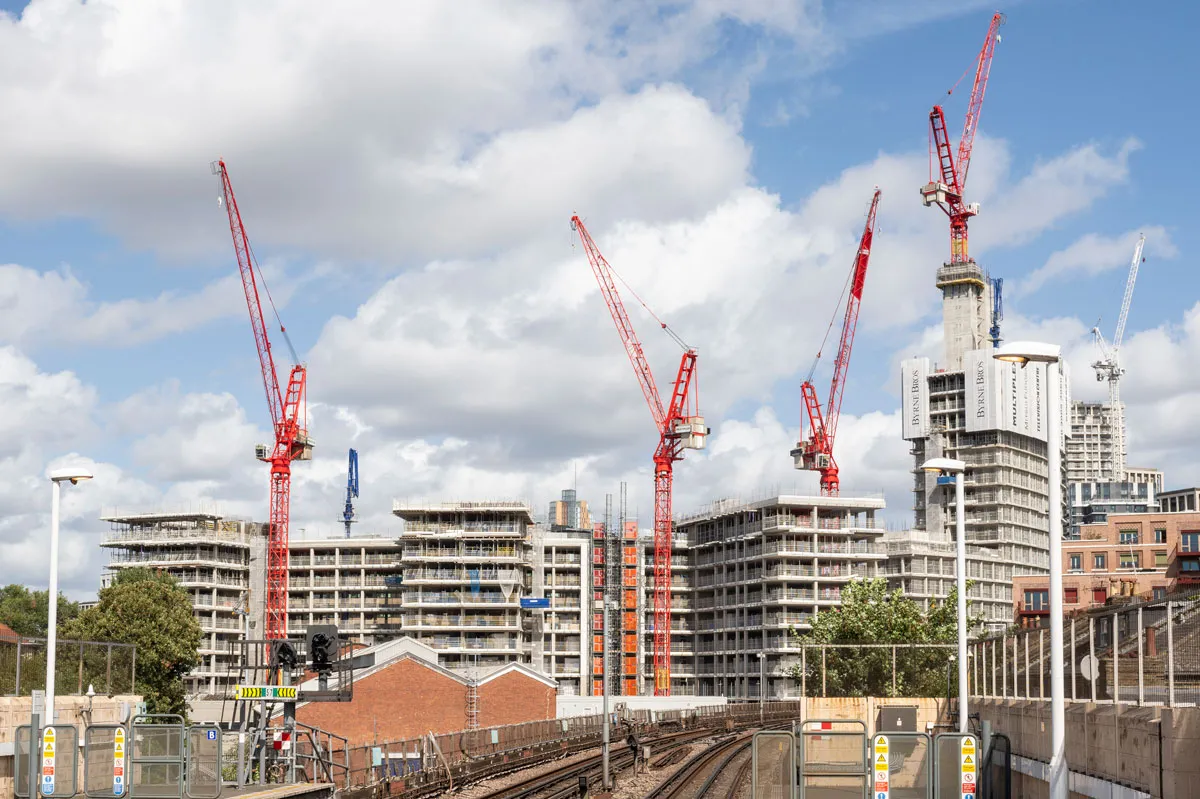
Wolffkran has deployed five tower cranes for Phase 2 of the Television Centre redevelopment in White City, London, supporting a mixed-use project led by Mitsui Fudosan UK and Multiplex Construction.
The development includes two residential buildings—The Ariel, a 23-storey tower with 167 units, and Scenery House, a nine-storey block with 180 units. Four WOLFF 355 B cranes were installed between July and August 2025, with one crane reaching a freestanding height of 95.2 m during core construction.
Post core completion, a WOLFF 630 B crane was installed atop the structure to support further works, while dismantling adjacent cranes.
The site posed significant logistical challenges due to its proximity to the London Underground. Cranes were restricted to 75 per cent lifting capacity and required foundations 33 per cent stronger than standard. Despite constraints, the cranes’ lifting capacity and compact jib design enabled efficient operations without oversailing railway tracks.
The project required precise planning for assembly and dismantling, including the use of a 650-ton mobile crane under constrained site conditions.
Wolffkran’s experience in dense urban environments and rail-adjacent construction enabled execution within tight timelines and regulatory constraints.

Wolffkran has deployed five tower cranes for Phase 2 of the Television Centre redevelopment in White City, London, supporting a mixed-use project led by Mitsui Fudosan UK and Multiplex Construction.The development includes two residential buildings—The Ariel, a 23-storey tower with 167 units, and Scenery House, a nine-storey block with 180 units. Four WOLFF 355 B cranes were installed between July and August 2025, with one crane reaching a freestanding height of 95.2 m during core construction.Post core completion, a WOLFF 630 B crane was installed atop the structure to support further works, while dismantling adjacent cranes.The site posed significant logistical challenges due to its proximity to the London Underground. Cranes were restricted to 75 per cent lifting capacity and required foundations 33 per cent stronger than standard. Despite constraints, the cranes’ lifting capacity and compact jib design enabled efficient operations without oversailing railway tracks.The project required precise planning for assembly and dismantling, including the use of a 650-ton mobile crane under constrained site conditions.Wolffkran’s experience in dense urban environments and rail-adjacent construction enabled execution within tight timelines and regulatory constraints.

Next Story
Infrastructure Transport

Sector 51-52 Metro skywalk in Noida remains shut despite being ready for over a year

Thousands of commuters travelling between Delhi Metro Rail Corporation’s (DMRC) Sector 52 station and Noida Metro Rail Corporation’s (NMRC) Sector 51 station continue to face daily inconvenience as the 300-metre air-conditioned skywalk connecting the two stations remains closed, despite being completed over a year ago, according to a report.The Noida Metro Rail Corporation built the foot overbridge to enable a seamless interchange between the Delhi Metro and Noida Metro networks. However, pending finishing work and a structural obstruction have delayed its opening.Krishna Karunesh, Chief E..

Next Story
Infrastructure Transport

Maharashtra clears Metro Line 5A, expansion of Mumbai Metro Line 5

The Maharashtra government has approved the expansion of Mumbai Metro Line 5 along with a new integrated corridor, Metro Line 5A, forming a combined 34.2-km metro network across the Thane-Bhiwandi-Kalyan-Ulhasnagar belt. The integrated project has been cleared at an estimated cost of ₹18,130.55 crore, according to a government resolution (GR).Metro Line 5 was originally approved in October 2017 as a 24.9-km fully elevated corridor with 17 stations connecting Thane, Bhiwandi and Kalyan, with an initial project cost of ₹8,416.51 crore. The corridor is being developed in two phases.The first ..

Next Story
Infrastructure Transport

Bengaluru Metro expansion seen driving office demand

Bengaluru’s expanding metro network is expected to emerge as a major catalyst for real estate growth, with the Yellow and Pink Lines likely to boost both office demand and residential prices across key micro-markets, according to a report by Colliers India.The report estimates that over the next two years, Bengaluru could witness an additional 5–7 million sq ft of Grade A office space demand across the Central Business District (CBD), Secondary Business District (SBD) and Electronic City. Improved metro connectivity and reduced commute times are expected to drive higher occupier interest a..

Advertisement

Subscribe to Our Newsletter

Get daily newsletters around different themes from Construction world.

STAY CONNECTED

Advertisement

Advertisement

Advertisement