


12 Years of Technology Lay Foundation for 2047
ECONOMY & POLICY

12 Years of Technology Lay Foundation for 2047

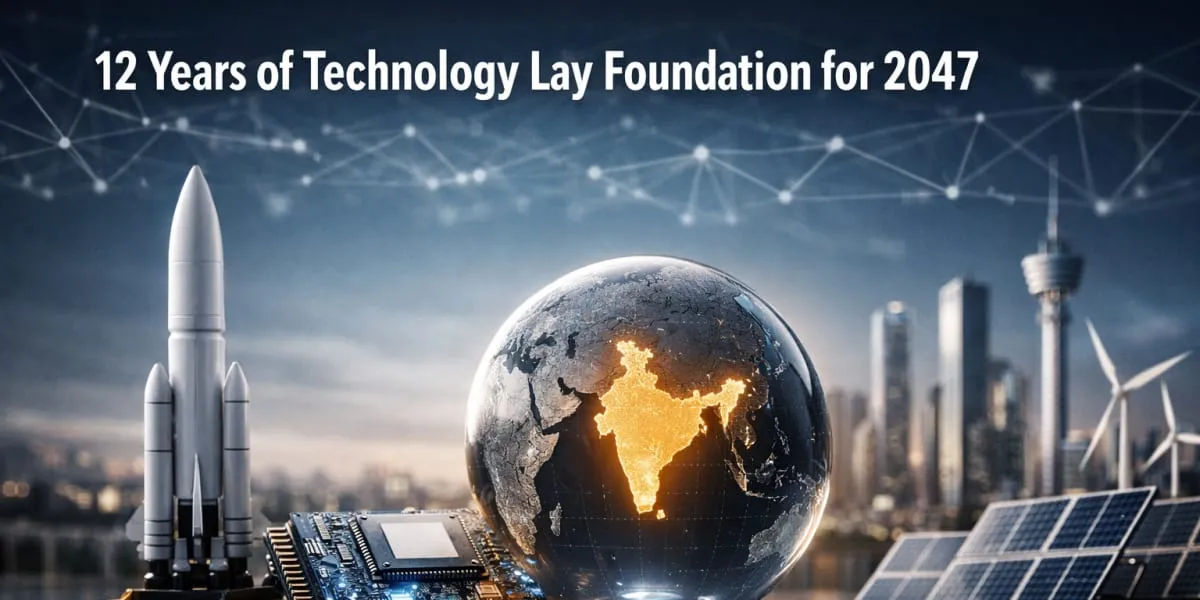
Union Minister Dr Jitendra Singh said 12 years of technological transformation under Prime Minister Narendra Modi have laid the foundation for Viksit Bharat by 2047 and shifted India from a technology follower to a technology leader. He said the change has altered India’s standing in the global scientific landscape and fostered a domestic innovation ecosystem. The minister said policy emphasis on science and technology, greater private participation and entrepreneurship has helped translate scientific advances into public benefit.

On space, he noted that opening the sector to private participation has created one of the world’s most dynamic ecosystems, with more than 400 startups and a space economy estimated at around nine bn US dollars. He said space technologies support communications, planning, disaster management, agriculture and national security and have increased public engagement with science. The minister added that the ecosystem has inspired a new generation of innovators.

He described the Prototype Fast Breeder Reactor as a major milestone in India’s long term energy strategy and a step forward in the three stage nuclear programme. He said reforms enabling greater private sector participation in nuclear activities are expected to accelerate innovation and expand advanced energy capabilities. He highlighted that India has completed nearly half of the targeted 2,000 kilometre quantum communication network under the National Quantum Mission and said the technology will strengthen secure communications and defence preparedness.

He pointed to the BioE3 policy and initiatives in genome sequencing, rare disease diagnosis, indigenous drug development and gene therapy as steps towards a biotechnology driven industrial transformation. He said the IndiaAI Mission, investments in computing infrastructure and datasets are building a foundation for leadership in advanced digital technologies while a diversified clean energy strategy includes nuclear, green hydrogen, solar and ocean based systems aligned with net zero commitments by 2070. The minister concluded that the scientific confidence and technological capabilities built over the last 12 years position India to emerge as a leading knowledge economy by 2047.

Union Minister Dr Jitendra Singh said 12 years of technological transformation under Prime Minister Narendra Modi have laid the foundation for Viksit Bharat by 2047 and shifted India from a technology follower to a technology leader. He said the change has altered India’s standing in the global scientific landscape and fostered a domestic innovation ecosystem. The minister said policy emphasis on science and technology, greater private participation and entrepreneurship has helped translate scientific advances into public benefit. On space, he noted that opening the sector to private participation has created one of the world’s most dynamic ecosystems, with more than 400 startups and a space economy estimated at around nine bn US dollars. He said space technologies support communications, planning, disaster management, agriculture and national security and have increased public engagement with science. The minister added that the ecosystem has inspired a new generation of innovators. He described the Prototype Fast Breeder Reactor as a major milestone in India’s long term energy strategy and a step forward in the three stage nuclear programme. He said reforms enabling greater private sector participation in nuclear activities are expected to accelerate innovation and expand advanced energy capabilities. He highlighted that India has completed nearly half of the targeted 2,000 kilometre quantum communication network under the National Quantum Mission and said the technology will strengthen secure communications and defence preparedness. He pointed to the BioE3 policy and initiatives in genome sequencing, rare disease diagnosis, indigenous drug development and gene therapy as steps towards a biotechnology driven industrial transformation. He said the IndiaAI Mission, investments in computing infrastructure and datasets are building a foundation for leadership in advanced digital technologies while a diversified clean energy strategy includes nuclear, green hydrogen, solar and ocean based systems aligned with net zero commitments by 2070. The minister concluded that the scientific confidence and technological capabilities built over the last 12 years position India to emerge as a leading knowledge economy by 2047.

Next Story
Infrastructure Urban

Adani Project to Redevelop Dharavi and Unlock Major Value

The Adani-led Dharavi redevelopment is presented as one of Asia's largest urban renewal schemes and aims to convert the settlement into a smart city precinct and transport hub while rehabilitating 0.125 million (mn) housing units for more than 1.0 mn residents, according to an HSBC report summarising a panel at the Adani Annual Conference 2026. The report frames the initiative as combining large-scale housing provision with planned public amenities and commercial inventory to raise living standards and unlock formal homeownership. HSBC highlights a substantial commercial opportunity with about..

Next Story
Infrastructure Urban

TCS Renews 1.5 Million Sq Ft Chennai Lease Worth Rs 14,200 mn

Tata Consultancy Services (TCS) has renewed a lease for 1.5 million sq ft of office space in Chennai and committed Rs 14,200 million (mn) in rentals over 10 years. The transaction secures a major corporate footprint in the city and reinforces the company's long-term occupancy plans. The renewal aligns with the company's strategy to maintain substantial physical capacity in major regional hubs. The decision follows internal assessments of space utilisation and long-term operational needs.\n\nThe lease renewal covers a substantial campus area and is intended to support the firm's delivery operat..

Next Story
Infrastructure Urban

Embassy Developments Targets Rs 80 bn Pre Sales In FY27

Embassy Developments said it is targeting Rs 80 billion (Rs 80 bn) of pre-sales in 2026-27 as housing demand remains strong across major cities and the company seeks to capitalise on market momentum. The managing director indicated that the firm recorded a 128 per cent rise in sales bookings in 2025-26 to Rs 46.31 bn, which was slightly short of its annual guidance but reflected robust consumer interest. The company reported that demand is particularly resilient for well-designed and high-quality residential properties sold by branded developers with proven execution. The target includes sales..

Advertisement

Subscribe to Our Newsletter

Get daily newsletters around different themes from Construction world.

STAY CONNECTED

Advertisement

Advertisement

Advertisement