


India Targets One Trillion Bio Economy By 2047
ECONOMY & POLICY

India Targets One Trillion Bio Economy By 2047

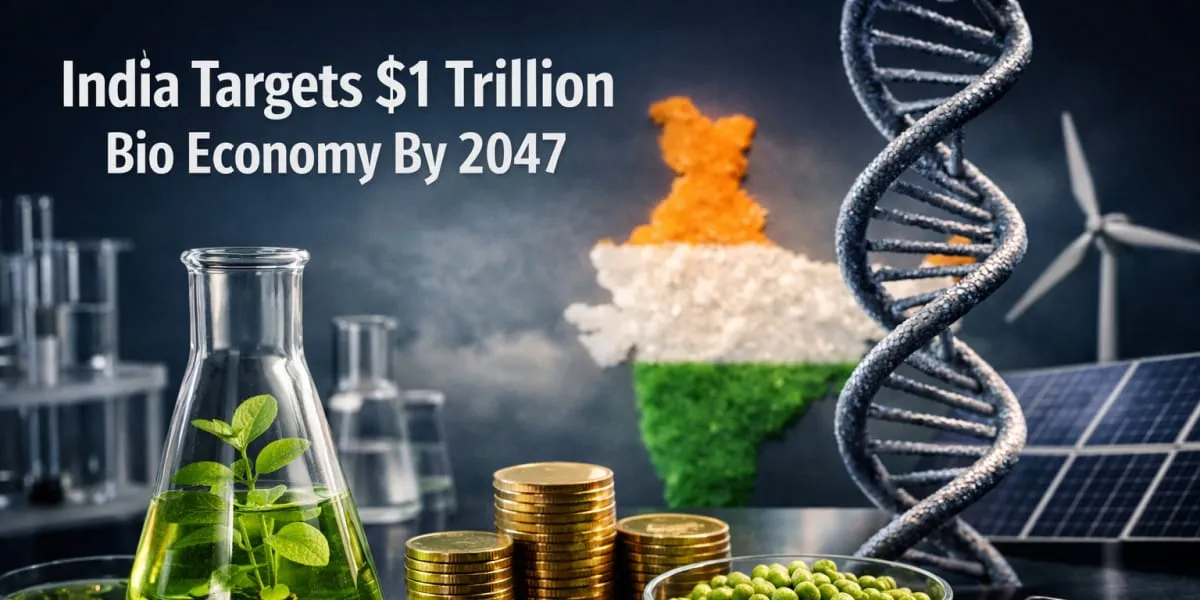
Union Minister of State Dr Jitendra Singh said the 21st century will belong to Bharat and will be driven by a biology-led economy, with the country aiming for a bio economy of one trillion (tn) dollars by 2047. He delivered the keynote address virtually at the International Conference Vision 2047, organised by IIT Roorkee and Swadeshi Shodh Sansthan, which brought together more than 100 institutions from India and abroad.

He outlined policy initiatives, including the BioE3 Policy approved in 2024, and said the sector has expanded rapidly, rising from $10 billion (bn) in 2014 to over $165 billion (bn) today and growing at nearly 18 per cent annually, with a target of $300 billion (bn) by 2030. The minister noted that the number of biotech startups has increased from around fifty to more than 11,000, reflecting an expanding innovation ecosystem and stronger institutional support.

He highlighted research advances such as Genome India, indigenous CAR T therapy and mRNA vaccine platforms, along with India’s first indigenously developed antibiotic and a National Biobank. He noted collaborative space biotechnology work with ISRO and the expansion of nuclear medicine and deep ocean exploration through missions including Samudrayaan. He also pointed to financing measures such as the Anusandhan National Research Foundation with a Rs 500 bn corpus and the Rs one tn Research, Development and Innovation Fund for long-term, low-cost support to deep tech.

He said the National Quantum Mission had met key milestones ahead of schedule and noted the Global Innovation Index rank rose from 81 to 39 alongside a doubling of research and development expenditure over the past decade. He outlined a roadmap with milestones for 2030, 2035, 2040 and 2047 covering scaling of bio manufacturing, operationalisation of the Bharatiya Antariksha Station and advancement of marine biotechnology and carbon-neutral technologies. He urged students, researchers and institutions to lead innovation and research to shape Viksit Bharat 2047 and to help India join the top three global bio economies.

Union Minister of State Dr Jitendra Singh said the 21st century will belong to Bharat and will be driven by a biology-led economy, with the country aiming for a bio economy of one trillion (tn) dollars by 2047. He delivered the keynote address virtually at the International Conference Vision 2047, organised by IIT Roorkee and Swadeshi Shodh Sansthan, which brought together more than 100 institutions from India and abroad. He outlined policy initiatives, including the BioE3 Policy approved in 2024, and said the sector has expanded rapidly, rising from $10 billion (bn) in 2014 to over $165 billion (bn) today and growing at nearly 18 per cent annually, with a target of $300 billion (bn) by 2030. The minister noted that the number of biotech startups has increased from around fifty to more than 11,000, reflecting an expanding innovation ecosystem and stronger institutional support. He highlighted research advances such as Genome India, indigenous CAR T therapy and mRNA vaccine platforms, along with India’s first indigenously developed antibiotic and a National Biobank. He noted collaborative space biotechnology work with ISRO and the expansion of nuclear medicine and deep ocean exploration through missions including Samudrayaan. He also pointed to financing measures such as the Anusandhan National Research Foundation with a Rs 500 bn corpus and the Rs one tn Research, Development and Innovation Fund for long-term, low-cost support to deep tech. He said the National Quantum Mission had met key milestones ahead of schedule and noted the Global Innovation Index rank rose from 81 to 39 alongside a doubling of research and development expenditure over the past decade. He outlined a roadmap with milestones for 2030, 2035, 2040 and 2047 covering scaling of bio manufacturing, operationalisation of the Bharatiya Antariksha Station and advancement of marine biotechnology and carbon-neutral technologies. He urged students, researchers and institutions to lead innovation and research to shape Viksit Bharat 2047 and to help India join the top three global bio economies.

Next Story
Infrastructure Urban

MoCA Releases Second Phase FTO Rankings to Strengthen Pilot Training

Ministry of Civil Aviation (MoCA) under Minister Ram Mohan Naidu released the second phase ranking of Directorate General of Civil Aviation (DGCA) approved Flying Training Organisations (FTOs) in April 2026. The framework was developed under the minister's guidance to standardise the evaluation of training institutions. The initiative aims to create a transparent, performance-driven system for pilot training across India. The data-driven framework compiled by the Directorate General of Civil Aviation ensures objective comparison and continuous monitoring of FTO performance with emphasis on saf..

Next Story
Infrastructure Urban

Centre Offers Financial Incentives For State Mining Reforms

The Centre has incorporated a financial incentive mechanism with an outlay of Rs 50,000 mn into the Scheme for Special Assistance to States for Capital Investment (SASCI) for the financial year 2026-27. The Ministry of Mines, acting as the nodal ministry, has issued operational guidelines for the new scheme component. The measure follows the perceived success of the previous fiscal year and aims to promote mining sector reforms across States and union territories with legislatures. The incentives are intended to expedite operationalisation of mines and to boost mineral production and state rev..

Next Story
Technology

India Netherlands Relations Move Towards Stronger Strategic Partnership

At the Dutch Embassy in Chanakyapuri, New Delhi, the Union Minister of State with independent charge of Science and Technology and Earth Sciences and minister in the Prime Minister's Office, Dr Jitendra Singh, attended the Netherlands National Day celebration as the chief guest. He noted that India and the Netherlands share an enduring relationship that is steadily progressing towards a stronger strategic partnership. The minister highlighted the event as a platform to reaffirm bilateral ties. He outlined that the partnership encompasses key sectors such as water management, agriculture and hi..

Advertisement

Subscribe to Our Newsletter

Get daily newsletters around different themes from Construction world.

STAY CONNECTED

Advertisement

Advertisement

Advertisement














