Governance Summit 2026 Advances Inclusive AI for Viksit Bharat
ECONOMY & POLICY

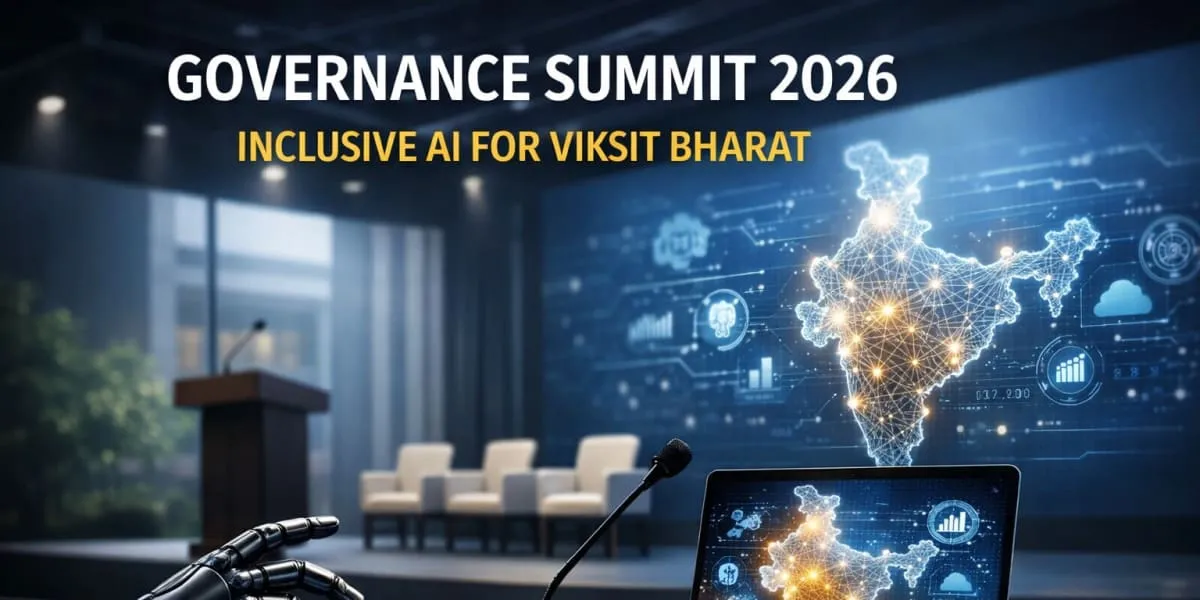
Governance Summit 2026 Advances Inclusive AI for Viksit Bharat

The one-day summit at the Indian School of Business Mohali campus on 23 May 2026 was hosted by the Ministry of Electronics and Information Technology in collaboration with the Bharti Institute of Public Policy at ISB.

The event, the fourth edition of the Governance Summit, focused on inclusive artificial intelligence under the Viksit Bharat vision and convened stakeholders from government, industry, academia and civil society to discuss actionable pathways.

The opening keynote by S. Krishnan, Secretary, Ministry of Electronics and Information Technology, set out the government’s commitment to build an AI ecosystem that serves every citizen, including those at the margins of the digital economy and framed artificial intelligence as a transformative opportunity to enhance productivity, improve governance and expand access across health, education, manufacturing and financial inclusion.

Prof. Ashwini Chhatre, Associate Professor and Executive Director of the Bharti Institute, emphasised the need to translate AI ambitions into governance frameworks that are practical and enduring, identifying inequality, the scope for leapfrogging and the future of work as key dimensions and urging that access to AI opportunities should remain equitable with appropriate safeguards, social security mechanisms and affirmative action.

The day-long programme featured four thematic panel discussions on AI’s role in digital commerce, online safety for women and children, healthcare access and affordability, and job creation with digital entrepreneurship, and a parallel roundtable examined the operationalisation of AI for last-mile public service delivery from state governments down to gram panchayats.

The summit attracted participation from Reliance Retail, Mastercard, Apollo Hospitals, Indian Institute of Technology Madras, UNICEF India, the Punjab Police and several central and state ministries, with delegates discussing models for public-private collaboration and capacity building to accelerate solutions that deepen inclusion and strengthen governance and stressing measurable outcomes and sustained intersectoral engagement to advance India’s development agenda.

The one-day summit at the Indian School of Business Mohali campus on 23 May 2026 was hosted by the Ministry of Electronics and Information Technology in collaboration with the Bharti Institute of Public Policy at ISB. The event, the fourth edition of the Governance Summit, focused on inclusive artificial intelligence under the Viksit Bharat vision and convened stakeholders from government, industry, academia and civil society to discuss actionable pathways. The opening keynote by S. Krishnan, Secretary, Ministry of Electronics and Information Technology, set out the government’s commitment to build an AI ecosystem that serves every citizen, including those at the margins of the digital economy and framed artificial intelligence as a transformative opportunity to enhance productivity, improve governance and expand access across health, education, manufacturing and financial inclusion. Prof. Ashwini Chhatre, Associate Professor and Executive Director of the Bharti Institute, emphasised the need to translate AI ambitions into governance frameworks that are practical and enduring, identifying inequality, the scope for leapfrogging and the future of work as key dimensions and urging that access to AI opportunities should remain equitable with appropriate safeguards, social security mechanisms and affirmative action. The day-long programme featured four thematic panel discussions on AI’s role in digital commerce, online safety for women and children, healthcare access and affordability, and job creation with digital entrepreneurship, and a parallel roundtable examined the operationalisation of AI for last-mile public service delivery from state governments down to gram panchayats. The summit attracted participation from Reliance Retail, Mastercard, Apollo Hospitals, Indian Institute of Technology Madras, UNICEF India, the Punjab Police and several central and state ministries, with delegates discussing models for public-private collaboration and capacity building to accelerate solutions that deepen inclusion and strengthen governance and stressing measurable outcomes and sustained intersectoral engagement to advance India’s development agenda.

Next Story
Products

Fynd Launches AI Platform to Accelerate Fashion Creation

Fynd, an AI-native retail technology company backed by Reliance Retail Ventures, has launched Fynd Create, a platform designed to bring design intelligence, sourcing and manufacturing onto a single connected ecosystem. The platform aims to help brands respond faster to changing consumer preferences and shorten product development cycles.As social media trends continue to compress traditional fashion seasons, brands are under increasing pressure to move from seasonal planning to demand-driven production. Conventional supply chains, often characterised by long lead times and fragmented operation..

Next Story
Resources

Modis Navnirman Appointed For Neel Kiran CHSL Redevelopment

Modis Navnirman (MNL) has been appointed as the developer for the redevelopment of Neel Kiran Co-operative Housing Society Ltd in Khar West, Mumbai, following a selection process in which members chose MNL as their preferred partner. The appointment will add approximately Rs two point five billion (Rs two point five bn) to the company's Gross Development Value pipeline and strengthen its focus on redevelopment and urban renewal projects across the Mumbai Metropolitan Region. The project site is a landmark residential society in Khar West, and the selection reflects members' preference for a pa..

Next Story
Infrastructure Energy

Diamond Power Commissions Eighth MV and EHV Cable Line

Diamond Power Infrastructure (DPIL) has commissioned its eighth Medium Voltage (MV) and Extra High Voltage (EHV) power cable production line at its manufacturing facility in Vadodara, Gujarat. The new line enhances the company's manufacturing capacity in the technologically advanced MV and EHV underground power cable segment. This segment supplies cables for power transmission networks, power generation projects and renewable energy evacuation systems. The development is presented as a step to meet evolving infrastructure needs. The MV and EHV cables produced at the Vadodara facility serve urb..

Advertisement

Subscribe to Our Newsletter

Get daily newsletters around different themes from Construction world.

STAY CONNECTED

Advertisement

Advertisement

Advertisement