INOX India Systems Power Indian Railways LNG DEMU Trial
ECONOMY & POLICY

INOX India Systems Power Indian Railways LNG DEMU Trial

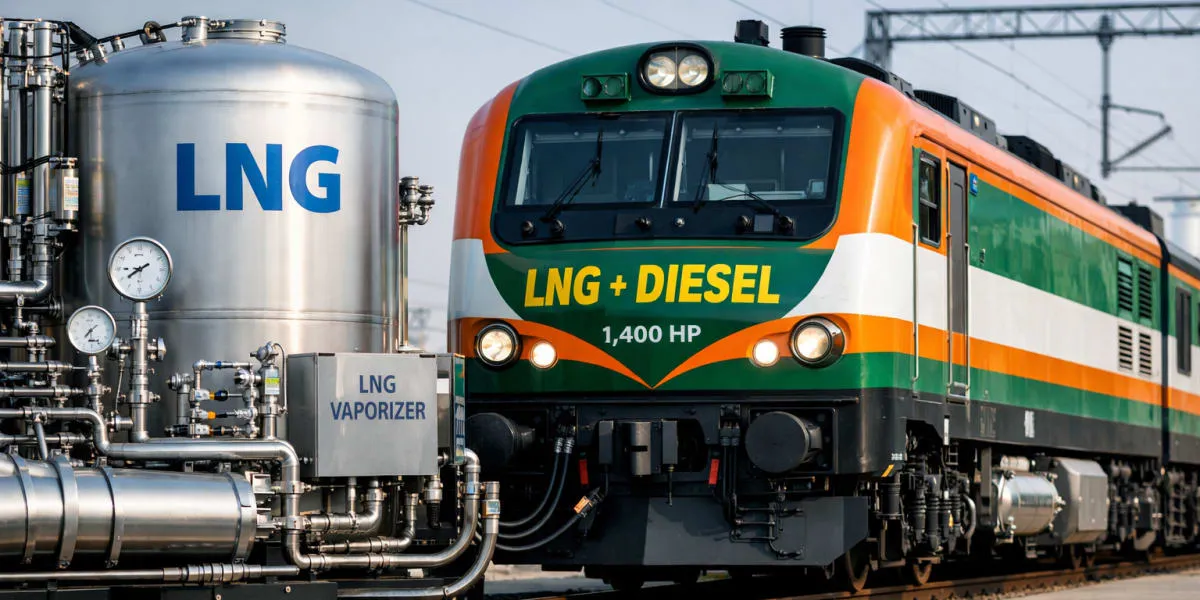
Indian Railways recently operationalised the nation’s first liquefied natural gas and diesel dual-fuel DEMU at Sabarmati, Ahmedabad on 17 February 2026 with INOX India Limited (INOXCVA) supplying 2,200-litre LNG receiving, storage and regasification systems for integration with 1,400 HP driving power units. The systems were fitted to the driving power cars to permit simultaneous use of LNG and diesel while retaining conventional engine operation.

The equipment is engineered to permit seamless dual-fuel operation and to substitute up to 40 per cent of diesel with LNG, improving fuel efficiency and lowering greenhouse gas emissions on short and medium-distance routes. The deployment was described by the company as a significant step in advancing energy-efficient, low-emission rail mobility and reinforcing its role in rail decarbonisation.

The initiative was conceived by the Indian Railways Alternative Fuels Division to convert an initial batch of 10 driving power units to a dual-fuel hybrid model, and INOXCVA provided the technology. The company had earlier delivered two units that underwent trials and certification at the Sabarmati Division and, following proven performance, additional units are now ready for induction under the contract.

The LNG fuel tank system was delivered through CLH Gaseous Fuel Applications Pvt. Ltd., and INOXCVA is the only provider in India to have completed delivery, testing and validation of cryogenic LNG systems for rail applications. Plans to double the on-board LNG capacity were indicated so trains could cover longer distances, and CLH handled the engine conversion from diesel to the dual-fuel configuration.

INOX India Limited said it views LNG as a transition fuel toward cleaner mobility and cited liquid hydrogen as a future frontier for zero-emission rail locomotives, noting its decades of cryogenic expertise and research and development capabilities. The company, with an after-sales network across 25 countries and an international user base, continues to pursue adoption of LNG for industrial and automotive purposes.

Indian Railways recently operationalised the nation’s first liquefied natural gas and diesel dual-fuel DEMU at Sabarmati, Ahmedabad on 17 February 2026 with INOX India Limited (INOXCVA) supplying 2,200-litre LNG receiving, storage and regasification systems for integration with 1,400 HP driving power units. The systems were fitted to the driving power cars to permit simultaneous use of LNG and diesel while retaining conventional engine operation. The equipment is engineered to permit seamless dual-fuel operation and to substitute up to 40 per cent of diesel with LNG, improving fuel efficiency and lowering greenhouse gas emissions on short and medium-distance routes. The deployment was described by the company as a significant step in advancing energy-efficient, low-emission rail mobility and reinforcing its role in rail decarbonisation. The initiative was conceived by the Indian Railways Alternative Fuels Division to convert an initial batch of 10 driving power units to a dual-fuel hybrid model, and INOXCVA provided the technology. The company had earlier delivered two units that underwent trials and certification at the Sabarmati Division and, following proven performance, additional units are now ready for induction under the contract. The LNG fuel tank system was delivered through CLH Gaseous Fuel Applications Pvt. Ltd., and INOXCVA is the only provider in India to have completed delivery, testing and validation of cryogenic LNG systems for rail applications. Plans to double the on-board LNG capacity were indicated so trains could cover longer distances, and CLH handled the engine conversion from diesel to the dual-fuel configuration. INOX India Limited said it views LNG as a transition fuel toward cleaner mobility and cited liquid hydrogen as a future frontier for zero-emission rail locomotives, noting its decades of cryogenic expertise and research and development capabilities. The company, with an after-sales network across 25 countries and an international user base, continues to pursue adoption of LNG for industrial and automotive purposes.

Next Story
Technology

AI-Enabled Workflows Lift Profitability and Productivity

Organisations modernising frontline workflows with artificial intelligence, automation and real-time data are reporting stronger financial performance, higher productivity and improved employee engagement, according to a global study by Zebra Technologies and Oxford Economics.The research covered 1,000 senior leaders across retail, manufacturing, transportation and logistics in the US, Mexico, the UK, Germany, India, Japan, Australia and New Zealand.In transportation and logistics, 54 per cent of companies that improved picking and packing operations reported faster operational performance, wh..

Next Story
Real Estate

India Leads Global AI Readiness but Implementation Lags

Indian companies lead global averages across all eight artificial intelligence readiness indicators tracked by JLL, but only 19 per cent have started making changes to their workplaces, according to the JLL 2026 Future of Work Survey.The study found that 77 per cent of Indian business leaders expect AI to change their office requirements, creating a 58-percentage-point gap between awareness and implementation. The survey covered more than 2,200 CEOs, CFOs and real estate leaders across 21 countries during the first quarter of 2026.Despite concerns over automation, 58 per cent of Indian leaders..

Next Story
Equipment

Three WOLFF Cranes Build Riyadh Cable-Stayed Bridges

Three WOLFF 180 B luffing jib cranes are supporting the construction of two cable-stayed bridges alongside the existing Wadi Laban Bridge in Riyadh, Saudi Arabia. The project is being developed for the Royal Commission for Riyadh City and executed by the ICRC joint venture comprising IC Ictas and Al Rashid Trading & Contracting Company.The cranes are handling lifting operations including formwork, reinforcement, concrete placement, work platforms, surveying equipment and other construction materials. Each crane is fitted with a 40 m jib, reaches a hook height of 157 m and offers a maximum ..

Advertisement

Subscribe to Our Newsletter

Get daily newsletters around different themes from Construction world.

STAY CONNECTED

Advertisement

Advertisement

Advertisement