LANXESS Binder CAB 30 Wins EPDs for Low Emission Screeds
ECONOMY & POLICY

LANXESS Binder CAB 30 Wins EPDs for Low Emission Screeds

LANXESS has received Environmental Product Declarations from the Institute for Construction and Environment (IBU) for its calcium sulfate binder CAB 30 and for its use in conventional calcium sulfate screeds, providing independent verification of the product's low carbon footprint and its suitability for eco-efficient construction projects. The binder has been tested for building biology and meets strict limits for volatile organic compounds, allowing it to carry recognised eco-labels. CAB 30 is standardised under DIN EN 13454 and is presented as a low-emission anhydrite binder for processors and builders seeking sustainable alternatives.

Independent emission tests show that the binder fulfils the requirements of the Committee for Health Assessment of Building Products, known as AgBB, and has obtained further positive assessments including compliance with Belgian volatile organic compound regulations. The product has also been awarded the French A+ indoor air emissions seal for very low indoor air emissions even when used with additives such as Mebonit pro or Mebofix pro. These assessments form the technical basis for its acceptance in green building schemes.

The Mebofix pro drying accelerator reduces the water required for mixing screed mortar and significantly shortens drying times, which conserves resources and accelerates construction schedules. A lower water content increases robustness and improves compressive, flexural and surface strength of the screed, while enabling application over large areas without joints or reinforcement. The combined result is an improved emissions balance and practical advantages over traditional cement screeds on site.

Environmental Product Declarations provide a transparent and comparable data basis for architects, engineers, builders and contractors and support certification and public procurement processes. LANXESS, a specialty chemicals company with sales of six point four billion (bn) euro in 2024 and about 11,800 employees in 32 countries, highlights the strategic value of verified product data in meeting sustainability goals. CAB 30 is therefore positioned as a suitable solution for projects with high eco-efficiency requirements and green building objectives.

LANXESS has received Environmental Product Declarations from the Institute for Construction and Environment (IBU) for its calcium sulfate binder CAB 30 and for its use in conventional calcium sulfate screeds, providing independent verification of the product's low carbon footprint and its suitability for eco-efficient construction projects. The binder has been tested for building biology and meets strict limits for volatile organic compounds, allowing it to carry recognised eco-labels. CAB 30 is standardised under DIN EN 13454 and is presented as a low-emission anhydrite binder for processors and builders seeking sustainable alternatives. Independent emission tests show that the binder fulfils the requirements of the Committee for Health Assessment of Building Products, known as AgBB, and has obtained further positive assessments including compliance with Belgian volatile organic compound regulations. The product has also been awarded the French A+ indoor air emissions seal for very low indoor air emissions even when used with additives such as Mebonit pro or Mebofix pro. These assessments form the technical basis for its acceptance in green building schemes. The Mebofix pro drying accelerator reduces the water required for mixing screed mortar and significantly shortens drying times, which conserves resources and accelerates construction schedules. A lower water content increases robustness and improves compressive, flexural and surface strength of the screed, while enabling application over large areas without joints or reinforcement. The combined result is an improved emissions balance and practical advantages over traditional cement screeds on site. Environmental Product Declarations provide a transparent and comparable data basis for architects, engineers, builders and contractors and support certification and public procurement processes. LANXESS, a specialty chemicals company with sales of six point four billion (bn) euro in 2024 and about 11,800 employees in 32 countries, highlights the strategic value of verified product data in meeting sustainability goals. CAB 30 is therefore positioned as a suitable solution for projects with high eco-efficiency requirements and green building objectives.

Related Stories

Gold Stories

Next Story
Infrastructure Urban

KONE Opens India's First Digital Experience Centre in Pune

KONE, a global elevator and escalator manufacturer, has inaugurated its first Digital Experience Centre (DEC) in India, located in Pune. The facility aims to showcase how artificial intelligence (AI), connectivity and data-driven technologies can enhance customer experiences and improve building operations.The centre was inaugurated by Jussi Herlin, Executive Vice Chair, KONE Corporation; Philippe Delorme, President and CEO, KONE; and Nandan Nilekani, Co-founder and Chairman of the Board, Infosys.Designed as an interactive customer environment, the facility demonstrates digital solutions cover..

Next Story
Infrastructure Urban

CII GreenCo Launches Circularity Guidelines for Indian Industry

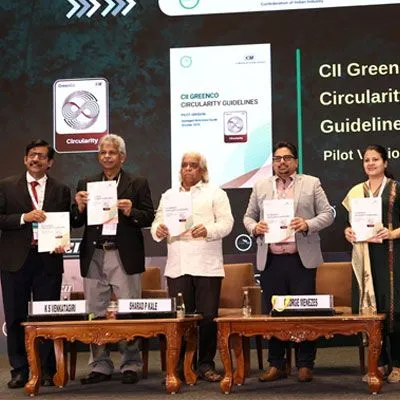
The Confederation of Indian Industry (CII) GreenCo Council has launched the CII GreenCo Circularity Guidelines – Pilot Version at the 17th CII GreenCo Waste & Resource Management Summit 2026 in Chennai. The initiative aims to strengthen resource efficiency, waste reduction and circular economy practices across Indian manufacturing and process industries.The guidelines introduce a structured framework with circularity indices covering raw materials, consumables, packaging and other resource inputs. These indicators will help industries assess existing practices, identify opportunities to ..

Next Story
Infrastructure Energy

Global Electronics Association Launches IPC-1783-CO2E Standard

The Global Electronics Association has introduced IPC-1783-CO2E, a new international standard aimed at improving consistency, transparency and comparability in product carbon footprint reporting across the electronics manufacturing industry.The standard, titled International Standard for Data Collection and Reporting of CO2 Equivalent (CO2e) Emissions for the Electronics Manufacturing Supply Chain, provides industry-specific guidance for collecting, estimating and reporting carbon emissions data.With increasing regulatory requirements and customer expectations, electronics manufacturers face c..

Advertisement

Subscribe to Our Newsletter

Get daily newsletters around different themes from Construction world.

STAY CONNECTED

Advertisement

SPECIAL OFFER
QR Code