Ministry Launches Version 2.0 of Indian Culture Portal
ECONOMY & POLICY

Ministry Launches Version 2.0 of Indian Culture Portal

Version 2.0 of the Indian Culture Portal (ICP) has been launched by the Ministry of Culture as a technological upgrade to the national digital platform that provides unified access to India’s cultural heritage. The portal was created to democratise knowledge about traditions, history, literature, arts and heritage and now offers a faster and more accessible user experience in response to rising user traffic.

Version 2.0 uses a modern architecture with a React based frontend and a Drupal backend, replacing the earlier monolithic system to improve speed, scalability and reliability. The reworked system supports millions of users and simplifies integration of future digital services. It also functions as a Progressive Web App, allowing an app like experience across desktops, tablets and smartphones without store downloads.

The upgraded ICP includes Artificial Intelligence enabled tools to enhance engagement and discovery. An AI powered chatbot named Bharti assists users in navigation, answering queries, summarising material and directing users to resources, with integration to the Government of India’s Bhashini platform enabling responses in 22 Indian languages. The portal provides an advanced multilevel global search with full text search, intelligent metadata filters and faceted navigation.

Immersive experiences include three dimensional walkthroughs and 360 degree virtual tours of heritage monuments, allowing digital exploration of architectural and historical landmarks. The platform presents 46 curated cultural categories and new original sections such as Iconic Battles of India, Folktales of India, Healing Through the Ages and Classical Dances of India to provide engaging narratives for students, researchers and general audiences. Interactive games, quizzes, puzzles and crosswords encourage learning through engagement.

The ICP is positioned as a scalable, future ready platform capable of integrating emerging technologies, expanding content partnerships and supporting wider outreach for India’s cultural knowledge resources. The upgrade is expected to benefit citizens, researchers, cultural institutions and policymakers by providing faster access to curated content, improved search capabilities and multilingual digital engagement. The Ministry of Culture has reiterated its commitment to digitise, preserve and democratise access to India’s cultural heritage.

Version 2.0 of the Indian Culture Portal (ICP) has been launched by the Ministry of Culture as a technological upgrade to the national digital platform that provides unified access to India’s cultural heritage. The portal was created to democratise knowledge about traditions, history, literature, arts and heritage and now offers a faster and more accessible user experience in response to rising user traffic. Version 2.0 uses a modern architecture with a React based frontend and a Drupal backend, replacing the earlier monolithic system to improve speed, scalability and reliability. The reworked system supports millions of users and simplifies integration of future digital services. It also functions as a Progressive Web App, allowing an app like experience across desktops, tablets and smartphones without store downloads. The upgraded ICP includes Artificial Intelligence enabled tools to enhance engagement and discovery. An AI powered chatbot named Bharti assists users in navigation, answering queries, summarising material and directing users to resources, with integration to the Government of India’s Bhashini platform enabling responses in 22 Indian languages. The portal provides an advanced multilevel global search with full text search, intelligent metadata filters and faceted navigation. Immersive experiences include three dimensional walkthroughs and 360 degree virtual tours of heritage monuments, allowing digital exploration of architectural and historical landmarks. The platform presents 46 curated cultural categories and new original sections such as Iconic Battles of India, Folktales of India, Healing Through the Ages and Classical Dances of India to provide engaging narratives for students, researchers and general audiences. Interactive games, quizzes, puzzles and crosswords encourage learning through engagement. The ICP is positioned as a scalable, future ready platform capable of integrating emerging technologies, expanding content partnerships and supporting wider outreach for India’s cultural knowledge resources. The upgrade is expected to benefit citizens, researchers, cultural institutions and policymakers by providing faster access to curated content, improved search capabilities and multilingual digital engagement. The Ministry of Culture has reiterated its commitment to digitise, preserve and democratise access to India’s cultural heritage.

Related Stories

Gold Stories

Next Story
Infrastructure Urban

KONE Opens India's First Digital Experience Centre in Pune

KONE, a global elevator and escalator manufacturer, has inaugurated its first Digital Experience Centre (DEC) in India, located in Pune. The facility aims to showcase how artificial intelligence (AI), connectivity and data-driven technologies can enhance customer experiences and improve building operations.The centre was inaugurated by Jussi Herlin, Executive Vice Chair, KONE Corporation; Philippe Delorme, President and CEO, KONE; and Nandan Nilekani, Co-founder and Chairman of the Board, Infosys.Designed as an interactive customer environment, the facility demonstrates digital solutions cover..

Next Story
Infrastructure Urban

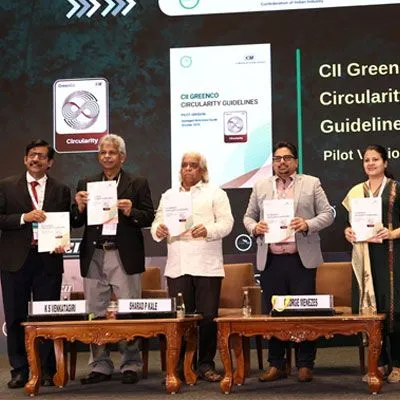
CII GreenCo Launches Circularity Guidelines for Indian Industry

The Confederation of Indian Industry (CII) GreenCo Council has launched the CII GreenCo Circularity Guidelines – Pilot Version at the 17th CII GreenCo Waste & Resource Management Summit 2026 in Chennai. The initiative aims to strengthen resource efficiency, waste reduction and circular economy practices across Indian manufacturing and process industries.The guidelines introduce a structured framework with circularity indices covering raw materials, consumables, packaging and other resource inputs. These indicators will help industries assess existing practices, identify opportunities to ..

Next Story
Infrastructure Energy

Global Electronics Association Launches IPC-1783-CO2E Standard

The Global Electronics Association has introduced IPC-1783-CO2E, a new international standard aimed at improving consistency, transparency and comparability in product carbon footprint reporting across the electronics manufacturing industry.The standard, titled International Standard for Data Collection and Reporting of CO2 Equivalent (CO2e) Emissions for the Electronics Manufacturing Supply Chain, provides industry-specific guidance for collecting, estimating and reporting carbon emissions data.With increasing regulatory requirements and customer expectations, electronics manufacturers face c..

Advertisement

Subscribe to Our Newsletter

Get daily newsletters around different themes from Construction world.

STAY CONNECTED

Advertisement

SPECIAL OFFER
QR Code