MNRE Extends PM KUSUM Project Completion Deadline To 31 March 2027
ECONOMY & POLICY

MNRE Extends PM KUSUM Project Completion Deadline To 31 March 2027

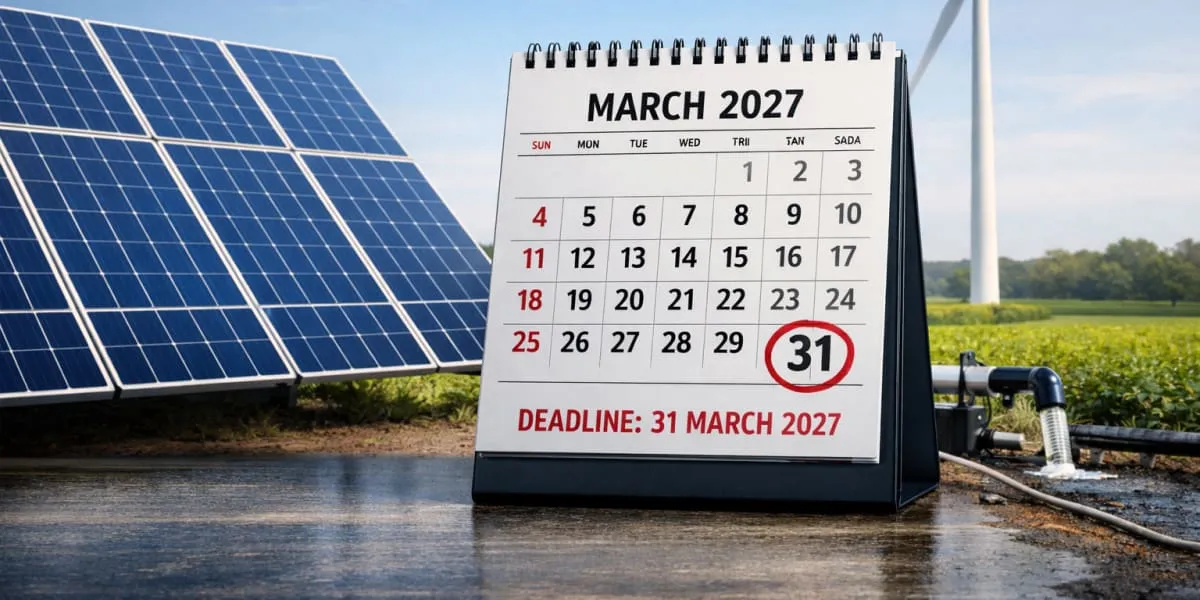
The Ministry of New and Renewable Energy has extended the completion deadline for eligible projects under the PM KUSUM scheme to 31 March 2027 for projects with power purchase agreements or notices to proceed issued on or before 31 December 2025. The move responds to delays in financial closure caused by constrained lending by banks and financial institutions and follows multiple representations from stakeholders. The extension applies to projects across all three components of the scheme and seeks to safeguard implementation progress.

MNRE stated that the proposal to extend the broader scheme timeline was taken up with the Department of Expenditure (DoE) and that the DoE indicated committed liabilities under the current scheme will be subsumed into the proposed PM KUSUM 2.0 framework. The new framework is currently under formulation and is expected to provide continuity for projects that cannot secure loans within the original timetable. The ministry advised states to continue engagement with lenders to expedite financial closures.

States have been urged to coordinate with banks and financial institutions to facilitate disbursal and loan agreements for affected projects beyond the prior deadline of 31 March 2026 to ensure continuity of implementation. The extension is intended to reduce the risk of project delays or cancellations while the central authorities finalise arrangements for the next phase. Stakeholders argued that without additional time several projects faced undue financial and operational strain.

The adjustment to the completion timeline reflects an acknowledgement of current lending conditions and attempts to balance fiscal commitments with on ground delivery. Officials expect that subsuming committed liabilities into PM KUSUM 2.0 will streamline support for pipelines already advanced to the stage of formal agreements. The ministry will monitor progress and maintain channels with state governments and financial institutions to support timely commissioning of projects.

The Ministry of New and Renewable Energy has extended the completion deadline for eligible projects under the PM KUSUM scheme to 31 March 2027 for projects with power purchase agreements or notices to proceed issued on or before 31 December 2025. The move responds to delays in financial closure caused by constrained lending by banks and financial institutions and follows multiple representations from stakeholders. The extension applies to projects across all three components of the scheme and seeks to safeguard implementation progress. MNRE stated that the proposal to extend the broader scheme timeline was taken up with the Department of Expenditure (DoE) and that the DoE indicated committed liabilities under the current scheme will be subsumed into the proposed PM KUSUM 2.0 framework. The new framework is currently under formulation and is expected to provide continuity for projects that cannot secure loans within the original timetable. The ministry advised states to continue engagement with lenders to expedite financial closures. States have been urged to coordinate with banks and financial institutions to facilitate disbursal and loan agreements for affected projects beyond the prior deadline of 31 March 2026 to ensure continuity of implementation. The extension is intended to reduce the risk of project delays or cancellations while the central authorities finalise arrangements for the next phase. Stakeholders argued that without additional time several projects faced undue financial and operational strain. The adjustment to the completion timeline reflects an acknowledgement of current lending conditions and attempts to balance fiscal commitments with on ground delivery. Officials expect that subsuming committed liabilities into PM KUSUM 2.0 will streamline support for pipelines already advanced to the stage of formal agreements. The ministry will monitor progress and maintain channels with state governments and financial institutions to support timely commissioning of projects.

Next Story
Infrastructure Transport

Sector 51-52 Metro skywalk in Noida remains shut despite being ready for over a year

Thousands of commuters travelling between Delhi Metro Rail Corporation’s (DMRC) Sector 52 station and Noida Metro Rail Corporation’s (NMRC) Sector 51 station continue to face daily inconvenience as the 300-metre air-conditioned skywalk connecting the two stations remains closed, despite being completed over a year ago, according to a report.The Noida Metro Rail Corporation built the foot overbridge to enable a seamless interchange between the Delhi Metro and Noida Metro networks. However, pending finishing work and a structural obstruction have delayed its opening.Krishna Karunesh, Chief E..

Next Story
Infrastructure Transport

Maharashtra clears Metro Line 5A, expansion of Mumbai Metro Line 5

The Maharashtra government has approved the expansion of Mumbai Metro Line 5 along with a new integrated corridor, Metro Line 5A, forming a combined 34.2-km metro network across the Thane-Bhiwandi-Kalyan-Ulhasnagar belt. The integrated project has been cleared at an estimated cost of ₹18,130.55 crore, according to a government resolution (GR).Metro Line 5 was originally approved in October 2017 as a 24.9-km fully elevated corridor with 17 stations connecting Thane, Bhiwandi and Kalyan, with an initial project cost of ₹8,416.51 crore. The corridor is being developed in two phases.The first ..

Next Story
Infrastructure Transport

Bengaluru Metro expansion seen driving office demand

Bengaluru’s expanding metro network is expected to emerge as a major catalyst for real estate growth, with the Yellow and Pink Lines likely to boost both office demand and residential prices across key micro-markets, according to a report by Colliers India.The report estimates that over the next two years, Bengaluru could witness an additional 5–7 million sq ft of Grade A office space demand across the Central Business District (CBD), Secondary Business District (SBD) and Electronic City. Improved metro connectivity and reduced commute times are expected to drive higher occupier interest a..

Advertisement

Subscribe to Our Newsletter

Get daily newsletters around different themes from Construction world.

STAY CONNECTED

Advertisement

Advertisement

Advertisement