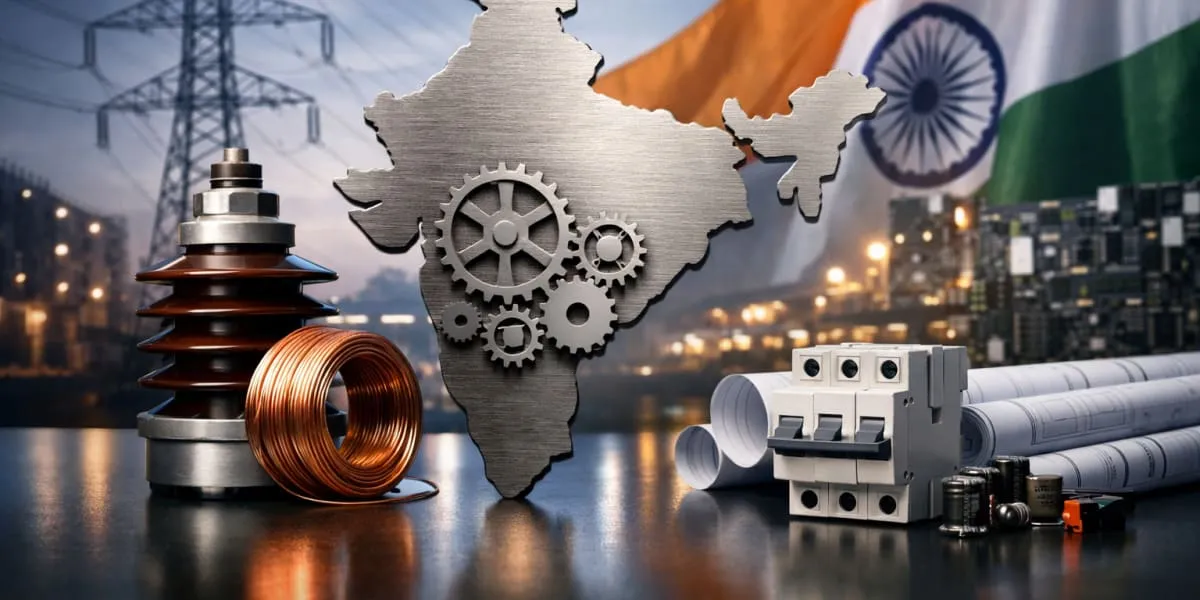
REC And PFC Lead Make In India Drive At Power Summit
ECONOMY & POLICY

REC And PFC Lead Make In India Drive At Power Summit

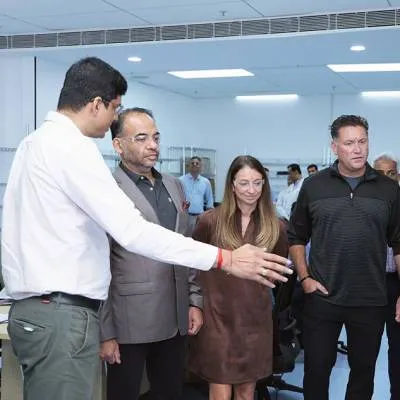
On the third day of the Bharat Electricity Summit 2026, a high-level vendor development session titled Advancing Make in India for Power Distribution was convened by REC Limited (REC) and Power Finance Corporation (PFC). The session brought together over 150 senior representatives from the Ministry of Power (MoP), the Ministry of Electronics and Information Technology, the Central Electricity Authority (CEA), leading distribution companies (DISCOMs), the Indian Electrical and Electronics Manufacturers' Association (IEEMA), original equipment manufacturers (OEMs), vendors, suppliers and industry associations. KPMG served as the knowledge partner for the deliberations.

The session was chaired by Shashank Misra, Joint Secretary (Distribution) at the MoP, and opened with context-setting remarks from T. S. C. Bosh, Director (Projects) at REC. Industry perspectives were presented by IEEMA and leading DISCOMs outlined best practices in modern distribution operations. Presentations covered indigenisation efforts for Supervisory Control and Data Acquisition (SCADA) systems and the application of Artificial Intelligence and Machine Learning (AI/ML) in distribution management.

A panel moderated by senior officials including Pranav Tayal from the MoP, Saurav Kumar Shah of PFC and Prabhat Kumar Singh of REC examined India’s readiness to bolster domestic manufacturing and supply chains. The discussion emphasised scaling proven DISCOM practices such as compact substations and planned underground cabling with GIS-based fault management. Integration across SCADA, Distribution Management System (DMS) and Outage Management System (OMS), together with Real-time Data Acquisition System (RT-DAS), was identified as critical for operational efficiency.

Panelists highlighted persistent gaps in import-dependent materials and urged reinforcement of standards, interoperability and testing infrastructure to ensure reliability and resilience at scale. The session stressed that strengthening testing and certification capacities would support deployment of indigenised equipment across networks. Closing remarks were delivered by Ravi Dhawan, Director (Distribution) at the MoP.

Organisers indicated that the Bharat Electricity Summit 2026 remains a pivotal platform to align government, industry and utilities towards the vision of a Viksit Bharat 2047. Attendees were encouraged to translate dialogue into coordinated action to advance domestic manufacturing in power distribution.

On the third day of the Bharat Electricity Summit 2026, a high-level vendor development session titled Advancing Make in India for Power Distribution was convened by REC Limited (REC) and Power Finance Corporation (PFC). The session brought together over 150 senior representatives from the Ministry of Power (MoP), the Ministry of Electronics and Information Technology, the Central Electricity Authority (CEA), leading distribution companies (DISCOMs), the Indian Electrical and Electronics Manufacturers' Association (IEEMA), original equipment manufacturers (OEMs), vendors, suppliers and industry associations. KPMG served as the knowledge partner for the deliberations. The session was chaired by Shashank Misra, Joint Secretary (Distribution) at the MoP, and opened with context-setting remarks from T. S. C. Bosh, Director (Projects) at REC. Industry perspectives were presented by IEEMA and leading DISCOMs outlined best practices in modern distribution operations. Presentations covered indigenisation efforts for Supervisory Control and Data Acquisition (SCADA) systems and the application of Artificial Intelligence and Machine Learning (AI/ML) in distribution management. A panel moderated by senior officials including Pranav Tayal from the MoP, Saurav Kumar Shah of PFC and Prabhat Kumar Singh of REC examined India’s readiness to bolster domestic manufacturing and supply chains. The discussion emphasised scaling proven DISCOM practices such as compact substations and planned underground cabling with GIS-based fault management. Integration across SCADA, Distribution Management System (DMS) and Outage Management System (OMS), together with Real-time Data Acquisition System (RT-DAS), was identified as critical for operational efficiency. Panelists highlighted persistent gaps in import-dependent materials and urged reinforcement of standards, interoperability and testing infrastructure to ensure reliability and resilience at scale. The session stressed that strengthening testing and certification capacities would support deployment of indigenised equipment across networks. Closing remarks were delivered by Ravi Dhawan, Director (Distribution) at the MoP. Organisers indicated that the Bharat Electricity Summit 2026 remains a pivotal platform to align government, industry and utilities towards the vision of a Viksit Bharat 2047. Attendees were encouraged to translate dialogue into coordinated action to advance domestic manufacturing in power distribution.

Next Story
Infrastructure Urban

Meghalaya And Assam Hold Talks To End Transport Stoppages In Garo Hills

Meghalaya and Assam have opened talks aimed at ending recent stoppages of commodity transport in the Garo Hills, officials said. The deputy chief minister, in charge of home affairs, reported that both state governments are coordinating to resolve disruptions and to restore normal movement of goods. He acknowledged that misunderstandings may have contributed to the incidents and that clarification between administrative units is under way. The discussions are intended to produce practical arrangements that will allow consignments to move without hindrance while respecting local procedures. The..

Next Story
Infrastructure Transport

Kochi Metro Records 1.375 mn Rise In Passengers In FY26

Kochi Metro recorded a marginal rise in ridership in the financial year 2025-26, carrying 1.375 mn more passengers than in the previous year. The service carried 36.8 million (mn) passengers in 2025-26 compared with 35.5 mn in 2024-25, representing a year-on-year increase of 3.9 per cent. The growth was described as distributed rather than concentrated in isolated spikes. A month-wise analysis shows steady gains across quarters. In the first quarter, ridership increased from 8.57 mn to 8.84 mn, while the second quarter rose from 9.13 mn to 9.51 mn. These trends indicated broad-based improvemen..

Next Story
Infrastructure Transport

Ghaziabad Plans 16km Metro Link To Delhi Via Hindon Airport

Ghaziabad authorities are pursuing a 16 km metro link to Delhi that will run via Hindon Airport, and a detailed project report is under way. The plan is intended to improve connectivity between Ghaziabad and the national capital and to provide an interchange with the airport. Officials said the project is being studied to assess alignments, station locations and cost estimates ahead of formal approvals and tendering. The announcement follows the inauguration of the Delhi?Faridabad metro extension, which will offer hassle free travel for around 0.2 mn daily commuters between the national capita..

Advertisement

Subscribe to Our Newsletter

Get daily newsletters around different themes from Construction world.

STAY CONNECTED

Advertisement

Advertisement

Advertisement