Roundtable on Expansion of Piped Natural Gas Services
ECONOMY & POLICY

Roundtable on Expansion of Piped Natural Gas Services

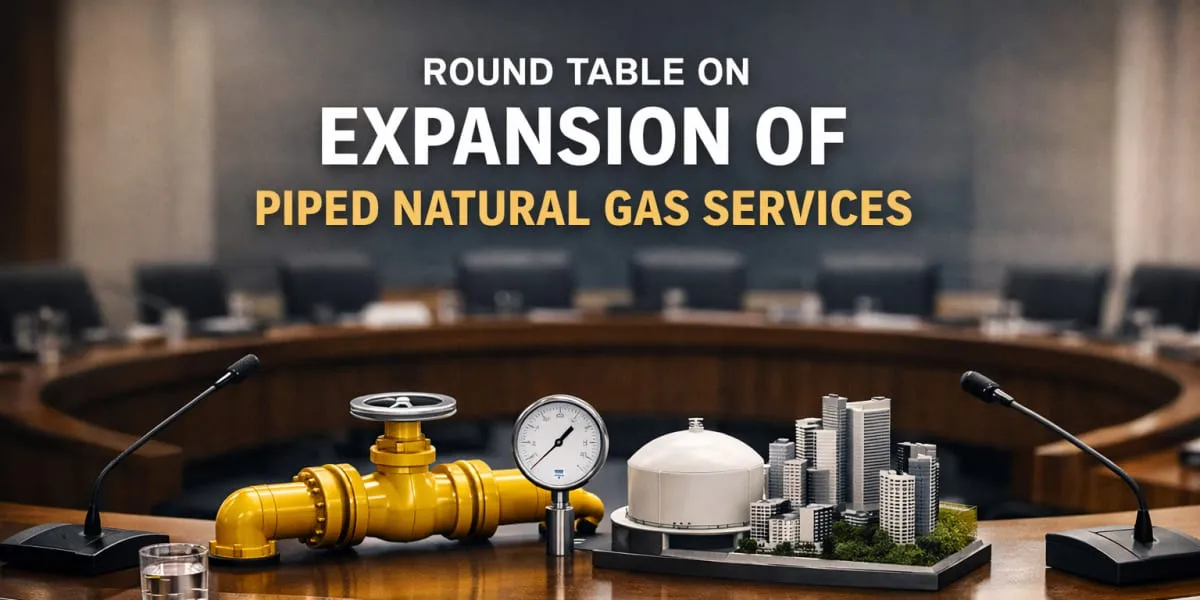
A Roundtable Review Meeting on expansion of Piped Natural Gas (PNG) services and maintaining essential services in urban areas was held at Vigyan Bhavan, bringing together Union and state ministers, secretaries and senior officials. The meeting drew representatives of the Ministry of Housing and Urban Affairs (MoHUA), the Ministry of Petroleum and Natural Gas (MoPNG), the Ministry of Consumer Affairs, Food and Public Distribution (MoCAFPD), municipal commissioners, chairpersons of GAIL and Indian Oil and City Gas Distribution (CGD) entities. Delegations attended in person and others joined virtually to discuss accelerating network expansion and ensuring uninterrupted urban services.

The Ministry of Petroleum and Natural Gas presented the rollout status and outlined the advantages of PNG over liquefied petroleum gas in safety, reliability, affordability and environmental sustainability. Officials identified impediments such as delays in municipal permissions, Right of Way (RoW) approvals and high restoration charges that hinder timely expansion. Deliberations considered institutional and regulatory adjustments, including single-window and time-bound clearance mechanisms to address these barriers.

Ministers emphasised the role of cities as engines of economic growth and urged mission-mode implementation with integration of PNG infrastructure into urban planning and facilitation of last-mile connectivity. The meeting highlighted an ambitious target of providing five mn new PNG connections and encouraged Urban Local Bodies (ULBs) to promote adoption, prioritising public institutions such as schools and colleges for early transition. Consumer affairs officials advised strengthened monitoring and vigilance to curb misinformation and black marketing while safeguarding essential supplies.

Participants shared best practices including fast-tracking road-cutting permissions, adoption of deemed approvals and rationalisation or temporary waivers of RoW charges to expedite projects. State representatives and CGD entities agreed to streamline approval processes, designate nodal officers and form local task teams to resolve city-specific bottlenecks. A break-out session reviewed pending approvals and produced a structured action plan with defined timelines, regular monitoring and accountability measures to ensure timely PNG network expansion.

A Roundtable Review Meeting on expansion of Piped Natural Gas (PNG) services and maintaining essential services in urban areas was held at Vigyan Bhavan, bringing together Union and state ministers, secretaries and senior officials. The meeting drew representatives of the Ministry of Housing and Urban Affairs (MoHUA), the Ministry of Petroleum and Natural Gas (MoPNG), the Ministry of Consumer Affairs, Food and Public Distribution (MoCAFPD), municipal commissioners, chairpersons of GAIL and Indian Oil and City Gas Distribution (CGD) entities. Delegations attended in person and others joined virtually to discuss accelerating network expansion and ensuring uninterrupted urban services. The Ministry of Petroleum and Natural Gas presented the rollout status and outlined the advantages of PNG over liquefied petroleum gas in safety, reliability, affordability and environmental sustainability. Officials identified impediments such as delays in municipal permissions, Right of Way (RoW) approvals and high restoration charges that hinder timely expansion. Deliberations considered institutional and regulatory adjustments, including single-window and time-bound clearance mechanisms to address these barriers. Ministers emphasised the role of cities as engines of economic growth and urged mission-mode implementation with integration of PNG infrastructure into urban planning and facilitation of last-mile connectivity. The meeting highlighted an ambitious target of providing five mn new PNG connections and encouraged Urban Local Bodies (ULBs) to promote adoption, prioritising public institutions such as schools and colleges for early transition. Consumer affairs officials advised strengthened monitoring and vigilance to curb misinformation and black marketing while safeguarding essential supplies. Participants shared best practices including fast-tracking road-cutting permissions, adoption of deemed approvals and rationalisation or temporary waivers of RoW charges to expedite projects. State representatives and CGD entities agreed to streamline approval processes, designate nodal officers and form local task teams to resolve city-specific bottlenecks. A break-out session reviewed pending approvals and produced a structured action plan with defined timelines, regular monitoring and accountability measures to ensure timely PNG network expansion.

Next Story
Real Estate

AI: The New Recruit

From getting ideas to evaluating designs, presenting concepts to clients and tracking projects, artificial intelligence (AI) is helping architects work better and faster.“AI allows architects to spend more time doing what only they can do: think critically, synthesise complexity and design with intent,” says Dikshu C Kukreja, Managing Principal, CP Kukreja Architects. “Every minute reclaimed from repetitive processes can be invested in creativity, contextual understanding, interdisciplinary collaboration and innovation – the qualities that define meaningful architecture.”To read the ..

Next Story
Real Estate

Redevelopment 2.0

In 2017, Mumbai identified 160,000 ageing buildings due for structural audit. Close to half of these were in the Western Suburbs. Redeveloping the oldest and structurally weakest of these would help unlock new housing, much needed given the city’s growing population density and constant developed area of 437.7 sq km. At 30,600 people per sq km in 2024, Mumbai’s density was almost thrice that of Gurugram, and 60 per cent higher than Bengaluru’s.Essentially, Mumbai’s realty market has demand. It has capital. It has realty development potential.Fast forward to 2026. Mumbai has 1,094 regis..

Next Story
Technology

Cost intelligence will become a strategic contributor to project success

As India's construction industry accelerates its digital transformation, integrated platforms, AI and connected data are becoming essential to improving cost certainty, project efficiency and sustainability. Ravi Kumar, Sales Director – India, RIB Software India, shares how digital workflows are reshaping project planning, commercial management and decision-making across the construction value chain.India's construction sector is embracing digital technologies at an unprecedented pace. From your perspective, what are the biggest shifts driving this transformation and how is RIB Software enab..

Advertisement

Subscribe to Our Newsletter

Get daily newsletters around different themes from Construction world.

STAY CONNECTED

Advertisement

Advertisement

Advertisement