SAIL Slurry Pipeline To Supply 8.3 Mn Tonnes To Bokaro
ECONOMY & POLICY

SAIL Slurry Pipeline To Supply 8.3 Mn Tonnes To Bokaro

Steel Authority of India (SAIL) said Bokaro Steel Plant will receive eight point three million tonnes (8.3 mn t) per year of iron ore directly from SAIL mines via a slurry pipeline. The company said the project will be the longest slurry pipeline in India’s steel sector and will remove dependence on railway rakes for ore transport. The move is intended to ensure a reliable uninterrupted raw material supply to support plant expansion.

As part of a brownfield expansion, crude steel production capacity is to rise from four point six five mn t per annum to seven point two five mn t per annum, while hot metal capacity will be enhanced to seven point five five mn t per annum. The project carries a direct capital investment of Rs 150 billion (Rs 150 bn) and is designed for an operational life of approximately 30 years. Company statements indicate the project is targeted for completion in about three and a half years.

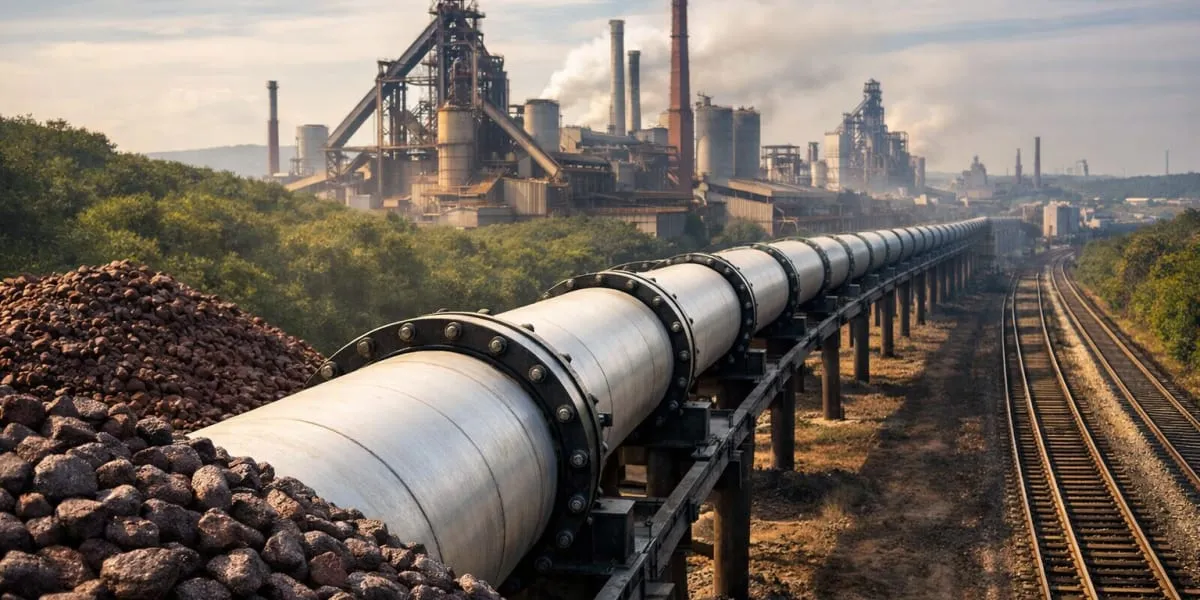
Iron ore from SAIL’s Gua and Bolani mines will be finely ground, mixed with water and routed via Jamda through a 258-kilometre main pipeline to Bokaro. The main pipeline has been engineered with additional capacity to carry up to 16 mn t per year, allowing future scaling in line with the plant expansion. The scheme includes ore preparation facilities at the mines, pumping stations at both mines and at Jamda, and dedicated receiving facilities at Bokaro.

The project incorporates a sustainable water management arrangement in which water used for slurry transport will be returned to the mines through a separate pipeline for reuse, thereby conserving water and improving resource efficiency. The scheme is expected to lower transportation costs, reduce pressure on the rail network and cut dust, diesel use and carbon emissions. The expansion includes a new 4,500 cubic metre blast furnace, a modern melt shop, a Thin Slab Casting and Direct Rolling facility and Industry 4.0 automation, and is expected to boost economic activity across construction, engineering, logistics and allied sectors.

Steel Authority of India (SAIL) said Bokaro Steel Plant will receive eight point three million tonnes (8.3 mn t) per year of iron ore directly from SAIL mines via a slurry pipeline. The company said the project will be the longest slurry pipeline in India’s steel sector and will remove dependence on railway rakes for ore transport. The move is intended to ensure a reliable uninterrupted raw material supply to support plant expansion. As part of a brownfield expansion, crude steel production capacity is to rise from four point six five mn t per annum to seven point two five mn t per annum, while hot metal capacity will be enhanced to seven point five five mn t per annum. The project carries a direct capital investment of Rs 150 billion (Rs 150 bn) and is designed for an operational life of approximately 30 years. Company statements indicate the project is targeted for completion in about three and a half years. Iron ore from SAIL’s Gua and Bolani mines will be finely ground, mixed with water and routed via Jamda through a 258-kilometre main pipeline to Bokaro. The main pipeline has been engineered with additional capacity to carry up to 16 mn t per year, allowing future scaling in line with the plant expansion. The scheme includes ore preparation facilities at the mines, pumping stations at both mines and at Jamda, and dedicated receiving facilities at Bokaro. The project incorporates a sustainable water management arrangement in which water used for slurry transport will be returned to the mines through a separate pipeline for reuse, thereby conserving water and improving resource efficiency. The scheme is expected to lower transportation costs, reduce pressure on the rail network and cut dust, diesel use and carbon emissions. The expansion includes a new 4,500 cubic metre blast furnace, a modern melt shop, a Thin Slab Casting and Direct Rolling facility and Industry 4.0 automation, and is expected to boost economic activity across construction, engineering, logistics and allied sectors.

Related Stories

Gold Stories

Next Story
Infrastructure Energy

Asian Energy Services Q1 FY27 PAT Rises 129 Per Cent

Asian Energy Services Limited reported a 129 per cent year-on-year rise in net profit to Rs 128 million for Q1 FY27, compared with the corresponding quarter last year.Revenue increased 135 per cent year-on-year to Rs 2.71 billion, supported by continued momentum across its services business, disciplined execution and contributions from domestic and international operations. EBITDA grew 81 per cent year-on-year during the quarter.As of June 30, 2026, the company’s standalone order book stood at Rs 17.54 billion, with around 60 per cent coming from oil and gas services and 40 per cent from min..

Next Story
Infrastructure Urban

BioBTX to Build First Commercial-Scale Circular Chemicals Plant

Dutch circular chemistry technology developer BioBTX is building what it says will be the world’s first commercial-scale plant to convert mixed plastic waste into high-quality aromatic chemicals using its proprietary Integrated Catalytic Cracking Process (ICCP) technology.The facility will be built at Chemical Park Delfzijl on the northern coast of the Netherlands and is expected to create 35 jobs. Covestro, which has been a shareholder and strategic partner of BioBTX since 2024, holds a mid-single-digit million-euro investment in the company.BioBTX’s ICCP technology uses catalytic pyrolys..

Next Story
Real Estate

Awfis Q1 FY27 PAT Jumps 140% as Revenue Rises 27%

Awfis Space Solutions reported a 140 per cent year-on-year rise in consolidated profit after tax (PAT) to Rs 240 million for Q1 FY27, compared with Rs 100 million in the corresponding quarter last year.Revenue from operations increased 27 per cent to Rs 4.25 billion from Rs 3.35 billion, while EBITDA rose 28 per cent to Rs 1.62 billion. EBITDA margin improved to 38.2 per cent from 37.8 per cent. Profit before tax increased 135 per cent to Rs 240 million.The company's co-working business recorded 27 per cent year-on-year growth, supported by demand from enterprises, Global Capability Centres (G..

Advertisement

Subscribe to Our Newsletter

Get daily newsletters around different themes from Construction world.

STAY CONNECTED

Advertisement