TRAI Reviews Mobile Network Performance in Baddi City
ECONOMY & POLICY

TRAI Reviews Mobile Network Performance in Baddi City

Telecom Regulatory Authority of India (TRAI) recently released the findings of its Independent Drive Test (IDT) for the Himachal Pradesh Licensed Service Area, covering Baddi city. The assessment evaluated real-world mobile network performance across urban zones, institutional hotspots, public transport hubs and high-speed corridors.

The drive tests were conducted over 180 km of city routes, along with walk tests at key commercial locations and inter-operator calling checks. Technologies assessed included 2G, 3G, 4G and 5G, reflecting the user experience across multiple handset capabilities. The findings have been shared with all concerned telecom service providers.

For voice services, call setup success rates in auto-selection mode were recorded at 98.11 per cent for Airtel, 98.64 per cent for BSNL, 99.73 per cent for RJIL and 96.82 per cent for VIL. Drop call rates stood at 2.20 per cent for Airtel, 6.34 per cent for BSNL, 0.55 per cent for RJIL and 0.27 per cent for VIL.

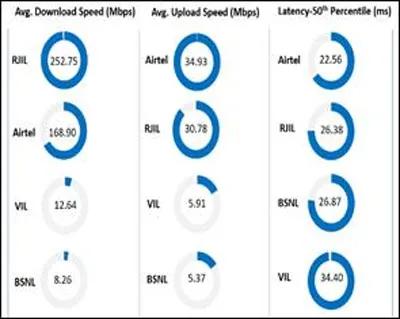
Data performance showed average download speeds of 168.90 Mbps for Airtel, 8.26 Mbps for BSNL, 252.75 Mbps for RJIL and 12.64 Mbps for VIL, while upload speeds ranged between 5.37 Mbps and 34.93 Mbps across operators. Latency levels were also assessed to benchmark overall network responsiveness.

The evaluation covered residential and industrial areas such as Baddi, Barotiwala, Nalagarh and surrounding localities, along with locations including Baddi Bus Stand, City Hospital, educational institutions and shopping centres. Walk tests were carried out in crowded pedestrian zones to capture performance under high user density.

According to TRAI, the tests were conducted using standardised protocols and recommended equipment to ensure accuracy. The detailed report has been made available on the TRAI website.

Telecom Regulatory Authority of India (TRAI) recently released the findings of its Independent Drive Test (IDT) for the Himachal Pradesh Licensed Service Area, covering Baddi city. The assessment evaluated real-world mobile network performance across urban zones, institutional hotspots, public transport hubs and high-speed corridors. The drive tests were conducted over 180 km of city routes, along with walk tests at key commercial locations and inter-operator calling checks. Technologies assessed included 2G, 3G, 4G and 5G, reflecting the user experience across multiple handset capabilities. The findings have been shared with all concerned telecom service providers. For voice services, call setup success rates in auto-selection mode were recorded at 98.11 per cent for Airtel, 98.64 per cent for BSNL, 99.73 per cent for RJIL and 96.82 per cent for VIL. Drop call rates stood at 2.20 per cent for Airtel, 6.34 per cent for BSNL, 0.55 per cent for RJIL and 0.27 per cent for VIL. Data performance showed average download speeds of 168.90 Mbps for Airtel, 8.26 Mbps for BSNL, 252.75 Mbps for RJIL and 12.64 Mbps for VIL, while upload speeds ranged between 5.37 Mbps and 34.93 Mbps across operators. Latency levels were also assessed to benchmark overall network responsiveness. The evaluation covered residential and industrial areas such as Baddi, Barotiwala, Nalagarh and surrounding localities, along with locations including Baddi Bus Stand, City Hospital, educational institutions and shopping centres. Walk tests were carried out in crowded pedestrian zones to capture performance under high user density. According to TRAI, the tests were conducted using standardised protocols and recommended equipment to ensure accuracy. The detailed report has been made available on the TRAI website.

Next Story
Infrastructure Transport

METRO MOVES!

There is no clearer sign that India’s metro-rail revolution is no longer a big-city story than having a metro in 23 cities. From being one-off projects in Kolkata and Delhi, metro rails have evolved into a national urban transformation project aiming at reshaping mobility, land use and sustainability in every city with an operational metro.However, this project has neither seen uniform success across cities, nor success in every city.Experts in unison agree with the observation of Vipul Surana, Senior Vice President and Head of Transit and Rail, India, AECOM: “The Delhi Metro Rail Cor..

Next Story
Infrastructure Urban

Multimodal Corridors Reshape India’s Freight Logistics

India’s freight and logistics landscape is undergoing a structural transformation, driven by Dedicated Freight Corridors (DFCs) and an expanding network of multimodal logistics infrastructure. Purpose-built freight rail corridors, combined with integrated logistics parks, are enabling faster, more predictable and cost-efficient cargo movement across the country. The Eastern and Western DFCs together span more than 2,800 km, with most sections now operational. Designed exclusively for freight, these corridors allow longer, heavier and faster trains, significantly improving throughput. Freigh..

Next Story
Infrastructure Urban

Jyoti Structures Secures TÜV ISO Certifications

Jyoti Structures (JSL), a listed global Engineering, Procurement and Construction (EPC) company, has secured ISO 9001:2015, ISO 14001:2015 and ISO 45001:2018 certifications following an independent audit by TÜV, one of the world’s most stringent and internationally recognised certification bodies. The certifications were awarded after an extensive, organisation-wide evaluation process spanning more than a year. They apply across JSL’s EPC operations, including design, engineering, manufacturing, procurement, erection and commissioning of transmission, substation and distribution projects..

Advertisement

Subscribe to Our Newsletter

Get daily newsletters around different themes from Construction world.

STAY CONNECTED

Advertisement

Advertisement

Advertisement

Advertisement

Open In App