+
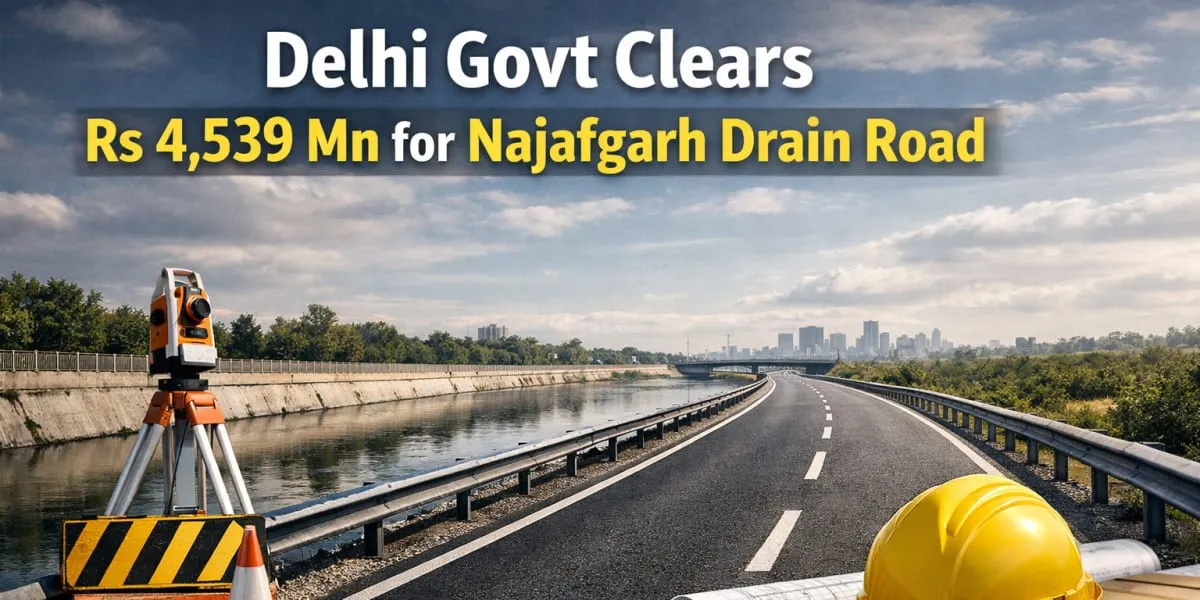
Delhi Government Clears Rs 4,539 Million for Najafgarh Drain Road
ROADS & HIGHWAYS

Delhi Government Clears Rs 4,539 Million for Najafgarh Drain Road

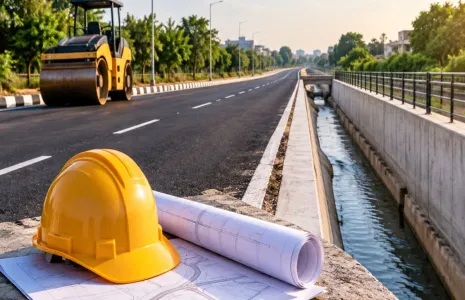
The Delhi government has cleared Rs 4,539 million (mn) in funding for the construction of a two-lane, 61 km road along the Najafgarh drain. The approval covers work intended to run adjacent to the drain and to provide a continuous carriageway linking neighbourhoods on either side. Officials described the allocation as a priority measure to strengthen connectivity and facilitate better movement across the affected corridor.

The project is being planned as a two-lane surface road with provisions for drainage maintenance and pedestrian access where feasible. Route alignment along the Najafgarh drain is expected to create an arterial link that could relieve pressure on existing roads and shorten travel distances for local traffic. Authorities anticipate that the continuous alignment will address recurring bottlenecks that have constrained mobility in peri urban sections.

The sanctioned amount of Rs 4,539 mn corresponds to 453.9 crore under the Indian scale and is equivalent to approximately 4.539 bn when expressed as billion. The release of funds follows budgetary approvals from the city administration and is intended to cover preliminary construction and associated civil works. Financial disbursement is likely to be phased in line with project milestones and contract awards.

Implementation will require coordination among municipal entities, utility agencies and local stakeholders to manage relocations and ensure continuity of services. The administration indicated that necessary statutory clearances and environmental and drainage considerations will be addressed during detailed design. Contractors will be expected to adhere to safety and quality norms while minimising disruption to residents.

City planners view the road as part of a broader infrastructure push to improve urban mobility and support economic activity in peripheral districts. Once completed, the link is expected to improve access to markets, educational institutions and healthcare facilities for communities along the drain. The project is positioned as a strategic investment in the city's transport network.

The Delhi government has cleared Rs 4,539 million (mn) in funding for the construction of a two-lane, 61 km road along the Najafgarh drain. The approval covers work intended to run adjacent to the drain and to provide a continuous carriageway linking neighbourhoods on either side. Officials described the allocation as a priority measure to strengthen connectivity and facilitate better movement across the affected corridor. The project is being planned as a two-lane surface road with provisions for drainage maintenance and pedestrian access where feasible. Route alignment along the Najafgarh drain is expected to create an arterial link that could relieve pressure on existing roads and shorten travel distances for local traffic. Authorities anticipate that the continuous alignment will address recurring bottlenecks that have constrained mobility in peri urban sections. The sanctioned amount of Rs 4,539 mn corresponds to 453.9 crore under the Indian scale and is equivalent to approximately 4.539 bn when expressed as billion. The release of funds follows budgetary approvals from the city administration and is intended to cover preliminary construction and associated civil works. Financial disbursement is likely to be phased in line with project milestones and contract awards. Implementation will require coordination among municipal entities, utility agencies and local stakeholders to manage relocations and ensure continuity of services. The administration indicated that necessary statutory clearances and environmental and drainage considerations will be addressed during detailed design. Contractors will be expected to adhere to safety and quality norms while minimising disruption to residents. City planners view the road as part of a broader infrastructure push to improve urban mobility and support economic activity in peripheral districts. Once completed, the link is expected to improve access to markets, educational institutions and healthcare facilities for communities along the drain. The project is positioned as a strategic investment in the city's transport network.

Next Story
Infrastructure Urban

Implementation Status of Jal Jeevan Mission

Since August 2019 the Government has implemented Jal Jeevan Mission to provide assured potable water through household tap connections in rural India. At the start of the mission only 32.3 million (mn) rural households, representing 16.7 per cent, were reported to have tap water connections. States and union territories have reported that 125.8 mn additional rural households have since been provided with tap connections. As a result, of about 193.6 mn rural households roughly 158.2 mn, or 81.71 per cent, are reported to have tap water supply at home.\n\nThe State, district and village level st..

Next Story
Infrastructure Urban

Jal Jeevan Mission Reaches Eighty One Per Cent Rural Coverage

The Government reported substantial progress under the Jal Jeevan Mission, launched in August 2019 to provide tap water to every rural household. At launch only 32.3 million (mn) rural households had tap connections and states and Union territories reported provision of 125.8 mn additional households by March 2026. Consequently, out of about 193.6 mn rural households around 158.2 mn, or 81.71 per cent, are reported to have tap water at home. The Finance Minister announced extension of the mission until 2028 in the 2025-26 budget speech. The Swachh Bharat Mission Grameen, launched in October 20..

Next Story
Infrastructure Urban

Empowering Local Governance for Sustainable Rural Water Supply

The Ministry of Jal Shakti has aligned the Jal Jeevan Mission (JJM) with the 73rd Amendment to strengthen village level planning and community ownership of water supply. Gram Panchayats, village water and sanitation committees and Pani Samitis are to plan, implement, manage and maintain piped water systems, with gram sabha processes formalising handover and oversight. Implementation support agencies including non government organisations, community based organisations and self help groups have been empanelled to train local committees and promote women participation. Under JJM, the department ..

Advertisement

Subscribe to Our Newsletter

Get daily newsletters around different themes from Construction world.

STAY CONNECTED

Advertisement

Advertisement

Advertisement