LG Sandhu Reviews Redevelopment Plan For Five Delhi Road Corridors
ROADS & HIGHWAYS

LG Sandhu Reviews Redevelopment Plan For Five Delhi Road Corridors

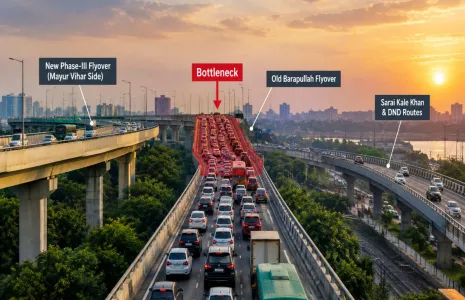
Lieutenant Governor Taranjit Singh Sandhu reviewed the progress of the proposed redevelopment of five key road corridors in the national capital and chaired a meeting to assess coordination between the School of Planning and Architecture (SPA) and the respective road owning agencies. The meeting noted that work on the stretches is expected to begin soon, and officials were asked to finalise timelines and coordination arrangements. The review placed particular emphasis on aligning designs with broader urban mobility and environmental objectives.

The Lieutenant Governor emphasised that the transformation should aim at making these extremely traffic-heavy stretches free of road dust and the resultant ambient air pollution, as outlined by the Commission for Air Quality Management (CAQM). He urged that designs bring people close to these stretches to instil public ownership of the assets, which would support safety, security and proper maintenance while creating open recreational spaces. The office highlighted that community engagement would be integral to long-term upkeep.

Key features of the corridor redevelopment include a stormwater drainage system intended to prevent flooding and ensure that silt is not left behind after rain. Controlling flooding is expected to smooth commuting and traffic flow during monsoon periods, while the absence of silt would reduce dust pollution and associated health impacts. The plan also proposes a Scientific Green Central Verge with grass carpeting and a piped watering facility to end silt spill caused by tankers and to reduce congestion from slow moving watering vehicles.

The release further states development of integrated pedestrian pathways with a cycle track interspersed with public utilities and resting shelters to improve connectivity and non motorised transport. SPA and the road agencies were asked to prepare detailed designs and maintenance protocols so that the corridors remain functional and safe over time. The Lieutenant Governor set a target for swift action while underscoring the need for sustainable, low maintenance solutions.

Lieutenant Governor Taranjit Singh Sandhu reviewed the progress of the proposed redevelopment of five key road corridors in the national capital and chaired a meeting to assess coordination between the School of Planning and Architecture (SPA) and the respective road owning agencies. The meeting noted that work on the stretches is expected to begin soon, and officials were asked to finalise timelines and coordination arrangements. The review placed particular emphasis on aligning designs with broader urban mobility and environmental objectives. The Lieutenant Governor emphasised that the transformation should aim at making these extremely traffic-heavy stretches free of road dust and the resultant ambient air pollution, as outlined by the Commission for Air Quality Management (CAQM). He urged that designs bring people close to these stretches to instil public ownership of the assets, which would support safety, security and proper maintenance while creating open recreational spaces. The office highlighted that community engagement would be integral to long-term upkeep. Key features of the corridor redevelopment include a stormwater drainage system intended to prevent flooding and ensure that silt is not left behind after rain. Controlling flooding is expected to smooth commuting and traffic flow during monsoon periods, while the absence of silt would reduce dust pollution and associated health impacts. The plan also proposes a Scientific Green Central Verge with grass carpeting and a piped watering facility to end silt spill caused by tankers and to reduce congestion from slow moving watering vehicles. The release further states development of integrated pedestrian pathways with a cycle track interspersed with public utilities and resting shelters to improve connectivity and non motorised transport. SPA and the road agencies were asked to prepare detailed designs and maintenance protocols so that the corridors remain functional and safe over time. The Lieutenant Governor set a target for swift action while underscoring the need for sustainable, low maintenance solutions.

Related Stories

Gold Stories

Next Story
Infrastructure Urban

KONE Opens India's First Digital Experience Centre in Pune

KONE, a global elevator and escalator manufacturer, has inaugurated its first Digital Experience Centre (DEC) in India, located in Pune. The facility aims to showcase how artificial intelligence (AI), connectivity and data-driven technologies can enhance customer experiences and improve building operations.The centre was inaugurated by Jussi Herlin, Executive Vice Chair, KONE Corporation; Philippe Delorme, President and CEO, KONE; and Nandan Nilekani, Co-founder and Chairman of the Board, Infosys.Designed as an interactive customer environment, the facility demonstrates digital solutions cover..

Next Story
Infrastructure Urban

CII GreenCo Launches Circularity Guidelines for Indian Industry

The Confederation of Indian Industry (CII) GreenCo Council has launched the CII GreenCo Circularity Guidelines – Pilot Version at the 17th CII GreenCo Waste & Resource Management Summit 2026 in Chennai. The initiative aims to strengthen resource efficiency, waste reduction and circular economy practices across Indian manufacturing and process industries.The guidelines introduce a structured framework with circularity indices covering raw materials, consumables, packaging and other resource inputs. These indicators will help industries assess existing practices, identify opportunities to ..

Next Story
Infrastructure Energy

Global Electronics Association Launches IPC-1783-CO2E Standard

The Global Electronics Association has introduced IPC-1783-CO2E, a new international standard aimed at improving consistency, transparency and comparability in product carbon footprint reporting across the electronics manufacturing industry.The standard, titled International Standard for Data Collection and Reporting of CO2 Equivalent (CO2e) Emissions for the Electronics Manufacturing Supply Chain, provides industry-specific guidance for collecting, estimating and reporting carbon emissions data.With increasing regulatory requirements and customer expectations, electronics manufacturers face c..

Advertisement

Subscribe to Our Newsletter

Get daily newsletters around different themes from Construction world.

STAY CONNECTED

Advertisement

SPECIAL OFFER
QR Code