



Lucknow To Kanpur In 45 Minutes With New Expressway
ROADS & HIGHWAYS

Lucknow To Kanpur In 45 Minutes With New Expressway

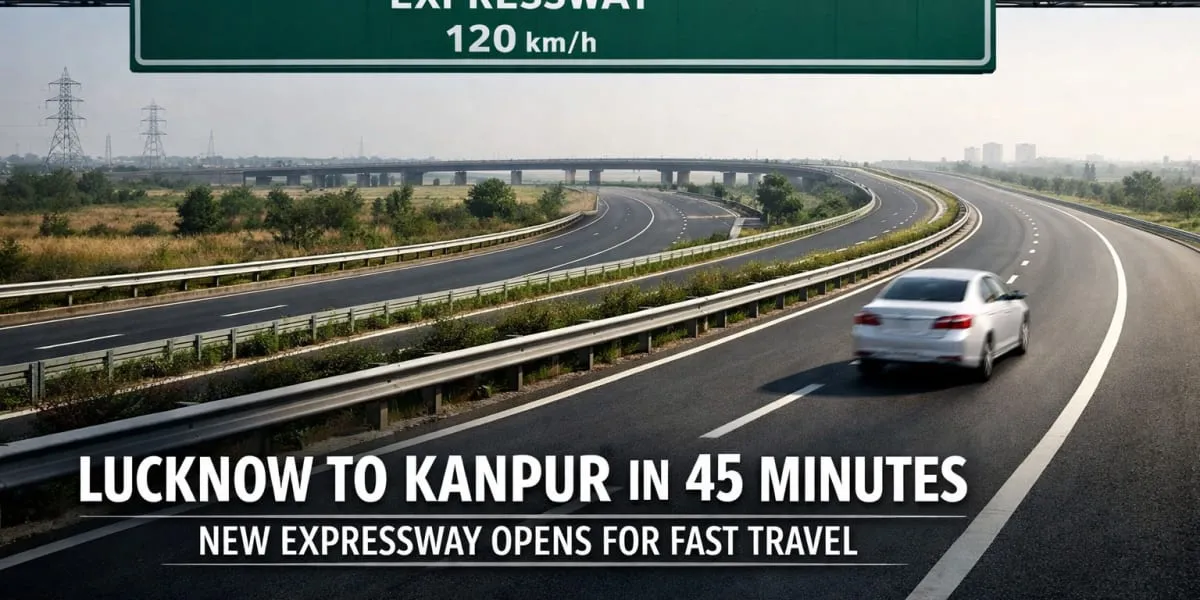
The 63-km Lucknow-Kanpur Greenfield Expressway, designated National Expressway-6, opened for traffic and is designed for speeds of up to 120 kmph, cutting travel time between Lucknow and Kanpur from nearly three hours to 35–45 minutes. The six-lane corridor was inaugurated on Monday by the defence minister, the Union road transport and highways minister and the chief minister and was built at a cost of Rs 45 billion (bn). The route is expected to boost connectivity and underpin the proposed State Capital Region.

The expressway uses Automated Machine Guidance Systems for precision construction and a Multi?Lane Free Flow tolling system that allows vehicles to pass without stopping as tolls are deducted via FASTag and Automatic Number Plate Recognition. Safety features include more than 80 high?definition CCTV cameras, 16 Video Incident Detection Systems, speed radars and a centralised traffic management system that can detect violations and issue e?challans automatically. More than 46,000 saplings have been planted along the alignment.

Conceived in 2018 and completed after 1,648 days, the project had its foundation stone laid in March 2019 and was declared NE?6 in December 2020. Developed by PNC Infratech for the National Highways Authority of India, it was executed in two packages: an 18?km elevated corridor linking Amausi and Shaheed Path and a 45?km greenfield section traversing 11 villages in Lucknow and 31 villages in Unnao. Construction accelerated after land acquisition was finalised.

At the inauguration the Union minister directed officials to prepare a Detailed Project Report for a 23?km three?tier corridor from Lucknow airport via Shaheed Path to Faizabad Road that would combine an elevated roadway with an electric mass rapid transit system and use Malaysian technology to permit 120?metre spans between piers instead of conventional 30 metres, reducing construction costs by nearly 30 per cent. Leaders also sought six?laning of the Lucknow?Sitapur road and improved service roads. Authorities said the expressway will serve commuters, strengthen the State Capital Region, improve logistics and attract industrial investment.

The 63-km Lucknow-Kanpur Greenfield Expressway, designated National Expressway-6, opened for traffic and is designed for speeds of up to 120 kmph, cutting travel time between Lucknow and Kanpur from nearly three hours to 35–45 minutes. The six-lane corridor was inaugurated on Monday by the defence minister, the Union road transport and highways minister and the chief minister and was built at a cost of Rs 45 billion (bn). The route is expected to boost connectivity and underpin the proposed State Capital Region. The expressway uses Automated Machine Guidance Systems for precision construction and a Multi?Lane Free Flow tolling system that allows vehicles to pass without stopping as tolls are deducted via FASTag and Automatic Number Plate Recognition. Safety features include more than 80 high?definition CCTV cameras, 16 Video Incident Detection Systems, speed radars and a centralised traffic management system that can detect violations and issue e?challans automatically. More than 46,000 saplings have been planted along the alignment. Conceived in 2018 and completed after 1,648 days, the project had its foundation stone laid in March 2019 and was declared NE?6 in December 2020. Developed by PNC Infratech for the National Highways Authority of India, it was executed in two packages: an 18?km elevated corridor linking Amausi and Shaheed Path and a 45?km greenfield section traversing 11 villages in Lucknow and 31 villages in Unnao. Construction accelerated after land acquisition was finalised. At the inauguration the Union minister directed officials to prepare a Detailed Project Report for a 23?km three?tier corridor from Lucknow airport via Shaheed Path to Faizabad Road that would combine an elevated roadway with an electric mass rapid transit system and use Malaysian technology to permit 120?metre spans between piers instead of conventional 30 metres, reducing construction costs by nearly 30 per cent. Leaders also sought six?laning of the Lucknow?Sitapur road and improved service roads. Authorities said the expressway will serve commuters, strengthen the State Capital Region, improve logistics and attract industrial investment.

Related Stories

Gold Stories
Next Story
Infrastructure Urban

KONE Opens India's First Digital Experience Centre in Pune

KONE, a global elevator and escalator manufacturer, has inaugurated its first Digital Experience Centre (DEC) in India, located in Pune. The facility aims to showcase how artificial intelligence (AI), connectivity and data-driven technologies can enhance customer experiences and improve building operations.The centre was inaugurated by Jussi Herlin, Executive Vice Chair, KONE Corporation; Philippe Delorme, President and CEO, KONE; and Nandan Nilekani, Co-founder and Chairman of the Board, Infosys.Designed as an interactive customer environment, the facility demonstrates digital solutions cover..

Next Story
Infrastructure Urban

CII GreenCo Launches Circularity Guidelines for Indian Industry

The Confederation of Indian Industry (CII) GreenCo Council has launched the CII GreenCo Circularity Guidelines – Pilot Version at the 17th CII GreenCo Waste & Resource Management Summit 2026 in Chennai. The initiative aims to strengthen resource efficiency, waste reduction and circular economy practices across Indian manufacturing and process industries.The guidelines introduce a structured framework with circularity indices covering raw materials, consumables, packaging and other resource inputs. These indicators will help industries assess existing practices, identify opportunities to ..

Next Story
Infrastructure Energy

Global Electronics Association Launches IPC-1783-CO2E Standard

The Global Electronics Association has introduced IPC-1783-CO2E, a new international standard aimed at improving consistency, transparency and comparability in product carbon footprint reporting across the electronics manufacturing industry.The standard, titled International Standard for Data Collection and Reporting of CO2 Equivalent (CO2e) Emissions for the Electronics Manufacturing Supply Chain, provides industry-specific guidance for collecting, estimating and reporting carbon emissions data.With increasing regulatory requirements and customer expectations, electronics manufacturers face c..

Advertisement

Subscribe to Our Newsletter

Get daily newsletters around different themes from Construction world.

STAY CONNECTED

Advertisement

SPECIAL OFFER
QR Code