

+
SWR Defends Mangaluru Railway Reorganisation
RAILWAYS & METRO RAIL

SWR Defends Mangaluru Railway Reorganisation

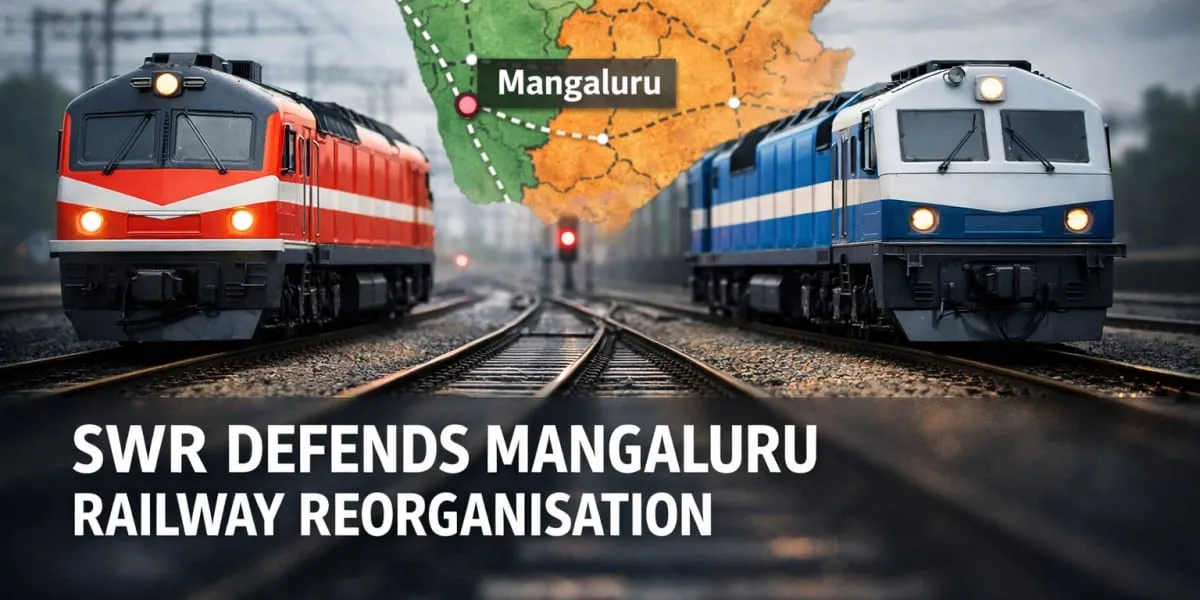
South Western Railway (SWR) has defended the decision to transfer the Mangaluru railway area from the Palakkad Division of Southern Railway (SR) to the Mysuru Division of SWR, saying the reorganisation aims to improve operational efficiency and will not affect revenue allocation or investment priorities. The railway described the move as an administrative and operational rationalisation to place the entire Mangaluru area under a single zone. The response followed opposition from Kerala to the Centre's order.

At present, operations in the Mangaluru region are shared by Southern Railway, SWR and the Konkan Railway Corporation (KRCL), producing multiple operational jurisdictions within a compact but traffic intensive network. The Padil interchange brings together the jurisdictions of the three administrations, so trains approaching Mangaluru from the Goa or Hassan directions cross several boundaries before reaching the station. The railway said this has caused avoidable delays, congestion and coordination challenges.

The railway administration noted that Mangaluru is located more than 350 km from the headquarters of the Palakkad Division, while major onward connectivity through the Mangaluru-Hassan-Mysuru-Bengaluru corridor already falls within SWR. Bringing the whole area under SWR would allow unified planning, train control and timetabling and reduce operational bottlenecks, leading to smoother passenger and freight services. Officials said suburban services around Mangaluru are already largely under SWR, which would facilitate comprehensive regional planning.

SWR highlighted the strategic importance of New Mangalore Port, which handles cargo for power and steel plants in Karnataka and is served by SWR and KRCL, saying integration with a single zone would improve coordination and facilitate seamless movement of loaded and empty freight rakes. The railway clarified that the realignment is confined to Karnataka and does not involve transfer of any station in Kerala, with the Palakkad Division retaining stations in Kasaragod, Kannur, Kozhikode, Malappuram, Palakkad and Thrissur districts. It emphasised that infrastructure investment is guided by network requirements rather than revenue and urged people to view the change as a technical measure to ensure seamless operations while reiterating that Kerala's railway development will continue to receive priority.

South Western Railway (SWR) has defended the decision to transfer the Mangaluru railway area from the Palakkad Division of Southern Railway (SR) to the Mysuru Division of SWR, saying the reorganisation aims to improve operational efficiency and will not affect revenue allocation or investment priorities. The railway described the move as an administrative and operational rationalisation to place the entire Mangaluru area under a single zone. The response followed opposition from Kerala to the Centre's order. At present, operations in the Mangaluru region are shared by Southern Railway, SWR and the Konkan Railway Corporation (KRCL), producing multiple operational jurisdictions within a compact but traffic intensive network. The Padil interchange brings together the jurisdictions of the three administrations, so trains approaching Mangaluru from the Goa or Hassan directions cross several boundaries before reaching the station. The railway said this has caused avoidable delays, congestion and coordination challenges. The railway administration noted that Mangaluru is located more than 350 km from the headquarters of the Palakkad Division, while major onward connectivity through the Mangaluru-Hassan-Mysuru-Bengaluru corridor already falls within SWR. Bringing the whole area under SWR would allow unified planning, train control and timetabling and reduce operational bottlenecks, leading to smoother passenger and freight services. Officials said suburban services around Mangaluru are already largely under SWR, which would facilitate comprehensive regional planning. SWR highlighted the strategic importance of New Mangalore Port, which handles cargo for power and steel plants in Karnataka and is served by SWR and KRCL, saying integration with a single zone would improve coordination and facilitate seamless movement of loaded and empty freight rakes. The railway clarified that the realignment is confined to Karnataka and does not involve transfer of any station in Kerala, with the Palakkad Division retaining stations in Kasaragod, Kannur, Kozhikode, Malappuram, Palakkad and Thrissur districts. It emphasised that infrastructure investment is guided by network requirements rather than revenue and urged people to view the change as a technical measure to ensure seamless operations while reiterating that Kerala's railway development will continue to receive priority.

Related Stories

Gold Stories
Next Story
Real Estate

BMC OC Amnesty Scheme Requires Key Approvals from Mumbai Societies

The Brihanmumbai Municipal Corporation (BMC) has clarified that housing societies applying under its Occupation Certificate (OC) amnesty scheme must possess key approvals linked to the original construction. The requirements include a valid Intimation of Disapproval (IOD), an approved building plan and a Commencement Certificate (CC), along with a No Objection Certificate (NOC) from the developer or original construction applicant. The Standard Operating Procedure (SOP) makes clear that the absence of an OC alone will not qualify a building for relief. Societies must establish that their build..

Next Story
Real Estate

Gurugram Emerges as Luxury Senior Living Hub

Gurugram is emerging as a potential hub for luxury senior living, supported by available land, healthcare infrastructure, connectivity and a concentration of affluent professionals, high-net-worth individuals and non-resident Indians. These factors could give the city an advantage over land-constrained metros such as Mumbai. A report by the Association of Senior Living India (ASLI) and JLL estimates that India’s organised senior living market could represent a $10.1 bn opportunity by 2030. The sector had about 25,050 organised units as of June 2026, while penetration stood at only 1.5 per ce..

Next Story
Real Estate

Corrosion Costs India’s Infrastructure Rs. 142 bn Annually

Corrosion costs India an estimated Rs. 1.42 tn annually, equivalent to 4.3 per cent of gross domestic product, according to a report by the Confederation of Indian Industry and the National Research Institute. Infrastructure accounts for Rs. 142 bn of the annual burden, making it the sector with the largest absolute cost among those examined. The report, presented at the CII Annual Infrastructure Summit 2026, said the infrastructure-sector cost equals about 2.9 per cent of the sector’s gross domestic product. It estimated that effective measures could generate maximum savings of Rs. 495.8 bn..

Advertisement

Subscribe to Our Newsletter

Get daily newsletters around different themes from Construction world.

STAY CONNECTED

Advertisement

SPECIAL OFFER
QR Code