Third Mountain Tunnel Breakthrough Boosts Bullet Train Progress
RAILWAYS & METRO RAIL

Third Mountain Tunnel Breakthrough Boosts Bullet Train Progress

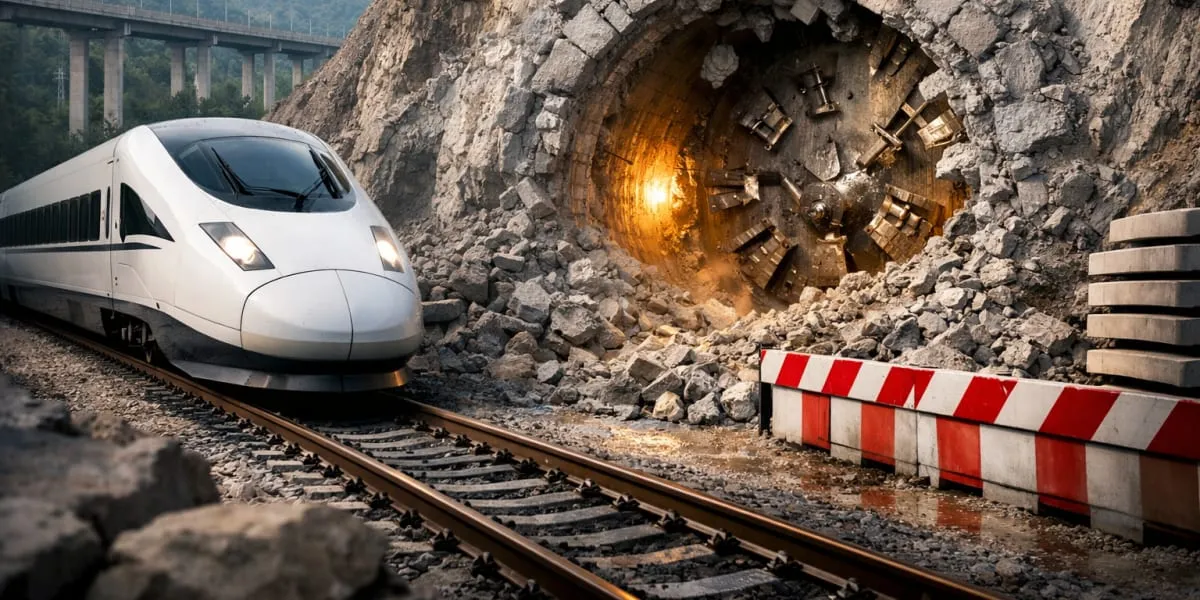
A major engineering milestone has been completed on the Mumbai–Ahmedabad high-speed rail corridor with the breakthrough of the third mountain tunnel, MT-07, at Ambesari village in Dahanu Taluka of Palghar district, Maharashtra. The development was announced by the project authority and noted on social media by a government minister, underlining rapid progress in this technically challenging section. The achievement brings three mountain tunnel breakthroughs in Maharashtra within five months.

The MT-07 mountain tunnel measures 417 metres in length and 14.4 metres in width and has been designed to accommodate both up and down tracks of the bullet train corridor. Excavation was completed by controlled drilling and blasting from both ends and was supported by advanced engineering and safety protocols. Construction teams applied industry-standard methods to integrate structural support and alignment for high-speed operations.

Throughout tunnelling, sophisticated monitoring systems and geotechnical instruments were deployed to ensure stability and worker safety. Real-time arrangements included surface settlement points, three-dimensional targets, strain gauges and seismographs to track vibrations and tunnel behaviour, while ventilation, fire-safety systems and controlled access managed site safety. Continuous geotechnical supervision and data-driven adjustments were described by engineers as central to precise execution and risk management.

The latest breakthrough follows earlier completions in the Maharashtra section, notably MT-05 at one point five km near Saphale and the MT-06 tunnel of 454 metres completed using the New Austrian Tunnelling Method. Of the seven mountain tunnels under construction in Maharashtra, three have now achieved breakthroughs, while MT-03 has crossed 80 per cent excavation progress, and MT-04 has reached nearly 60 per cent. Tunnelling between Vapi and Boisar has been completed, and work in the industrial corridor linking Boisar and Vapi is proceeding rapidly, reflecting the adoption of advanced tunnelling and monitoring technology that will strengthen capabilities in high-speed rail infrastructure.

A major engineering milestone has been completed on the Mumbai–Ahmedabad high-speed rail corridor with the breakthrough of the third mountain tunnel, MT-07, at Ambesari village in Dahanu Taluka of Palghar district, Maharashtra. The development was announced by the project authority and noted on social media by a government minister, underlining rapid progress in this technically challenging section. The achievement brings three mountain tunnel breakthroughs in Maharashtra within five months. The MT-07 mountain tunnel measures 417 metres in length and 14.4 metres in width and has been designed to accommodate both up and down tracks of the bullet train corridor. Excavation was completed by controlled drilling and blasting from both ends and was supported by advanced engineering and safety protocols. Construction teams applied industry-standard methods to integrate structural support and alignment for high-speed operations. Throughout tunnelling, sophisticated monitoring systems and geotechnical instruments were deployed to ensure stability and worker safety. Real-time arrangements included surface settlement points, three-dimensional targets, strain gauges and seismographs to track vibrations and tunnel behaviour, while ventilation, fire-safety systems and controlled access managed site safety. Continuous geotechnical supervision and data-driven adjustments were described by engineers as central to precise execution and risk management. The latest breakthrough follows earlier completions in the Maharashtra section, notably MT-05 at one point five km near Saphale and the MT-06 tunnel of 454 metres completed using the New Austrian Tunnelling Method. Of the seven mountain tunnels under construction in Maharashtra, three have now achieved breakthroughs, while MT-03 has crossed 80 per cent excavation progress, and MT-04 has reached nearly 60 per cent. Tunnelling between Vapi and Boisar has been completed, and work in the industrial corridor linking Boisar and Vapi is proceeding rapidly, reflecting the adoption of advanced tunnelling and monitoring technology that will strengthen capabilities in high-speed rail infrastructure.

Next Story
Infrastructure Urban

Cabinet Approves Two Year Scheme To Replace Old Trucks And Buses

The Union Cabinet, chaired by the Prime Minister, approved a two-year scheme to reduce air pollution in the Delhi–NCR region and promote cleaner mobility. The programme will be funded through the National Capital Region Planning Board under the Ministry of Housing and Urban Affairs and implemented by the Ministry of Road Transport and Highways and the Ministry of Petroleum and Natural Gas, with participating States and Union Territories of Delhi, Haryana, Rajasthan and Uttar Pradesh. The total financial outlay has been set at Rs 95.85 billion (bn), with the Central Government contributing Rs..

Next Story
Infrastructure Transport

Bengaluru Suburban Rail And Metro To Share 500-Metre Corridor

Bengaluru suburban rail and the Metro will share a 500-metre corridor at Benniganahalli, a decision that planners say will reduce capital expenditure and urban disruption. The consolidation of alignments across the short stretch is intended to avoid duplication of elevated structures and station facilities while cutting land acquisition needs. Authorities put the maximum savings at Rs 1.69 bn (1,690 mn). The arrangement also aims to streamline construction interfaces between the two systems. The shared corridor will require coordinated design of track beds, piers and passenger access so that s..

Next Story
Infrastructure Urban

DRDO And IAF Complete Successful RudraM-II Flight Tests

The Defence Research and Development Organisation (DRDO) and the Indian Air Force (IAF) have conducted successful flight tests of the RudraM-II air-to-surface missile from an airborne platform. The trials were carried out under extreme release conditions with a critical trajectory that established the capability of all subsystems. The series of releases tested the missile's guidance, seeker and propulsion elements in an operationally representative environment. The missiles, released from the aircraft, were guided to a predefined target with pinpoint accuracy and all test objectives were fully..

Advertisement

Subscribe to Our Newsletter

Get daily newsletters around different themes from Construction world.

STAY CONNECTED

Advertisement

Advertisement

Advertisement