Three Tamil Nadu Railway Projects Get Special Status
RAILWAYS & METRO RAIL

Three Tamil Nadu Railway Projects Get Special Status

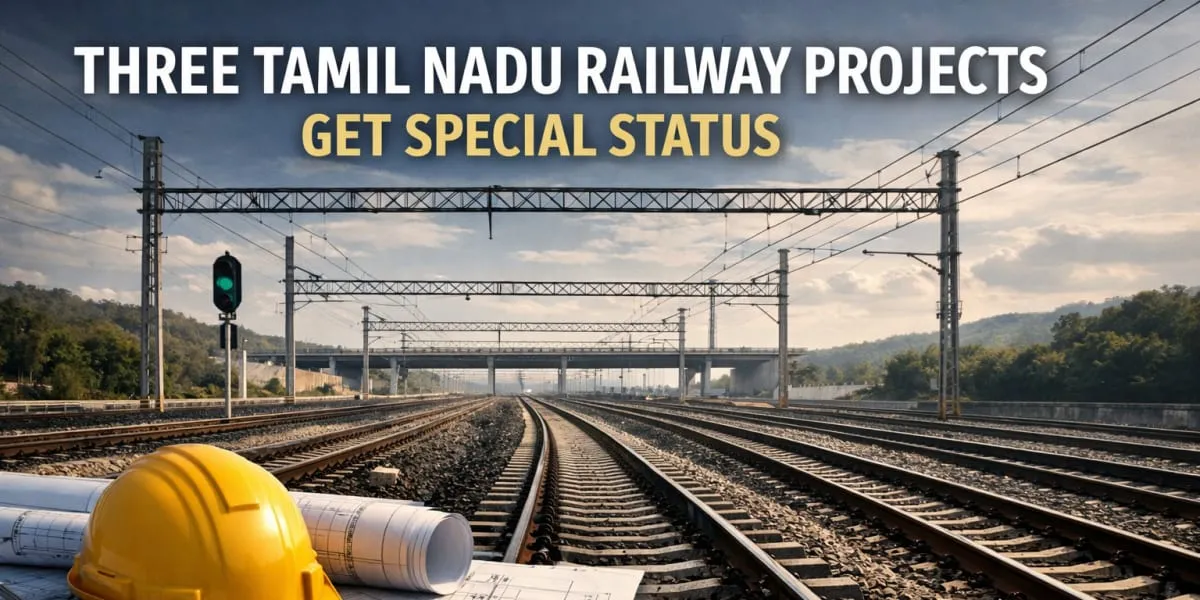
The Ministry of Railways has granted Special Railway Project status to three rail infrastructure works in Tamil Nadu, aimed at accelerating land acquisition and project delivery. The projects are the 77 km Arakkonam–Renigunta third and fourth line, the 90 km Gummidipundi–Gudur third and fourth line, and the 147 km Hosur–Omalur doubling project. The designation is intended to simplify procedures and reduce delays caused by standard acquisition routes.

Officials said the move is expected to ease congestion, enhance operational capacity and improve revenue generation while boosting both freight and passenger traffic. Extending additional lines from Chennai–Arakkonam to Renigunta is expected to strengthen freight movement towards Andhra Pradesh, Karnataka and Maharashtra. On the Chennai–Gudur corridor the Railways have sanctioned a third and fourth line between Athipattu and Gummidipundi covering 23 km and plan to extend the lines up to Gudur along the 140 km corridor.

Under the special mechanism land parcels required for a project are treated as a single package and compensation is negotiated directly with landowners, with transfers effected by registration at sub?registrar offices similar to private transactions. Compensation rates may be 30 per cent to 40 per cent higher than standard settlements and officials explained that nearly 75 per cent of the land required for a project could be acquired within three months under this approach compared with two to three years under the regular process. The space for negotiated settlements is illustrated by an example from revenue sources noting a person who would otherwise receive Rs 0.3 million (mn) to Rs 0.4 million (mn) can negotiate up to Rs 0.6 million (mn).

Officials said the Detailed Project Report for the Arakkonam–Renigunta third and fourth line has been completed and submitted to the Railway Board for approval, and the Chennai–Arakkonam section has four lines. Work on the Athipattu–Gummidipundi section is due to start shortly and the extension to Gudur will enhance freight capacity along the 140 km corridor. The Hosur–Omalur doubling project should reduce waiting time and crossing delays while land acquisition issues continue to affect other Tamil Nadu schemes.

The Ministry of Railways has granted Special Railway Project status to three rail infrastructure works in Tamil Nadu, aimed at accelerating land acquisition and project delivery. The projects are the 77 km Arakkonam–Renigunta third and fourth line, the 90 km Gummidipundi–Gudur third and fourth line, and the 147 km Hosur–Omalur doubling project. The designation is intended to simplify procedures and reduce delays caused by standard acquisition routes. Officials said the move is expected to ease congestion, enhance operational capacity and improve revenue generation while boosting both freight and passenger traffic. Extending additional lines from Chennai–Arakkonam to Renigunta is expected to strengthen freight movement towards Andhra Pradesh, Karnataka and Maharashtra. On the Chennai–Gudur corridor the Railways have sanctioned a third and fourth line between Athipattu and Gummidipundi covering 23 km and plan to extend the lines up to Gudur along the 140 km corridor. Under the special mechanism land parcels required for a project are treated as a single package and compensation is negotiated directly with landowners, with transfers effected by registration at sub?registrar offices similar to private transactions. Compensation rates may be 30 per cent to 40 per cent higher than standard settlements and officials explained that nearly 75 per cent of the land required for a project could be acquired within three months under this approach compared with two to three years under the regular process. The space for negotiated settlements is illustrated by an example from revenue sources noting a person who would otherwise receive Rs 0.3 million (mn) to Rs 0.4 million (mn) can negotiate up to Rs 0.6 million (mn). Officials said the Detailed Project Report for the Arakkonam–Renigunta third and fourth line has been completed and submitted to the Railway Board for approval, and the Chennai–Arakkonam section has four lines. Work on the Athipattu–Gummidipundi section is due to start shortly and the extension to Gudur will enhance freight capacity along the 140 km corridor. The Hosur–Omalur doubling project should reduce waiting time and crossing delays while land acquisition issues continue to affect other Tamil Nadu schemes.

Related Stories

Gold Stories

Next Story
Infrastructure Urban

KONE Opens India's First Digital Experience Centre in Pune

KONE, a global elevator and escalator manufacturer, has inaugurated its first Digital Experience Centre (DEC) in India, located in Pune. The facility aims to showcase how artificial intelligence (AI), connectivity and data-driven technologies can enhance customer experiences and improve building operations.The centre was inaugurated by Jussi Herlin, Executive Vice Chair, KONE Corporation; Philippe Delorme, President and CEO, KONE; and Nandan Nilekani, Co-founder and Chairman of the Board, Infosys.Designed as an interactive customer environment, the facility demonstrates digital solutions cover..

Next Story
Infrastructure Urban

CII GreenCo Launches Circularity Guidelines for Indian Industry

The Confederation of Indian Industry (CII) GreenCo Council has launched the CII GreenCo Circularity Guidelines – Pilot Version at the 17th CII GreenCo Waste & Resource Management Summit 2026 in Chennai. The initiative aims to strengthen resource efficiency, waste reduction and circular economy practices across Indian manufacturing and process industries.The guidelines introduce a structured framework with circularity indices covering raw materials, consumables, packaging and other resource inputs. These indicators will help industries assess existing practices, identify opportunities to ..

Next Story
Infrastructure Energy

Global Electronics Association Launches IPC-1783-CO2E Standard

The Global Electronics Association has introduced IPC-1783-CO2E, a new international standard aimed at improving consistency, transparency and comparability in product carbon footprint reporting across the electronics manufacturing industry.The standard, titled International Standard for Data Collection and Reporting of CO2 Equivalent (CO2e) Emissions for the Electronics Manufacturing Supply Chain, provides industry-specific guidance for collecting, estimating and reporting carbon emissions data.With increasing regulatory requirements and customer expectations, electronics manufacturers face c..

Advertisement

Subscribe to Our Newsletter

Get daily newsletters around different themes from Construction world.

STAY CONNECTED

Advertisement

SPECIAL OFFER
QR Code