+
Centre Raises Deep-Water Gas Price Ceiling to USD 9.89 per MMBtu
WATER & WASTE

Centre Raises Deep-Water Gas Price Ceiling to USD 9.89 per MMBtu

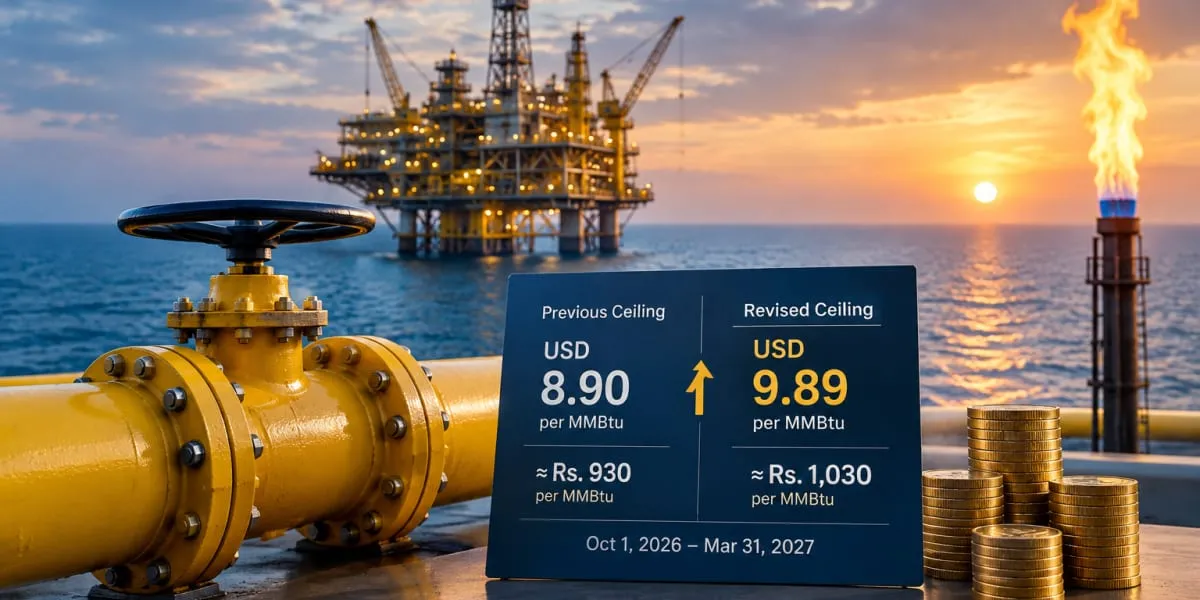
The Ministry of Petroleum and Natural Gas has raised the maximum price at which natural gas from deep-water, ultra-deep-water and high-pressure-high-temperature (HP-HT) fields can be sold to USD 9.89 per million British thermal units (MMBtu), from the earlier ceiling of USD 8.90 per MMBtu. The revised ceiling will apply from October 1, 2026, to March 31, 2027.

In rupee terms, the ceiling has increased from around Rs. 930 to approximately Rs. 1,030 per MMBtu. The pricing framework covers gas produced from offshore fields where extraction costs are substantially higher than those associated with conventional fields. Production blocks such as KG-D6 in the Krishna-Godavari basin fall under the mechanism.

The higher ceiling is expected to provide greater pricing flexibility and improve the economics for companies producing gas from technically challenging offshore areas. The change allows producers to charge a higher maximum price for eligible output, although the actual price paid by downstream consumers will depend on supply agreements and market conditions.

Natural gas is used across several important sectors. It is supplied as compressed natural gas (CNG) for vehicles and piped natural gas (PNG) for households through city gas distribution networks. It is also a major feedstock for fertiliser production and is used as a fuel for power generation.

The revised ceiling could therefore affect the cost structures of these industries. However, the increase does not automatically result in an immediate or proportionate rise in retail prices for consumers. The eventual impact on CNG and PNG prices will depend on the rates at which gas is actually supplied and on whether city gas distributors and other downstream users absorb or pass on higher input costs. Fertiliser and power producers may similarly assess the effect based on their procurement arrangements and operating costs.

The Ministry of Petroleum and Natural Gas has raised the maximum price at which natural gas from deep-water, ultra-deep-water and high-pressure-high-temperature (HP-HT) fields can be sold to USD 9.89 per million British thermal units (MMBtu), from the earlier ceiling of USD 8.90 per MMBtu. The revised ceiling will apply from October 1, 2026, to March 31, 2027. In rupee terms, the ceiling has increased from around Rs. 930 to approximately Rs. 1,030 per MMBtu. The pricing framework covers gas produced from offshore fields where extraction costs are substantially higher than those associated with conventional fields. Production blocks such as KG-D6 in the Krishna-Godavari basin fall under the mechanism. The higher ceiling is expected to provide greater pricing flexibility and improve the economics for companies producing gas from technically challenging offshore areas. The change allows producers to charge a higher maximum price for eligible output, although the actual price paid by downstream consumers will depend on supply agreements and market conditions. Natural gas is used across several important sectors. It is supplied as compressed natural gas (CNG) for vehicles and piped natural gas (PNG) for households through city gas distribution networks. It is also a major feedstock for fertiliser production and is used as a fuel for power generation. The revised ceiling could therefore affect the cost structures of these industries. However, the increase does not automatically result in an immediate or proportionate rise in retail prices for consumers. The eventual impact on CNG and PNG prices will depend on the rates at which gas is actually supplied and on whether city gas distributors and other downstream users absorb or pass on higher input costs. Fertiliser and power producers may similarly assess the effect based on their procurement arrangements and operating costs.

Related Stories

Gold Stories

Next Story
Infrastructure Transport

Madhya Pradesh Plans Airport Every 150 Km, Airstrip Every 75 Km

The Madhya Pradesh government plans to establish an airport every 150 km, an airstrip every 75 km and a helipad every 45 km, according to the state aviation department. Airports being developed in Ujjain and Shivpuri are expected to take the state’s airport count to 10. The government stated that Madhya Pradesh currently has eight airports in eight cities. The locations named by the department include Indore, Bhopal, Jabalpur, Gwalior, Khajuraho, Rewa and Satna. The state also has more than 20 airstrips and 220 helipads, while permanent helipads are planned in all 230 Assembly constituencies..

Next Story
Infrastructure Transport

West Bengal Plans Four Airports for 2028 Completion Under UDAN

West Bengal will develop four new airports under an agreement signed between the Union Civil Aviation Ministry and the state government, with all facilities targeted for completion by 2028. Union Civil Aviation Minister K Rammohan Naidu said the airports would be located at Charra in Purulia, Kalaikunda in Paschim Medinipur, Balurghat in Dakshin Dinajpur and Hasimara in Alipurduar. The project is part of the Centre’s regional connectivity UDAN programme. The Union government has committed Rs. 290 bn for West Bengal’s aviation sector over the next decade, while the state government will pro..

Next Story
Infrastructure Transport

Mumbai Airport Bars Russian Airlines as Agent Seeks Ministry Intervention

Mumbai airport has stopped accepting cargo booked on Russian flag carrier Aeroflot, disrupting shipments and prompting the airline’s cargo sales agent, Delmos Aviation, to seek intervention from the Ministry of Civil Aviation. The restrictions also affect cargo booked on Volga-Dnepr Airlines, according to a letter submitted by Delmos Aviation to the ministry on September 30. Aeroflot operates daily flights between Moscow and Delhi and runs a winter seasonal service to Goa. Bonded cargo from Mumbai and other cities is transported by road to Delhi before being flown to Russia. The agent said t..

Advertisement

Subscribe to Our Newsletter

Get daily newsletters around different themes from Construction world.

STAY CONNECTED

Advertisement

SPECIAL OFFER
QR Code