


CSIR Transfers 13 Indigenous Building Technologies
Technology

CSIR Transfers 13 Indigenous Building Technologies

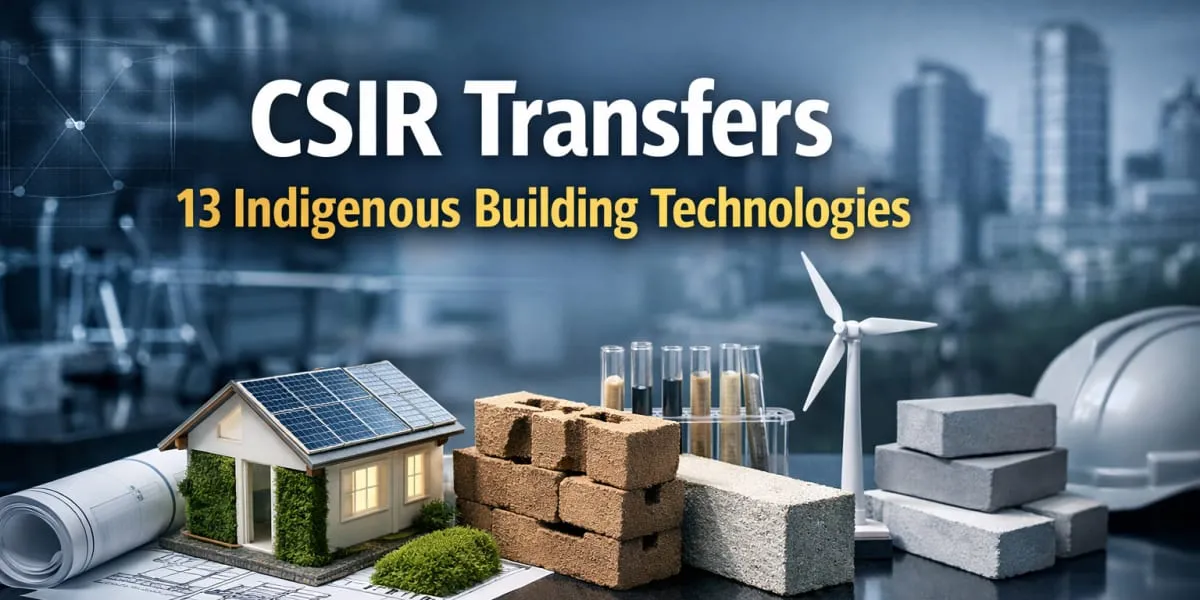
On National Technology Day the Council of Scientific and Industrial Research (CSIR) organised its monthly Technology Transfer Event at CSIR headquarters in New Delhi focused on technology transfers by CSIR-Central Building Research Institute (CSIR-CBRI), Roorkee. The event marked the transfer of 13 indigenous technologies to industries and start-ups and was presented as a reaffirmation of India’s commitment to technology-led growth and self-reliance.

Dr Ajay Chaurasia of CSIR-CBRI welcomed participants and highlighted the importance of industry-oriented dissemination in accelerating innovation-led development. The director of CSIR-CBRI, Professor R. Pradeep Kumar, outlined the institute’s technological achievements and noted that holding the transfer programme on National Technology Day underscored its significance. He emphasised that transferring indigenous innovations to industry strengthens the research ecosystem and advances the vision of Aatmanirbhar Bharat and sustainable infrastructure.

During the programme 13 technologies were formally transferred, covering fire safety, sustainable construction, infrastructure protection, energy efficiency and advanced building materials. Major technologies included a fire-resistant transparent intumescent coating for wood and wood substitute surfaces; interpenetrating polymer network coating technology for protection of reinforced cement concrete structures; a low-carbon footprint brick manufacturing technology; a hybrid solar-assisted heat pump system; and a prefabricated high-strength steel cord reinforcement technology for wall protection.

A video on the CSIR Smart Village Initiative was released and the Annual Report 2025–26 of CSIR-CBRI was presented during the programme. Dr N. Kalaiselvi, Director General of CSIR and Secretary, Department of Scientific and Industrial Research, observed that science, innovation and technology-based development are emerging drivers in India’s journey towards becoming a developed nation and said the transfer of laboratory technologies to industry is strengthening the national innovation ecosystem. The programme concluded with a vote of thanks by Chief Scientist Dr S. K. Panigrahi followed by the National Anthem.

On National Technology Day the Council of Scientific and Industrial Research (CSIR) organised its monthly Technology Transfer Event at CSIR headquarters in New Delhi focused on technology transfers by CSIR-Central Building Research Institute (CSIR-CBRI), Roorkee. The event marked the transfer of 13 indigenous technologies to industries and start-ups and was presented as a reaffirmation of India’s commitment to technology-led growth and self-reliance. Dr Ajay Chaurasia of CSIR-CBRI welcomed participants and highlighted the importance of industry-oriented dissemination in accelerating innovation-led development. The director of CSIR-CBRI, Professor R. Pradeep Kumar, outlined the institute’s technological achievements and noted that holding the transfer programme on National Technology Day underscored its significance. He emphasised that transferring indigenous innovations to industry strengthens the research ecosystem and advances the vision of Aatmanirbhar Bharat and sustainable infrastructure. During the programme 13 technologies were formally transferred, covering fire safety, sustainable construction, infrastructure protection, energy efficiency and advanced building materials. Major technologies included a fire-resistant transparent intumescent coating for wood and wood substitute surfaces; interpenetrating polymer network coating technology for protection of reinforced cement concrete structures; a low-carbon footprint brick manufacturing technology; a hybrid solar-assisted heat pump system; and a prefabricated high-strength steel cord reinforcement technology for wall protection. A video on the CSIR Smart Village Initiative was released and the Annual Report 2025–26 of CSIR-CBRI was presented during the programme. Dr N. Kalaiselvi, Director General of CSIR and Secretary, Department of Scientific and Industrial Research, observed that science, innovation and technology-based development are emerging drivers in India’s journey towards becoming a developed nation and said the transfer of laboratory technologies to industry is strengthening the national innovation ecosystem. The programme concluded with a vote of thanks by Chief Scientist Dr S. K. Panigrahi followed by the National Anthem.

Next Story
Infrastructure Energy

India Adds Record 44.61 GW Solar Capacity in FY2026

India’s solar sector reached a milestone in FY2026, with cumulative installed capacity crossing 150 GW and annual additions hitting a record 44.61 GW, exceeding the government target of 34 GW and nearly doubling FY2025’s 23.83 GW. Distributed Renewable Energy contributed 16.3 GW, while PPA and C&I segments accounted for 34 per cent and 30 per cent, respectively.India has risen from 9th globally in 2015 to 3rd in cumulative solar capacity by 2025 and is set to become the world’s second-largest solar market in annual installations in 2026. Seven states, led by Rajasthan and Gujarat, ac..

Next Story
Real Estate

Abhee Ventures unveils Scottish-themed 45-acre township in Bengaluru

Abhee Ventures, a leading South Indian real estate developer, has announced “Codename New Dimension,” a 45-acre Scottish-themed residential township at Gunjur on Whitefield–Sarjapur Road, Bengaluru. Strategically located between Whitefield and Sarjapur Road, Gunjur benefits from strong connectivity to the Outer Ring Road IT corridor, ITPL, EPIP, the upcoming Dommasandra Metro Station, and the proposed SWIFT City and Peripheral Ring Road.The township, designed in collaboration with London-based UHA London and India’s RSP Architects, offers low-density living with 85 per cent open spaces..

Next Story
Infrastructure Urban

Hindalco unveils Eternia experience centre for high-performance aluminium windows

Hindalco Industries, the metals flagship of the Aditya Birla Group, has launched its Eternia experience centre in Lajpat Nagar, New Delhi, highlighting its high-performance aluminium window systems designed for India’s evolving construction sector. The company is also expanding its manufacturing footprint in North India with a new Bilaspur facility.Eternia has emerged as one of the fastest-growing brands in system aluminium windows, registering nearly 65 per cent CAGR over the last three years. With a nationwide network of 170+ channel partners across 100+ cities, the brand serves homeowners..

Advertisement

Subscribe to Our Newsletter

Get daily newsletters around different themes from Construction world.

STAY CONNECTED

Advertisement

Advertisement

Advertisement

-->