Andhra Cabinet Approves Draft Resolution on Amaravati Capital
ECONOMY & POLICY

Andhra Cabinet Approves Draft Resolution on Amaravati Capital

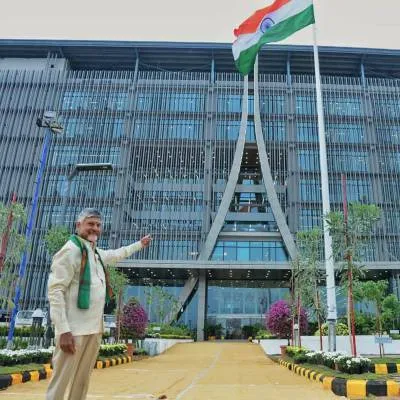
The State Cabinet, chaired by Chief Minister N Chandrababu Naidu, approved a draft resolution seeking amendment of Section five of the Andhra Pradesh Reorganisation Act, 2014 to make Amaravati the State capital. The resolution proposes inserting Amaravati in sub-section two and was set for introduction in the Legislative Assembly on March 28. The draft defines Amaravati as the area notified under the AP Capital Region Development Authority Act and states the notified area will remain part of the capital.

The Cabinet cleared a request from SRM University in Neerukonda to build academic blocks up to sixty metres, subject to safety norms under the AP Fire Services Act. The Cabinet approved establishment of 96 new courts and the creation of 1,730 posts as sought by the AP High Court. It cited Supreme Court guidance that there should be 50 judges for every one million (mn) population to prevent cases remaining unresolved for more than five years.

Using the 2011 Census as a baseline, officials said the State requires about 2,500 courts and that, given current caseloads, at least 1,420 to 1,500 courts were needed; pending cases had crossed 0.89 mn. As a first phase response, the Cabinet approved 96 new courts. The Cabinet also decided to allot fifteen per cent of quarry leases to Vaddera societies and to grant a fifty per cent concession on premium and seigniorage.

The Cabinet agreed to extend subsidy to household piped natural gas users, expanding benefits previously limited to LPG recipients under the Deepam-2 scheme, and issued a draft to register coaching institutions with district monitoring committees to address student suicides and academic stress. Land in Nandyal and Kadapa was allotted for wind and solar projects and NREDCAP was named the nodal agency for Renewable Energy Manufacturing Zones, replacing APSPCL. Administrative overheads for power line shifting in Amaravati works were cut from fifteen per cent to 2.5 per cent and fifty per cent interest on property tax dues was waived while posts were sanctioned for a BC Residential School for Girls at Kuppam.

The State Cabinet, chaired by Chief Minister N Chandrababu Naidu, approved a draft resolution seeking amendment of Section five of the Andhra Pradesh Reorganisation Act, 2014 to make Amaravati the State capital. The resolution proposes inserting Amaravati in sub-section two and was set for introduction in the Legislative Assembly on March 28. The draft defines Amaravati as the area notified under the AP Capital Region Development Authority Act and states the notified area will remain part of the capital. The Cabinet cleared a request from SRM University in Neerukonda to build academic blocks up to sixty metres, subject to safety norms under the AP Fire Services Act. The Cabinet approved establishment of 96 new courts and the creation of 1,730 posts as sought by the AP High Court. It cited Supreme Court guidance that there should be 50 judges for every one million (mn) population to prevent cases remaining unresolved for more than five years. Using the 2011 Census as a baseline, officials said the State requires about 2,500 courts and that, given current caseloads, at least 1,420 to 1,500 courts were needed; pending cases had crossed 0.89 mn. As a first phase response, the Cabinet approved 96 new courts. The Cabinet also decided to allot fifteen per cent of quarry leases to Vaddera societies and to grant a fifty per cent concession on premium and seigniorage. The Cabinet agreed to extend subsidy to household piped natural gas users, expanding benefits previously limited to LPG recipients under the Deepam-2 scheme, and issued a draft to register coaching institutions with district monitoring committees to address student suicides and academic stress. Land in Nandyal and Kadapa was allotted for wind and solar projects and NREDCAP was named the nodal agency for Renewable Energy Manufacturing Zones, replacing APSPCL. Administrative overheads for power line shifting in Amaravati works were cut from fifteen per cent to 2.5 per cent and fifty per cent interest on property tax dues was waived while posts were sanctioned for a BC Residential School for Girls at Kuppam.

Next Story
Infrastructure Urban

Shree KB Group Leases 75% of KB Mart in Greater Noida

Shree KB Group has leased over 75 per cent of its commercial project, KB Mart, in Knowledge Park II, Greater Noida, to domestic and international brands.Spread across approximately 2,90,000 sq ft, the mixed-use development integrates high-street retail, a food court and studio apartments. The company expects to generate around Rs 20 crore in revenue through leasing.Located opposite the India Expo Centre & Mart, the project benefits from strong connectivity via the Aqua Line Metro and proximity to major educational institutions, with a catchment of over two lakh students.Developed over 2.3 ..

Next Story
Real Estate

Janus Living Debuts on NYSE as Senior Housing REIT

New York Stock Exchange announced that Janus Living has commenced trading, marking its public debut as a senior housing real estate investment trust (REIT).The listing was highlighted during the exchange’s pre-market update, with the company celebrating its IPO at the NYSE trading floor. The debut reflects continued investor interest in specialised real estate segments, particularly senior housing.The update also noted broader market movements, with equities trading lower amid geopolitical developments in the Middle East impacting global sentiment.In addition, Guardian Metal Resources marked..

Next Story
Infrastructure Urban

WACKER to Increase Silicone Product Prices from April

WACKER Chemie AG has announced a price increase for its silicone-based products, effective April 1, 2026, citing rising input and logistics costs.The company stated that ongoing geopolitical developments in the Middle East have disrupted global supply chains, leading to sharp increases in energy, raw material and transportation costs. These factors have significantly impacted its global silicones business.Despite efforts to optimise its production and logistics network to minimise customer impact, WACKER noted that the scale of cost escalation has made price adjustments unavoidable. Customers ..

Advertisement

Subscribe to Our Newsletter

Get daily newsletters around different themes from Construction world.

STAY CONNECTED

Advertisement

Advertisement

Advertisement