AUDA Plans 20-Year Development Blueprint For Ahmedabad
ECONOMY & POLICY

AUDA Plans 20-Year Development Blueprint For Ahmedabad

The Ahmedabad Urban Development Authority (AUDA) is preparing a 20-year Development Plan, DP-2041, to guide growth in Ahmedabad and Gandhinagar with an eye on the 2036 Olympics. The authority has begun work on the blueprint and is seeking assistance from the Indian Space Research Organisation (ISRO) while augmenting staff through outsourcing. The approach departs from the usual 10-year cycle and reflects a strategic move to align infrastructure planning with long horizon growth objectives.

AUDA previously prepared its first draft plan, DP-2011, in 2001, and the second plan, DP-2021, was drafted between 2011 and 2014 before state government approval in December 2014. The tenure of DP-2021 ended nearly a year ago and the authority has chosen to extend the horizon for the next statutory plan rather than follow the earlier sequencing. In July 2022 AUDA's board approved a proposal for a 20-year plan and sanctioned a dedicated DP unit together with funds for consultants and operational expenses.

Sources indicate the upcoming plan may include provisions linked to the prospective 2036 Olympics, with emphasis on the development of sports infrastructure through public-private partnerships and on securing land for such facilities. The new plan aims to position Ahmedabad as a global metropolitan city while building on lessons from DP-2021, which promoted a compact city model centred on public transport. DP-2021 allowed an FSI of four point zero along Metro and BRTS corridors and an FSI of five point four in the Ashram Road business district, and DP-2041 will reassess density and transit alignment to support metropolitan ambitions. Officials expect the plan to balance growth corridors with sustainable urban design and enhanced connectivity.

The authority plans to prioritise about 20 villages within a five-kilometre radius outside the SP Ring Road for major infrastructure investment and the plan may include a midterm review after 10 years to accommodate changing needs. Technical collaboration with agencies including ISRO and targeted outsourcing are intended to strengthen analytical capacity and expedite plan preparation. AUDA is preparing the statutory framework and arrangements to enable implementation once the draft is finalised.

The Ahmedabad Urban Development Authority (AUDA) is preparing a 20-year Development Plan, DP-2041, to guide growth in Ahmedabad and Gandhinagar with an eye on the 2036 Olympics. The authority has begun work on the blueprint and is seeking assistance from the Indian Space Research Organisation (ISRO) while augmenting staff through outsourcing. The approach departs from the usual 10-year cycle and reflects a strategic move to align infrastructure planning with long horizon growth objectives. AUDA previously prepared its first draft plan, DP-2011, in 2001, and the second plan, DP-2021, was drafted between 2011 and 2014 before state government approval in December 2014. The tenure of DP-2021 ended nearly a year ago and the authority has chosen to extend the horizon for the next statutory plan rather than follow the earlier sequencing. In July 2022 AUDA's board approved a proposal for a 20-year plan and sanctioned a dedicated DP unit together with funds for consultants and operational expenses. Sources indicate the upcoming plan may include provisions linked to the prospective 2036 Olympics, with emphasis on the development of sports infrastructure through public-private partnerships and on securing land for such facilities. The new plan aims to position Ahmedabad as a global metropolitan city while building on lessons from DP-2021, which promoted a compact city model centred on public transport. DP-2021 allowed an FSI of four point zero along Metro and BRTS corridors and an FSI of five point four in the Ashram Road business district, and DP-2041 will reassess density and transit alignment to support metropolitan ambitions. Officials expect the plan to balance growth corridors with sustainable urban design and enhanced connectivity. The authority plans to prioritise about 20 villages within a five-kilometre radius outside the SP Ring Road for major infrastructure investment and the plan may include a midterm review after 10 years to accommodate changing needs. Technical collaboration with agencies including ISRO and targeted outsourcing are intended to strengthen analytical capacity and expedite plan preparation. AUDA is preparing the statutory framework and arrangements to enable implementation once the draft is finalised.

Related Stories

Gold Stories

Next Story
Infrastructure Urban

KONE Opens India's First Digital Experience Centre in Pune

KONE, a global elevator and escalator manufacturer, has inaugurated its first Digital Experience Centre (DEC) in India, located in Pune. The facility aims to showcase how artificial intelligence (AI), connectivity and data-driven technologies can enhance customer experiences and improve building operations.The centre was inaugurated by Jussi Herlin, Executive Vice Chair, KONE Corporation; Philippe Delorme, President and CEO, KONE; and Nandan Nilekani, Co-founder and Chairman of the Board, Infosys.Designed as an interactive customer environment, the facility demonstrates digital solutions cover..

Next Story
Infrastructure Urban

CII GreenCo Launches Circularity Guidelines for Indian Industry

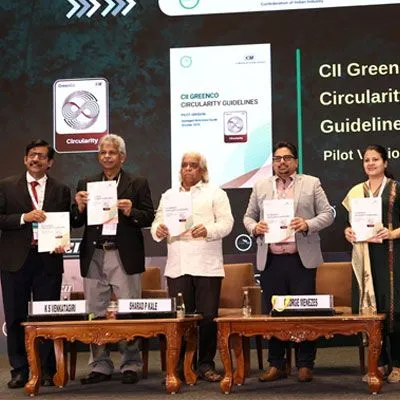
The Confederation of Indian Industry (CII) GreenCo Council has launched the CII GreenCo Circularity Guidelines – Pilot Version at the 17th CII GreenCo Waste & Resource Management Summit 2026 in Chennai. The initiative aims to strengthen resource efficiency, waste reduction and circular economy practices across Indian manufacturing and process industries.The guidelines introduce a structured framework with circularity indices covering raw materials, consumables, packaging and other resource inputs. These indicators will help industries assess existing practices, identify opportunities to ..

Next Story
Infrastructure Energy

Global Electronics Association Launches IPC-1783-CO2E Standard

The Global Electronics Association has introduced IPC-1783-CO2E, a new international standard aimed at improving consistency, transparency and comparability in product carbon footprint reporting across the electronics manufacturing industry.The standard, titled International Standard for Data Collection and Reporting of CO2 Equivalent (CO2e) Emissions for the Electronics Manufacturing Supply Chain, provides industry-specific guidance for collecting, estimating and reporting carbon emissions data.With increasing regulatory requirements and customer expectations, electronics manufacturers face c..

Advertisement

Subscribe to Our Newsletter

Get daily newsletters around different themes from Construction world.

STAY CONNECTED

Advertisement

SPECIAL OFFER
QR Code