Draft Rules Set Operator Liability And Safeguards For Private Nuclear Push
ECONOMY & POLICY

Draft Rules Set Operator Liability And Safeguards For Private Nuclear Push

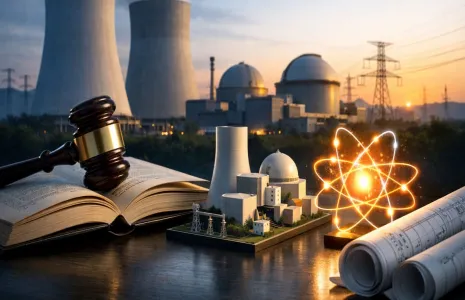
As the government moves to operationalise the Sustainable Harnessing and Advancement of Nuclear Energy Act, 2025 (SHANTI Act), it has published draft rules to open the strategically critical nuclear power sector to greater private participation. The Department of Atomic Energy (DAE) released the rules to establish a clearer framework for operator liability, financial protection and the deployment of foreign reactor technology while retaining long term regulatory oversight.

The draft rules require plant operators to maintain an insurance policy, financial security or a combination of both to cover nuclear damage and specify that such protection must remain until all spent fuel is removed from the relevant storage pool. This extends operator obligations beyond the operational phase and is intended to safeguard against potential nuclear damage as private capital and expertise enter the sector.

The Centre will constitute once in every five years a group of experts to review the maximum limits of an operator’s civil liability for nuclear damage. For reactors based on foreign designs, the design must be certified or approved by the regulatory authority in the country of origin, which the drafts define as a state that is self reliant in reactor design and supply chain and whose regulatory approvals are trusted globally.

The draft introduces an in principle approval mechanism that would allow prospective developers to begin key preparations before site selection or reactor technology is finalised. The licensing authority may grant such approval after admitting an application, enabling applicants to negotiate with reactor technology vendors and to acquire land and necessary infrastructure at an earlier stage to reduce project lead times.

The government has proposed a single composite licence covering the entire lifecycle of a nuclear power plant or reactor, from construction and ownership to operation and decommissioning, with no licence to be sought for those activities separately. The measure is framed to provide regulatory clarity while the Centre retains oversight of safety, liability and long term decommissioning responsibilities.

As the government moves to operationalise the Sustainable Harnessing and Advancement of Nuclear Energy Act, 2025 (SHANTI Act), it has published draft rules to open the strategically critical nuclear power sector to greater private participation. The Department of Atomic Energy (DAE) released the rules to establish a clearer framework for operator liability, financial protection and the deployment of foreign reactor technology while retaining long term regulatory oversight. The draft rules require plant operators to maintain an insurance policy, financial security or a combination of both to cover nuclear damage and specify that such protection must remain until all spent fuel is removed from the relevant storage pool. This extends operator obligations beyond the operational phase and is intended to safeguard against potential nuclear damage as private capital and expertise enter the sector. The Centre will constitute once in every five years a group of experts to review the maximum limits of an operator’s civil liability for nuclear damage. For reactors based on foreign designs, the design must be certified or approved by the regulatory authority in the country of origin, which the drafts define as a state that is self reliant in reactor design and supply chain and whose regulatory approvals are trusted globally. The draft introduces an in principle approval mechanism that would allow prospective developers to begin key preparations before site selection or reactor technology is finalised. The licensing authority may grant such approval after admitting an application, enabling applicants to negotiate with reactor technology vendors and to acquire land and necessary infrastructure at an earlier stage to reduce project lead times. The government has proposed a single composite licence covering the entire lifecycle of a nuclear power plant or reactor, from construction and ownership to operation and decommissioning, with no licence to be sought for those activities separately. The measure is framed to provide regulatory clarity while the Centre retains oversight of safety, liability and long term decommissioning responsibilities.

Related Stories

Gold Stories

Next Story
Infrastructure Urban

Gopalan Metals Enters Building Wires Segment

Gopalan Metals (India) has recently launched Gopalan Wires and Cables, marking its entry into the building wires segment for residential, commercial and industrial applications.The product portfolio currently includes Flame Retardant (FR) and Flame Retardant Low Smoke and Halogen (FRLS-H) PVC house wires. The products are manufactured at the company’s Hoskote facility in Karnataka, which has a production capacity of around 6,000 km of building wires per month.Gopalan Wires and Cables will cater to electrical dealers, distributors, contractors, builders, infrastructure projects, OEMs and end ..

Next Story
Real Estate

KONE India Opens New Office in Jabalpur

KONE India has recently inaugurated a new office in Jabalpur, strengthening its presence and customer reach across Central Madhya Pradesh.The office will serve customers in Rewa, Satna, Singrauli and Katni, while also expanding the company’s reach into emerging markets such as Shahdol and Seoni. It will provide local sales, service and installation support to address growing customer requirements across the region.Amit Gossain, Managing Director, KONE India, said, “Jabalpur is an important market for us, and this new office brings us closer to our customers in the area. As the region conti..

Next Story
Infrastructure Urban

Greenr Opens 12th Outlet at Oberoi Garden City, Goregaon

Greenr has recently opened its newest outlet at Cafés. Restaurants. Bars. within International Business Park, Oberoi Garden City, Goregaon, marking its 12th location in India and further strengthening its presence in Mumbai.The outlet brings together Greenr’s plant-forward food, specialty coffee and community-focused experiences in a format designed for professionals, residents and visitors. The space is intended to support dining, coffee meetings, informal work sessions and social interactions throughout the day.Greenr’s offering combines globally inspired vegetarian cuisine with wellnes..

Advertisement

Subscribe to Our Newsletter

Get daily newsletters around different themes from Construction world.

STAY CONNECTED

Advertisement