+
Himachal CM Sukhu Inaugurates 17 Projects Worth Rs 1.9 bn
ECONOMY & POLICY

Himachal CM Sukhu Inaugurates 17 Projects Worth Rs 1.9 bn

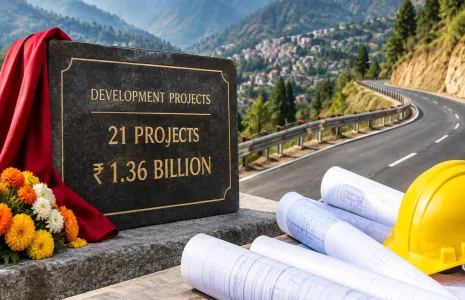
The Chief Minister of Himachal Pradesh, Sukhvinder Singh Sukhu, inaugurated and laid foundation stones for 17 development projects worth Rs 1.9 billion (bn) during a one-day tour of Sirmaur district. The total included foundation stones amounting to Rs 1.52 billion and several completed works opened for public use. The programme was organised by the state administration to accelerate local infrastructure and public services.

The foundation stone package comprised infrastructure investments, including Smart Grid Technologies in Nahan at Rs 534 million (mn) and Poanta Sahib at Rs 436.6 mn, a Bheron?Adi Badri road at Rs 160.4 mn and a Kanshiwala?Biroja Factory road at Rs 123.6 mn. Other works included a Chief Medical Office at Nahan at Rs 84.2 mn, upgradation of Burma Papri, Palion and Majri road at Rs 81.7 mn, a link road from Sainwala to Kotla at Rs 69.8 mn and a link from NH07 via Bhaderkali to Forest Check Post Kolar Bilaspur road at Rs 31.3 mn. These projects were described as intended to enhance connectivity and urban services across the district.

The Chief Minister inaugurated facilities including a new Table Tennis?cum?Squash Court Complex in Nahan at Rs 30.3 mn, a boys hostel at the Government Polytechnic, Dhaula Kuan, at Rs 31.7 mn and the second floor of its academic block at Rs 49.1 mn. He also opened a residential accommodation block at Rs 78.1 mn, an automobile block at Rs 24.1 mn, a girls hostel at Rs 33.0 mn, a link road from Judda?Ka?Johar to village Gadda at Rs 25.7 mn, a fire post building at Kala Amb at Rs 38.0 mn and the District Panchayat Resource Centre in Nahan at Rs 56.5 mn. The facilities were presented as measures to strengthen technical education and district administration.

On International Women’s Day the Chief Minister honoured women for contributions in administration, mountaineering and examinations and awarded beneficiaries under welfare schemes. Several beneficiaries under the Mahila Vikas Protsahan Yojana received Rs 0.1 mn each and Mukhyamantri Sukh Aashray Yojana provided marriage assistance of Rs 60,000 and second instalments of Rs 0.1 mn.

The Chief Minister of Himachal Pradesh, Sukhvinder Singh Sukhu, inaugurated and laid foundation stones for 17 development projects worth Rs 1.9 billion (bn) during a one-day tour of Sirmaur district. The total included foundation stones amounting to Rs 1.52 billion and several completed works opened for public use. The programme was organised by the state administration to accelerate local infrastructure and public services. The foundation stone package comprised infrastructure investments, including Smart Grid Technologies in Nahan at Rs 534 million (mn) and Poanta Sahib at Rs 436.6 mn, a Bheron?Adi Badri road at Rs 160.4 mn and a Kanshiwala?Biroja Factory road at Rs 123.6 mn. Other works included a Chief Medical Office at Nahan at Rs 84.2 mn, upgradation of Burma Papri, Palion and Majri road at Rs 81.7 mn, a link road from Sainwala to Kotla at Rs 69.8 mn and a link from NH07 via Bhaderkali to Forest Check Post Kolar Bilaspur road at Rs 31.3 mn. These projects were described as intended to enhance connectivity and urban services across the district. The Chief Minister inaugurated facilities including a new Table Tennis?cum?Squash Court Complex in Nahan at Rs 30.3 mn, a boys hostel at the Government Polytechnic, Dhaula Kuan, at Rs 31.7 mn and the second floor of its academic block at Rs 49.1 mn. He also opened a residential accommodation block at Rs 78.1 mn, an automobile block at Rs 24.1 mn, a girls hostel at Rs 33.0 mn, a link road from Judda?Ka?Johar to village Gadda at Rs 25.7 mn, a fire post building at Kala Amb at Rs 38.0 mn and the District Panchayat Resource Centre in Nahan at Rs 56.5 mn. The facilities were presented as measures to strengthen technical education and district administration. On International Women’s Day the Chief Minister honoured women for contributions in administration, mountaineering and examinations and awarded beneficiaries under welfare schemes. Several beneficiaries under the Mahila Vikas Protsahan Yojana received Rs 0.1 mn each and Mukhyamantri Sukh Aashray Yojana provided marriage assistance of Rs 60,000 and second instalments of Rs 0.1 mn.

Next Story
Infrastructure Urban

Implementation Status of Jal Jeevan Mission

Since August 2019 the Government has implemented Jal Jeevan Mission to provide assured potable water through household tap connections in rural India. At the start of the mission only 32.3 million (mn) rural households, representing 16.7 per cent, were reported to have tap water connections. States and union territories have reported that 125.8 mn additional rural households have since been provided with tap connections. As a result, of about 193.6 mn rural households roughly 158.2 mn, or 81.71 per cent, are reported to have tap water supply at home.\n\nThe State, district and village level st..

Next Story
Infrastructure Urban

Jal Jeevan Mission Reaches Eighty One Per Cent Rural Coverage

The Government reported substantial progress under the Jal Jeevan Mission, launched in August 2019 to provide tap water to every rural household. At launch only 32.3 million (mn) rural households had tap connections and states and Union territories reported provision of 125.8 mn additional households by March 2026. Consequently, out of about 193.6 mn rural households around 158.2 mn, or 81.71 per cent, are reported to have tap water at home. The Finance Minister announced extension of the mission until 2028 in the 2025-26 budget speech. The Swachh Bharat Mission Grameen, launched in October 20..

Next Story
Infrastructure Urban

Empowering Local Governance for Sustainable Rural Water Supply

The Ministry of Jal Shakti has aligned the Jal Jeevan Mission (JJM) with the 73rd Amendment to strengthen village level planning and community ownership of water supply. Gram Panchayats, village water and sanitation committees and Pani Samitis are to plan, implement, manage and maintain piped water systems, with gram sabha processes formalising handover and oversight. Implementation support agencies including non government organisations, community based organisations and self help groups have been empanelled to train local committees and promote women participation. Under JJM, the department ..

Advertisement

Subscribe to Our Newsletter

Get daily newsletters around different themes from Construction world.

STAY CONNECTED

Advertisement

Advertisement

Advertisement