


India To Install 200 Urban Weather Stations In 2026
ECONOMY & POLICY

India To Install 200 Urban Weather Stations In 2026

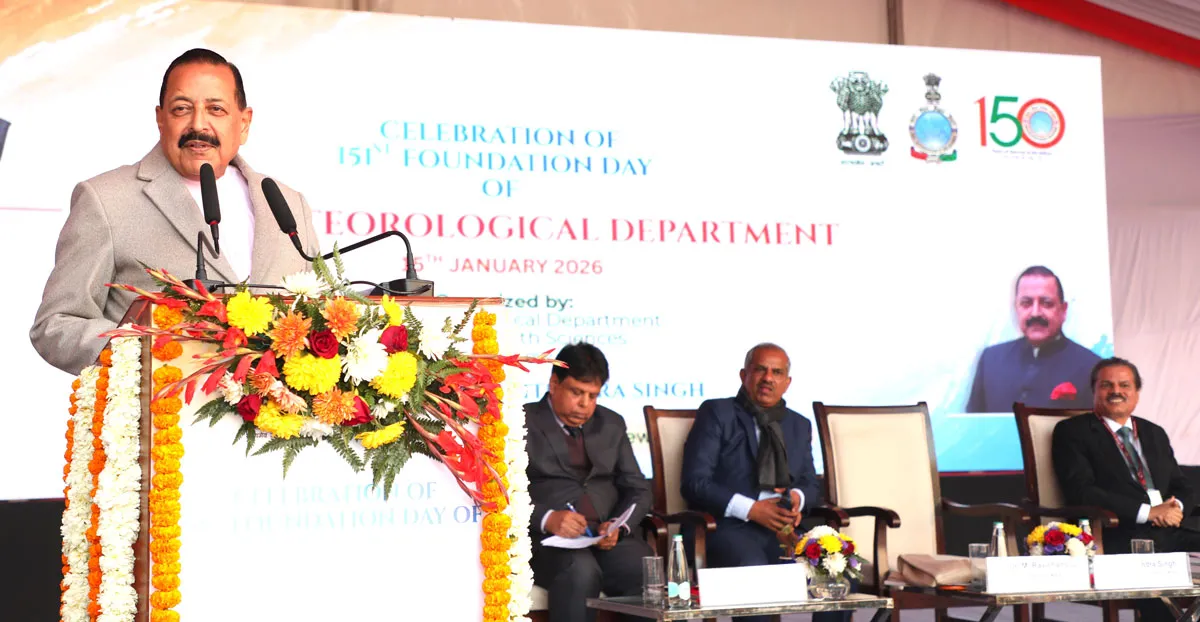
Union Minister Dr Jitendra Singh has announced a major expansion of India’s urban weather observation network with the deployment of 200 Automatic Weather Stations (AWS) across four major metropolitan cities.

Under the plan, 50 AWS each will be installed in Delhi, Mumbai, Chennai and Pune during 2026 to strengthen hyper-local, real-time forecasting and improve disaster preparedness in densely populated urban centres.

Speaking at the 151st Foundation Day of the India Meteorological Department (IMD), Dr Singh said the dense AWS network will provide granular spatial data, enabling more accurate prediction of sudden rainfall, thunderstorms, heatwaves and rapid pressure variations. Such high-resolution data, he noted, will support better planning in agriculture, aviation, public safety and urban management.

Highlighting IMD’s transformation, the Minister said forecast accuracy has improved by more than 40 to 50 per cent over earlier decades. Cyclone track prediction accuracy has risen by nearly 35 to 40 per cent, while errors in monthly and seasonal forecasts have reduced from around 7.5 per cent to nearly 2.5 per cent, driven by technological upgrades and sustained institutional support.

Dr Singh described Mission Mausam, launched by Prime Minister Narendra Modi, as a landmark initiative underscoring the government’s priority for advanced meteorological science and climate services.

India has also emerged as a regional provider of weather and disaster support, sharing satellite-based alerts and forecasting assistance with neighbouring countries including Bangladesh, Nepal, Bhutan and Sri Lanka.

Over the past decade, IMD has nearly tripled its radar coverage, now covering around 87 per cent of India’s geographical area. The department has significantly expanded Doppler Weather Radars, radiation monitoring systems, aerosol networks and rainfall observation at district and block levels, enabling ultra-short-range forecasts accurate to within three hours.

The Minister also highlighted IMD’s transition to solar energy at its headquarters, which has reduced operational costs and contributed surplus electricity to the grid.

During the event, Dr Singh inaugurated a Model Observatory, a 3D-printed AWS and an Agro-AWS at the IMD campus, reflecting India’s push towards indigenous and cost-effective meteorological technologies.

Concluding his address, he said proposals are underway to establish Centres of Excellence and additional Regional Meteorological Centres across the country to further enhance IMD’s capacity and outreach.

Union Minister Dr Jitendra Singh has announced a major expansion of India’s urban weather observation network with the deployment of 200 Automatic Weather Stations (AWS) across four major metropolitan cities. Under the plan, 50 AWS each will be installed in Delhi, Mumbai, Chennai and Pune during 2026 to strengthen hyper-local, real-time forecasting and improve disaster preparedness in densely populated urban centres. Speaking at the 151st Foundation Day of the India Meteorological Department (IMD), Dr Singh said the dense AWS network will provide granular spatial data, enabling more accurate prediction of sudden rainfall, thunderstorms, heatwaves and rapid pressure variations. Such high-resolution data, he noted, will support better planning in agriculture, aviation, public safety and urban management. Highlighting IMD’s transformation, the Minister said forecast accuracy has improved by more than 40 to 50 per cent over earlier decades. Cyclone track prediction accuracy has risen by nearly 35 to 40 per cent, while errors in monthly and seasonal forecasts have reduced from around 7.5 per cent to nearly 2.5 per cent, driven by technological upgrades and sustained institutional support. Dr Singh described Mission Mausam, launched by Prime Minister Narendra Modi, as a landmark initiative underscoring the government’s priority for advanced meteorological science and climate services. India has also emerged as a regional provider of weather and disaster support, sharing satellite-based alerts and forecasting assistance with neighbouring countries including Bangladesh, Nepal, Bhutan and Sri Lanka. Over the past decade, IMD has nearly tripled its radar coverage, now covering around 87 per cent of India’s geographical area. The department has significantly expanded Doppler Weather Radars, radiation monitoring systems, aerosol networks and rainfall observation at district and block levels, enabling ultra-short-range forecasts accurate to within three hours. The Minister also highlighted IMD’s transition to solar energy at its headquarters, which has reduced operational costs and contributed surplus electricity to the grid. During the event, Dr Singh inaugurated a Model Observatory, a 3D-printed AWS and an Agro-AWS at the IMD campus, reflecting India’s push towards indigenous and cost-effective meteorological technologies. Concluding his address, he said proposals are underway to establish Centres of Excellence and additional Regional Meteorological Centres across the country to further enhance IMD’s capacity and outreach.

Next Story
Real Estate

Trident Realty Launches 125-Acre Integrated Township In Panipat

Trident Realty has announced the launch of Trident Parktown, a premium integrated township spread over approximately 125 acres in Sectors 19A and 40, Panipat. Marking the developer’s strategic entry into the city, the project involves a total planned investment of around Rs 12 billion.Phase 1 of Trident Parktown will offer over 400 residential plots, with sizes starting from 200 sq yds. The township is planned as a mixed-use development comprising residential plots, independent floors, group housing, and retail and commercial spaces, aimed at meeting the region’s evolving lifestyle and hou..

Next Story
Infrastructure Transport

Concord Wins NTPC Order For World’s Largest Hydrogen Locomotive

Concord Control Systems has secured an order from NTPC Limited to develop the world’s largest 3,100 HP hydrogen-fuelled locomotive propulsion system, marking a global first in high-horsepower hydrogen rail technology. The Rs 470 million order has been awarded to Concord’s wholly owned subsidiary, Advance Rail Controls  (ARCPL), in collaboration with Railway Engineering Works.The project will convert an existing diesel locomotive into a 3,100 HP hydrogen-powered engine, the highest-ever horsepower conversion globally. Until now, hydrogen rail systems internationally have been limited t..

Next Story
Real Estate

Signature Global Signs Rs 380 Cr Pact for Seismic Safety Tech

Signature Global has signed a Rs 3.8 billion memorandum of understanding with Indo-Italian joint venture CECO Hirun to implement advanced earthquake-resistance technology across its projects over the next 15 years. The initiative is aimed at strengthening structural safety and occupant comfort in high-rise developments, particularly in seismic-prone regions such as Delhi-NCR, which falls under Seismic Zone IV.As Indian cities continue to grow vertically, buildings are increasingly exposed to dynamic forces including seismic activity, strong winds and temperature variations. To address these ch..

Advertisement

Subscribe to Our Newsletter

Get daily newsletters around different themes from Construction world.

STAY CONNECTED

Advertisement

Advertisement

Advertisement

Advertisement

Open In App