Kumaraswamy Urges Tech Adoption To Boost Steel Competitiveness
ECONOMY & POLICY

Kumaraswamy Urges Tech Adoption To Boost Steel Competitiveness

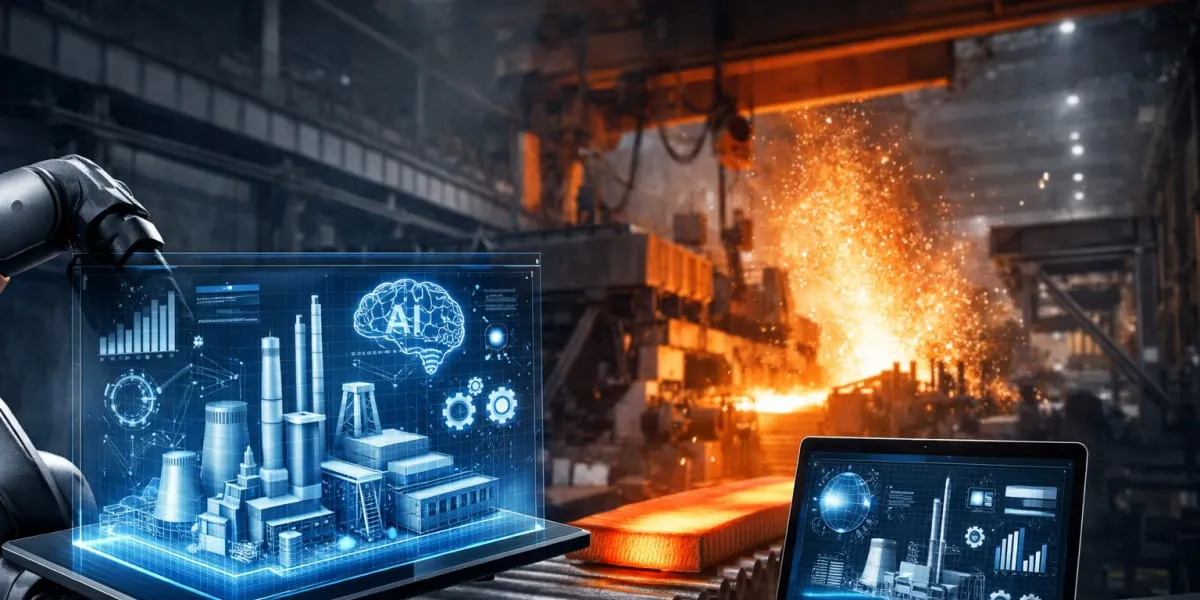
Union Steel Minister HD Kumaraswamy urged the steel industry to embrace emerging technologies to remain globally competitive and boost productivity at Chintan Shivir 2026 convened by the Ministry of Steel in the national capital. He said the future of the sector would depend not only on production capacity but on intelligent ecosystems that link public and private participants. The minister identified artificial intelligence, machine learning, industrial internet of things, digital twins, robotics and advanced data analytics as technologies reshaping steel manufacturing.

Adoption of these technologies was said to deliver gains in throughput and operational efficiency while aiding decarbonisation and export competitiveness. Digitalisation and automation enable predictive maintenance that identifies equipment faults before failure and reduces unplanned downtime. Automation also lowers human error and enhances workplace safety in plants.

The government is aiming for 300 million tonne (mn t) steel capacity by 2030 and 400 mn t by 2035, driven by domestic fundamentals. Large scale infrastructure, manufacturing growth under Make in India, renewable energy expansion and rapid urbanisation were cited as demand drivers. The outlook was described as promising but dependent on securing raw materials and modernising operations.

The minister characterised digitalisation as a foundational cornerstone for long term survival and growth of the sector. He emphasised that technology must be customised and integrated to plant level needs and value chains. The steel secretary said the tools and solutions exist and that implementation and adaptation are now the primary tasks for industry.

Policy support and private investment will be required to scale pilot projects into full deployments and to build workforce capability for intelligent systems. Wider data driven models can support export competitiveness while helping meet sustainability commitments. Stakeholders were urged to prioritise adoption, integration and skill development so that the sector captures productivity and safety gains offered by digitalisation.

"Join industry leaders at RAHSTA Expo, India's premier platform for roads, highways and traffic infrastructure. Register now to explore innovations, network with experts and shape the future of mobility."

Union Steel Minister HD Kumaraswamy urged the steel industry to embrace emerging technologies to remain globally competitive and boost productivity at Chintan Shivir 2026 convened by the Ministry of Steel in the national capital. He said the future of the sector would depend not only on production capacity but on intelligent ecosystems that link public and private participants. The minister identified artificial intelligence, machine learning, industrial internet of things, digital twins, robotics and advanced data analytics as technologies reshaping steel manufacturing. Adoption of these technologies was said to deliver gains in throughput and operational efficiency while aiding decarbonisation and export competitiveness. Digitalisation and automation enable predictive maintenance that identifies equipment faults before failure and reduces unplanned downtime. Automation also lowers human error and enhances workplace safety in plants. The government is aiming for 300 million tonne (mn t) steel capacity by 2030 and 400 mn t by 2035, driven by domestic fundamentals. Large scale infrastructure, manufacturing growth under Make in India, renewable energy expansion and rapid urbanisation were cited as demand drivers. The outlook was described as promising but dependent on securing raw materials and modernising operations. The minister characterised digitalisation as a foundational cornerstone for long term survival and growth of the sector. He emphasised that technology must be customised and integrated to plant level needs and value chains. The steel secretary said the tools and solutions exist and that implementation and adaptation are now the primary tasks for industry. Policy support and private investment will be required to scale pilot projects into full deployments and to build workforce capability for intelligent systems. Wider data driven models can support export competitiveness while helping meet sustainability commitments. Stakeholders were urged to prioritise adoption, integration and skill development so that the sector captures productivity and safety gains offered by digitalisation.

Next Story
Infrastructure Transport

Third Railway Line Between Tatanagar And Adityapur Likely By September

The third railway line between Tatanagar and Adityapur is expected to be commissioned by September as work on the corridor advances, according to railway sources. The project to add a fourth line on the busy route is progressing and has been allocated Rs 50.89 billion (bn) in funding. The allocation underscores the focus on increasing capacity and easing congestion on the corridor. Relevant timetables are being adjusted to integrate the new capacity into regular operations. Construction activity has involved track laying, formation work and signalling upgrades along strategic stretches, with m..

Next Story
Infrastructure Transport

Indian Railways Approves Rs 2.7 bn Kavach Rollout in Odisha

Indian Railways has approved a Rs 2.7 billion (Rs 2.7 bn) plan to install the Kavach train collision avoidance system on 631 route kilometres in the East Coast Railway zone. The Ministry of Railways said the work will form part of a wider Kavach deployment programme that relies on an LTE based communication backbone rather than a standalone installation. The approval marks the latest stage in the steady expansion of the indigenous safety technology across the national network. The decision aims to enhance safety and reliability on corridors serving Odisha and adjoining areas. The project will ..

Next Story
Infrastructure Transport

Indian Railways Accelerates Modernisation Drive

Indian Railways utilised nearly 30 per cent of its capital expenditure budget for FY2026-27 within the first two months of the financial year, spending more than Rs 840 billion (bn) in April and May against a planned outlay of Rs 2.93 trillion (tn) for the year. The Union Budget allocated Rs 2.93 tn in total capex, comprising Rs 2.81 tn through gross budgetary support and Rs 120 bn from extra-budgetary resources. The early absorption indicates robust project execution and an aggressive infrastructure push. A significant share of the spending is being channelled towards track infrastructure, in..

Advertisement

Subscribe to Our Newsletter

Get daily newsletters around different themes from Construction world.

STAY CONNECTED

Advertisement

Advertisement

Advertisement