Ministry Of Earth Sciences And Puducherry Sign MoU For Blue Economy
ECONOMY & POLICY

Ministry Of Earth Sciences And Puducherry Sign MoU For Blue Economy

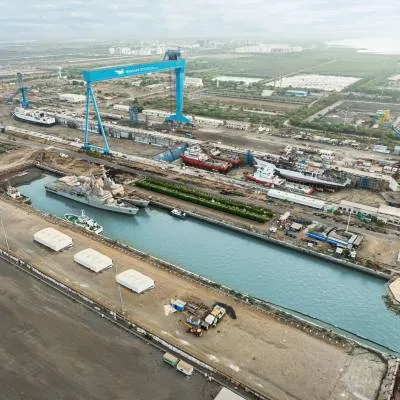
The Ministry of Earth Sciences (MoES) and the Government of Puducherry have signed a memorandum of understanding to strengthen the blue economy and improve coastal resilience. The agreement establishes a framework of cooperation across six strategic areas that aim to support sustainable development and climate adaptation in coastal communities. The signing took place in New Delhi on 12 February 2026 and was attended by senior officials from both sides.

The memorandum identifies sustainable marine fisheries, offshore wind energy, desalination technologies, ocean climate advisory and real time monitoring, permanent coastal management and marine spatial planning as priority domains. Under sustainable marine fisheries MoES will support livelihoods by promoting deep sea fishing, seaweed cultivation and by helping to identify migratory routes and productive fishing grounds. The offshore wind work will include feasibility studies and technical assistance to diversify the energy portfolio towards renewables while desalination efforts will focus on deploying seawater desalination plants to address freshwater scarcity. The climate advisory component will establish observation infrastructure and forecasting systems to support climate resilient planning.

Implementation arrangements will see designation of nodal officers and the establishment of joint working groups to oversee specific projects and monitor progress. The MoU has an initial validity of five years and will be subject to at least annual progress reviews to ensure timely delivery. Representatives from the Deep Ocean Mission, the National Institute of Ocean Technology and other MoES divisions and Puducherry administration were present at the event.

The partnership is expected to deliver science driven shoreline monitoring, erosion control measures and upgraded marine spatial planning that integrates offshore wind and resource mapping to support multiple marine sectors. Technical support for desalination and renewable energy projects will aim to enhance water security and diversify the local energy mix, thereby supporting livelihoods and resilience. MoES indicated that the collaboration will lay a foundation for a robust and sustainable blue economy in the region.

The Ministry of Earth Sciences (MoES) and the Government of Puducherry have signed a memorandum of understanding to strengthen the blue economy and improve coastal resilience. The agreement establishes a framework of cooperation across six strategic areas that aim to support sustainable development and climate adaptation in coastal communities. The signing took place in New Delhi on 12 February 2026 and was attended by senior officials from both sides. The memorandum identifies sustainable marine fisheries, offshore wind energy, desalination technologies, ocean climate advisory and real time monitoring, permanent coastal management and marine spatial planning as priority domains. Under sustainable marine fisheries MoES will support livelihoods by promoting deep sea fishing, seaweed cultivation and by helping to identify migratory routes and productive fishing grounds. The offshore wind work will include feasibility studies and technical assistance to diversify the energy portfolio towards renewables while desalination efforts will focus on deploying seawater desalination plants to address freshwater scarcity. The climate advisory component will establish observation infrastructure and forecasting systems to support climate resilient planning. Implementation arrangements will see designation of nodal officers and the establishment of joint working groups to oversee specific projects and monitor progress. The MoU has an initial validity of five years and will be subject to at least annual progress reviews to ensure timely delivery. Representatives from the Deep Ocean Mission, the National Institute of Ocean Technology and other MoES divisions and Puducherry administration were present at the event. The partnership is expected to deliver science driven shoreline monitoring, erosion control measures and upgraded marine spatial planning that integrates offshore wind and resource mapping to support multiple marine sectors. Technical support for desalination and renewable energy projects will aim to enhance water security and diversify the local energy mix, thereby supporting livelihoods and resilience. MoES indicated that the collaboration will lay a foundation for a robust and sustainable blue economy in the region.

Related Stories

Gold Stories

Next Story
Infrastructure Urban

KONE Opens India's First Digital Experience Centre in Pune

KONE, a global elevator and escalator manufacturer, has inaugurated its first Digital Experience Centre (DEC) in India, located in Pune. The facility aims to showcase how artificial intelligence (AI), connectivity and data-driven technologies can enhance customer experiences and improve building operations.The centre was inaugurated by Jussi Herlin, Executive Vice Chair, KONE Corporation; Philippe Delorme, President and CEO, KONE; and Nandan Nilekani, Co-founder and Chairman of the Board, Infosys.Designed as an interactive customer environment, the facility demonstrates digital solutions cover..

Next Story
Infrastructure Urban

CII GreenCo Launches Circularity Guidelines for Indian Industry

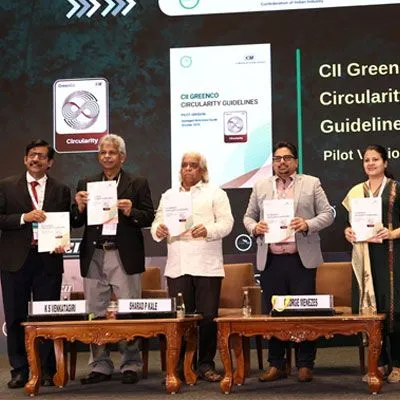
The Confederation of Indian Industry (CII) GreenCo Council has launched the CII GreenCo Circularity Guidelines – Pilot Version at the 17th CII GreenCo Waste & Resource Management Summit 2026 in Chennai. The initiative aims to strengthen resource efficiency, waste reduction and circular economy practices across Indian manufacturing and process industries.The guidelines introduce a structured framework with circularity indices covering raw materials, consumables, packaging and other resource inputs. These indicators will help industries assess existing practices, identify opportunities to ..

Next Story
Infrastructure Energy

Global Electronics Association Launches IPC-1783-CO2E Standard

The Global Electronics Association has introduced IPC-1783-CO2E, a new international standard aimed at improving consistency, transparency and comparability in product carbon footprint reporting across the electronics manufacturing industry.The standard, titled International Standard for Data Collection and Reporting of CO2 Equivalent (CO2e) Emissions for the Electronics Manufacturing Supply Chain, provides industry-specific guidance for collecting, estimating and reporting carbon emissions data.With increasing regulatory requirements and customer expectations, electronics manufacturers face c..

Advertisement

Subscribe to Our Newsletter

Get daily newsletters around different themes from Construction world.

STAY CONNECTED

Advertisement

SPECIAL OFFER
QR Code