MSME Implements Cluster Development Programme Nationwide
ECONOMY & POLICY

MSME Implements Cluster Development Programme Nationwide

The Ministry of Micro, Small and Medium Enterprises is implementing the Micro and Small Enterprises Cluster Development Programme (MSE-CDP) nationwide. The scheme aims to enhance the productivity and competitiveness of micro and small enterprises through a cluster development approach by extending government grants to establish Common Facility Centres (CFCs) and to develop or upgrade infrastructure in industrial estates and flatted factory complexes. The scheme operates on a demand driven basis and receives proposals from state governments and Union Territories according to local needs.

A total of 242 CFCs have been approved under the MSE-CDP, including six in the State of Punjab, while 513 clusters have been approved under the Scheme of Fund for Regeneration of Traditional Industries (SFURTI), including two in Punjab. Details of state-wise approvals are recorded in the annexure accompanying the release. Two of the Punjab CFCs are in the textile and automobile sectors located in Ludhiana and Patiala.

The Common Facility Centres are designed to enhance sustainability, competitiveness and overall growth of micro and small enterprises by addressing shared challenges in technology upgradation, skill development, quality improvement and market access. For implementation of CFC projects, the ministry provided Rs. 4,389.4 mn during the last five years. The MSE-CDP is demand led and prioritises interventions that can deliver collective benefits for cluster members.

The Credit Guarantee Scheme (CGS) for micro and small enterprises, implemented through the Credit Guarantee Fund Trust for Micro and Small Enterprises (CGTMSE), provides guarantee coverage for loans with a ceiling of Rs. 100 mn from one April 2026. A special provision guarantees unsecured composite credit up to Rs. 2 mn for informal micro enterprises with coverage of 85 per cent. The ministry has notified that certificates issued on the Udyam Assist platform for informal micro enterprises shall be treated at par with Udyam registration certificates for Priority Sector Lending and the information was provided by the Minister of State in a written reply to Rajya Sabha.

The Ministry of Micro, Small and Medium Enterprises is implementing the Micro and Small Enterprises Cluster Development Programme (MSE-CDP) nationwide. The scheme aims to enhance the productivity and competitiveness of micro and small enterprises through a cluster development approach by extending government grants to establish Common Facility Centres (CFCs) and to develop or upgrade infrastructure in industrial estates and flatted factory complexes. The scheme operates on a demand driven basis and receives proposals from state governments and Union Territories according to local needs. A total of 242 CFCs have been approved under the MSE-CDP, including six in the State of Punjab, while 513 clusters have been approved under the Scheme of Fund for Regeneration of Traditional Industries (SFURTI), including two in Punjab. Details of state-wise approvals are recorded in the annexure accompanying the release. Two of the Punjab CFCs are in the textile and automobile sectors located in Ludhiana and Patiala. The Common Facility Centres are designed to enhance sustainability, competitiveness and overall growth of micro and small enterprises by addressing shared challenges in technology upgradation, skill development, quality improvement and market access. For implementation of CFC projects, the ministry provided Rs. 4,389.4 mn during the last five years. The MSE-CDP is demand led and prioritises interventions that can deliver collective benefits for cluster members. The Credit Guarantee Scheme (CGS) for micro and small enterprises, implemented through the Credit Guarantee Fund Trust for Micro and Small Enterprises (CGTMSE), provides guarantee coverage for loans with a ceiling of Rs. 100 mn from one April 2026. A special provision guarantees unsecured composite credit up to Rs. 2 mn for informal micro enterprises with coverage of 85 per cent. The ministry has notified that certificates issued on the Udyam Assist platform for informal micro enterprises shall be treated at par with Udyam registration certificates for Priority Sector Lending and the information was provided by the Minister of State in a written reply to Rajya Sabha.

Related Stories

Gold Stories

Next Story
Infrastructure Urban

KONE Opens India's First Digital Experience Centre in Pune

KONE, a global elevator and escalator manufacturer, has inaugurated its first Digital Experience Centre (DEC) in India, located in Pune. The facility aims to showcase how artificial intelligence (AI), connectivity and data-driven technologies can enhance customer experiences and improve building operations.The centre was inaugurated by Jussi Herlin, Executive Vice Chair, KONE Corporation; Philippe Delorme, President and CEO, KONE; and Nandan Nilekani, Co-founder and Chairman of the Board, Infosys.Designed as an interactive customer environment, the facility demonstrates digital solutions cover..

Next Story
Infrastructure Urban

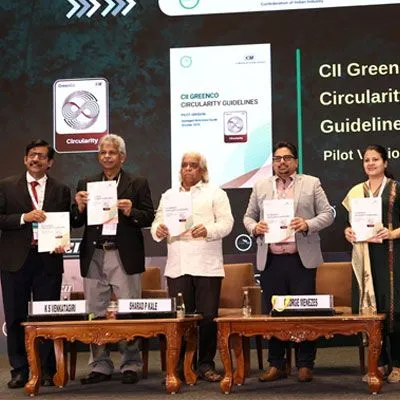
CII GreenCo Launches Circularity Guidelines for Indian Industry

The Confederation of Indian Industry (CII) GreenCo Council has launched the CII GreenCo Circularity Guidelines – Pilot Version at the 17th CII GreenCo Waste & Resource Management Summit 2026 in Chennai. The initiative aims to strengthen resource efficiency, waste reduction and circular economy practices across Indian manufacturing and process industries.The guidelines introduce a structured framework with circularity indices covering raw materials, consumables, packaging and other resource inputs. These indicators will help industries assess existing practices, identify opportunities to ..

Next Story
Infrastructure Energy

Global Electronics Association Launches IPC-1783-CO2E Standard

The Global Electronics Association has introduced IPC-1783-CO2E, a new international standard aimed at improving consistency, transparency and comparability in product carbon footprint reporting across the electronics manufacturing industry.The standard, titled International Standard for Data Collection and Reporting of CO2 Equivalent (CO2e) Emissions for the Electronics Manufacturing Supply Chain, provides industry-specific guidance for collecting, estimating and reporting carbon emissions data.With increasing regulatory requirements and customer expectations, electronics manufacturers face c..

Advertisement

Subscribe to Our Newsletter

Get daily newsletters around different themes from Construction world.

STAY CONNECTED

Advertisement

SPECIAL OFFER
QR Code