+
Raksha Mantri Inaugurates Missile Integration Facility At BEL
ECONOMY & POLICY

Raksha Mantri Inaugurates Missile Integration Facility At BEL

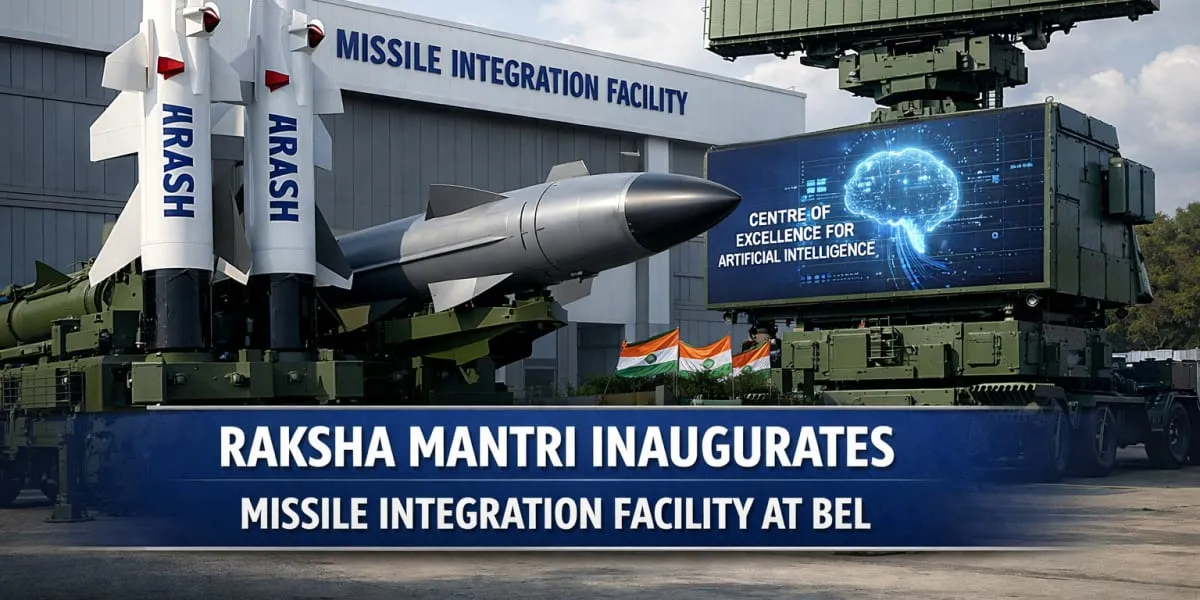
Raksha Mantri Shri Rajnath Singh visited Bharat Electronics Limited (BEL) in Bengaluru on February 16, 2026, to inaugurate the Missile Integration facility and to flag off the Akash third and fourth regiment combat systems while unveiling the Mountain Fire Control Radar. He also remotely inaugurated the Centre of Excellence for Artificial Intelligence (CoE-AI) in Pune and formally launched BEL's AI policy. The visit underscored the emphasis on indigenous capability development across defence sectors.

During a detailed briefing, he was apprised of advanced indigenous defence technologies and AI based solutions developed by Indian start ups, which highlighted the growing emphasis on innovation and indigenisation in the defence ecosystem. He commended BEL for progress in electronic warfare systems, avionics, naval platforms, electro optics, and tank electronics and observed that integrated systems and real time data sharing were enhancing decision support and network centric operations. The brief indicated that these capabilities were taking combat effectiveness to a new level.

Officials outlined ongoing research and development aligned with major national defence programmes including Quick Reaction Surface to Air Missile Systems, Light Combat Aircraft Mark II, Advanced Medium Combat Aircraft and Project Kusha, as well as counter drone and naval weapon control systems. The briefing noted that indigenous R and D initiatives were bolstering operational preparedness across land, air, naval and strategic domains while reducing dependence on foreign technologies. It was highlighted that indigenously developed air defence and anti drone systems had been effectively utilised to neutralise threats during Operation Sindoor and that advances in threat prediction and early warning using AI were instilling operational confidence.

He underlined that AI and quantum computing were already influencing real time decision making, autonomous systems, cyber defence and precision operations and exhorted BEL, other defence public sector undertakings and industry partners to remain at the technological forefront. He encouraged collaboration between the R and D community, start ups, industry and academia for agile product development, cross disciplinary innovation and rapid prototyping to support the vision of a Viksit Bharat. Senior ministry and BEL officials, start ups and young scientists participated in the event.

Raksha Mantri Shri Rajnath Singh visited Bharat Electronics Limited (BEL) in Bengaluru on February 16, 2026, to inaugurate the Missile Integration facility and to flag off the Akash third and fourth regiment combat systems while unveiling the Mountain Fire Control Radar. He also remotely inaugurated the Centre of Excellence for Artificial Intelligence (CoE-AI) in Pune and formally launched BEL's AI policy. The visit underscored the emphasis on indigenous capability development across defence sectors. During a detailed briefing, he was apprised of advanced indigenous defence technologies and AI based solutions developed by Indian start ups, which highlighted the growing emphasis on innovation and indigenisation in the defence ecosystem. He commended BEL for progress in electronic warfare systems, avionics, naval platforms, electro optics, and tank electronics and observed that integrated systems and real time data sharing were enhancing decision support and network centric operations. The brief indicated that these capabilities were taking combat effectiveness to a new level. Officials outlined ongoing research and development aligned with major national defence programmes including Quick Reaction Surface to Air Missile Systems, Light Combat Aircraft Mark II, Advanced Medium Combat Aircraft and Project Kusha, as well as counter drone and naval weapon control systems. The briefing noted that indigenous R and D initiatives were bolstering operational preparedness across land, air, naval and strategic domains while reducing dependence on foreign technologies. It was highlighted that indigenously developed air defence and anti drone systems had been effectively utilised to neutralise threats during Operation Sindoor and that advances in threat prediction and early warning using AI were instilling operational confidence. He underlined that AI and quantum computing were already influencing real time decision making, autonomous systems, cyber defence and precision operations and exhorted BEL, other defence public sector undertakings and industry partners to remain at the technological forefront. He encouraged collaboration between the R and D community, start ups, industry and academia for agile product development, cross disciplinary innovation and rapid prototyping to support the vision of a Viksit Bharat. Senior ministry and BEL officials, start ups and young scientists participated in the event.

Next Story
Infrastructure Urban

ABB to Invest Rs 6.25 Billion to Expand India Manufacturing

ABB recently announced plans to invest approximately Rs 6.25 billion ($75 million) in India during 2026 to expand its manufacturing footprint and research and development capabilities. The investment follows more than $35 million spent in 2025 and reflects the company’s continued focus on strengthening its ‘local-for-local’ strategy in the country.The investment will support ABB’s Electrification, Motion and Automation businesses and expand manufacturing capacity for infrastructure sectors such as renewable energy, metro rail, data centres and industrial applications. Approximately 300..

Next Story
Equipment

Six WOLFF Cranes Handle 60,000 m³ Concrete for German Hospital

Six WOLFF tower cranes are playing a key role in constructing a new hospital complex in Memmingen, Germany, supporting large-scale material handling for the project. The facility is being built on a 7.7-hectare site and will feature six floors, around 480 beds and a gross floor area exceeding 75,000 sq m.Building shell works began recently in February 2025. One WOLFF 6531.12 Cross crane supported early site preparation before being dismantled in autumn 2025, while five remaining cranes continue operations. Over an average deployment period of 16 months, the cranes are expected to move approxim..

Next Story
Equipment

REC Funds Rs 115.6 Million CSR Support for Bihar Eye Hospital

REC recently committed Rs 115.6 million under its Corporate Social Responsibility (CSR) programme for the procurement of clinical and non-clinical equipment at Sankara Eye Hospital in Saharsa, Bihar. The initiative aims to strengthen healthcare infrastructure and improve access to specialised eye care services in the region.A Memorandum of Agreement (MoA) was recently signed between Pradeep Fellows, Executive Director (CSR), REC Limited, and Wg Cdr V. Shankar (Retd), Trustee and Executive Director of Sankara Eye Hospital, at the REC office in the SCOPE Complex, New Delhi.The support is expecte..

Advertisement

Subscribe to Our Newsletter

Get daily newsletters around different themes from Construction world.

STAY CONNECTED

Advertisement

Advertisement

Advertisement