TCS and GitLab Team Up to Orchestrate AI for DevSecOps
ECONOMY & POLICY

TCS and GitLab Team Up to Orchestrate AI for DevSecOps

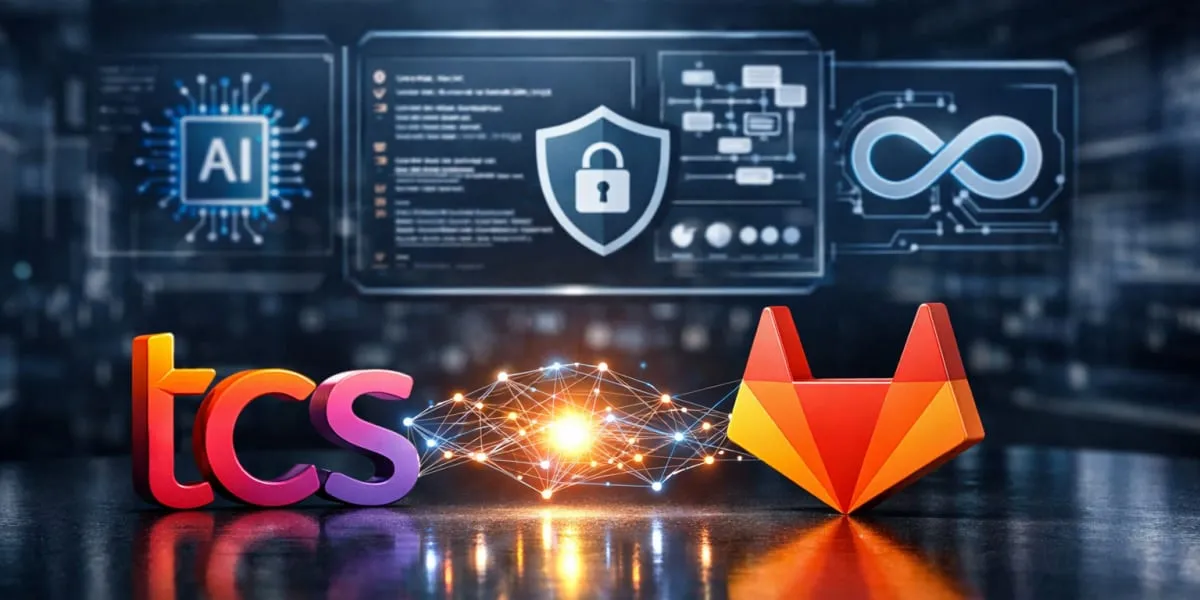
Tata Consultancy Services has partnered with GitLab to deploy intelligent orchestration and agentic artificial intelligence automation to accelerate software innovation at scale across the software development lifecycle. The collaboration will combine TCS's AI-led enterprise transformation capabilities with GitLab's pre-built AI agents and orchestration features to help customers accelerate software delivery, enhance security, and maintain governance and guardrails. The partners will implement the GitLab Duo Agent Platform to orchestrate AI agents in the full context of organisations' standards and workflows.

GitLab's vice-president of global ecosystems noted that TCS brings industry experience and global scale necessary to maximise the value of the Duo Agent Platform, and TCS's head of AI practice said the alliance seeks to make AI real for enterprises by introducing AI-native DevSecOps capabilities. The platform provides agentic chat, foundational agents prebuilt by GitLab experts, custom agents to automate complex development tasks, external agent integration with leading AI tools, and governance and security controls. TCS will develop industry-specific AI workflow templates and pre-built agents to accelerate time-to-value.

The partnership will also modernise legacy development practices and help consolidate fragmented tool chains to reduce complexity while improving visibility, security, and compliance across the SDLC. It will support large-scale migrations and transformations for global enterprises with complex multi-team environments and is expected to benefit telecommunications, media, banking, retail, manufacturing, healthcare, and public sector organisations needing rapid rollout of services and AI-driven customer experiences at scale. TCS will combine proven methodologies with GitLab's scalable architecture to create seamless automated workflows from planning to production.

TCS will offer assessments, migration roadmaps, custom agent development, industry accelerators, managed platform services, and Centres of Excellence for enablement, change management, and enterprise support. GitLab reports more than 50 million (50 mn) registered users and more than 50 per cent of the Fortune 100 trust the platform to ship secure software faster. TCS operates across 55 countries and 202 service delivery centres and reported consolidated revenues of over US $30 billion (US $30 bn) in the fiscal year ended 31 March 2025.

Tata Consultancy Services has partnered with GitLab to deploy intelligent orchestration and agentic artificial intelligence automation to accelerate software innovation at scale across the software development lifecycle. The collaboration will combine TCS's AI-led enterprise transformation capabilities with GitLab's pre-built AI agents and orchestration features to help customers accelerate software delivery, enhance security, and maintain governance and guardrails. The partners will implement the GitLab Duo Agent Platform to orchestrate AI agents in the full context of organisations' standards and workflows. GitLab's vice-president of global ecosystems noted that TCS brings industry experience and global scale necessary to maximise the value of the Duo Agent Platform, and TCS's head of AI practice said the alliance seeks to make AI real for enterprises by introducing AI-native DevSecOps capabilities. The platform provides agentic chat, foundational agents prebuilt by GitLab experts, custom agents to automate complex development tasks, external agent integration with leading AI tools, and governance and security controls. TCS will develop industry-specific AI workflow templates and pre-built agents to accelerate time-to-value. The partnership will also modernise legacy development practices and help consolidate fragmented tool chains to reduce complexity while improving visibility, security, and compliance across the SDLC. It will support large-scale migrations and transformations for global enterprises with complex multi-team environments and is expected to benefit telecommunications, media, banking, retail, manufacturing, healthcare, and public sector organisations needing rapid rollout of services and AI-driven customer experiences at scale. TCS will combine proven methodologies with GitLab's scalable architecture to create seamless automated workflows from planning to production. TCS will offer assessments, migration roadmaps, custom agent development, industry accelerators, managed platform services, and Centres of Excellence for enablement, change management, and enterprise support. GitLab reports more than 50 million (50 mn) registered users and more than 50 per cent of the Fortune 100 trust the platform to ship secure software faster. TCS operates across 55 countries and 202 service delivery centres and reported consolidated revenues of over US $30 billion (US $30 bn) in the fiscal year ended 31 March 2025.

Next Story
Infrastructure Urban

HVAC: Cool Advice

India’s Cooling Action Plan forecasts cooling demand to grow nearly eight times in the next 20 years. In light of the fact that cooling is no longer just a comfort product but lies at the intersection of national development, public health, climate action and energy security, this means the HVAC industry shoulders a very serious responsibility. Mihir Sanghavi, Managing Partner, Auro Engineering Company, Immediate Past President RATA, Secretary, ISHRAE, and Regional Representative, ASHRAE Region XV, describes that responsibility as “identifying a system that can serve for 15 to 20 years o..

Next Story
Infrastructure Urban

Wanted: 2 Million Workers

Construction, India’s second largest employer by industry, employs about 50 million workers but could additionally absorb another 40 million workers, according to estimates shared by the Construction Skill Development Council of India (CSDCI) in 2023. Within this, citing trade estimates, Rahul Bahl, Managing Director, Krishna Buildestates, says the shortage of trained, skilled workers is currently about 2 million, and is expected to rise to 5 million by 2030.Not only is the construction industry struggling to find workers but construction labour productivity in India significantly trails glo..

Next Story
Infrastructure Transport

The Critical Path

In Ircon International Ltd v. Afcons Infrastructure Ltd, OMP (Comm) 279/2019, the Delhi High Court examined how delay and extension of time (‘EOT’) are to be assessed in construction contracts, particularly in the context of the ‘critical path’ while dealing with challenge to an arbitral award under Section 34 of the Arbitration and Conciliation Act 1996 (‘the Act’). The High Court’s observations regarding the critical path are of significant import for construction and infrastructure projects and related arbitration. The parties entered into a contract for construction of T..

Advertisement

Subscribe to Our Newsletter

Get daily newsletters around different themes from Construction world.

STAY CONNECTED

Advertisement

Advertisement

Advertisement