+
MahaMetro Unveils Land Use Plans for 500-Metre Metro Corridors
RAILWAYS & METRO RAIL

MahaMetro Unveils Land Use Plans for 500-Metre Metro Corridors

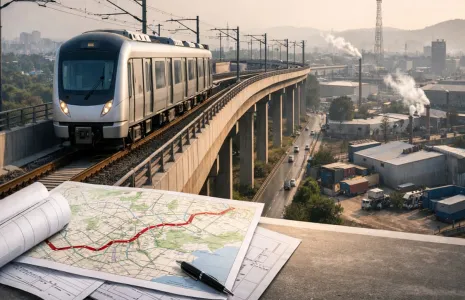
MahaMetro has begun preparing and implementing Land Use Action Plans under its Transit-Oriented Development policy to transform corridors within 500 metres of metro stations into dense growth hubs. The managing director, Shravan Hardikar, announced the initiative during the Global Capability Centres meeting at the Advantage Vidarbha event on Sunday. The plans aim to redesign station areas as modern urban hubs with improved multimodal connectivity and faster last-mile travel.

The Land Use Action Plans will encourage mixed-use development so that offices, colleges, shops, hospitals and homes are located close to public transport, supporting increased footfall and reduced commute times. Hardikar indicated that Global Capability Centres are likely to locate along these corridors owing to direct metro access. He emphasised that infrastructure alone is insufficient to attract and retain talent and that cities must offer a high quality of life.

The managing director highlighted that entertainment, cultural spaces and a lively city atmosphere are essential components of urban livability which influence where young professionals choose to work and live. He observed that people continue to migrate to larger cities because of superior social and lifestyle facilities despite challenges such as water shortages, and that creating this livability factor is central to Nagpur's growth. The approach links land use reforms with placemaking to bolster the city’s attractiveness.

Nagpur Improvement Trust chairman Sanjay Meena said the New Nagpur Business District is being developed to provide a clear commercial centre, with Indian and international experts contributing to the master plan. Meena outlined infrastructure planning for the next 20 years, including a new 140-km ring road, multimodal and industrial corridors, and reliable water and power supply. He added that organised land allotment and a fully online single-window approval system will simplify establishment for domestic and foreign companies.

MahaMetro has begun preparing and implementing Land Use Action Plans under its Transit-Oriented Development policy to transform corridors within 500 metres of metro stations into dense growth hubs. The managing director, Shravan Hardikar, announced the initiative during the Global Capability Centres meeting at the Advantage Vidarbha event on Sunday. The plans aim to redesign station areas as modern urban hubs with improved multimodal connectivity and faster last-mile travel. The Land Use Action Plans will encourage mixed-use development so that offices, colleges, shops, hospitals and homes are located close to public transport, supporting increased footfall and reduced commute times. Hardikar indicated that Global Capability Centres are likely to locate along these corridors owing to direct metro access. He emphasised that infrastructure alone is insufficient to attract and retain talent and that cities must offer a high quality of life. The managing director highlighted that entertainment, cultural spaces and a lively city atmosphere are essential components of urban livability which influence where young professionals choose to work and live. He observed that people continue to migrate to larger cities because of superior social and lifestyle facilities despite challenges such as water shortages, and that creating this livability factor is central to Nagpur's growth. The approach links land use reforms with placemaking to bolster the city’s attractiveness. Nagpur Improvement Trust chairman Sanjay Meena said the New Nagpur Business District is being developed to provide a clear commercial centre, with Indian and international experts contributing to the master plan. Meena outlined infrastructure planning for the next 20 years, including a new 140-km ring road, multimodal and industrial corridors, and reliable water and power supply. He added that organised land allotment and a fully online single-window approval system will simplify establishment for domestic and foreign companies.

Next Story
Infrastructure Urban

Implementation Status of Jal Jeevan Mission

Since August 2019 the Government has implemented Jal Jeevan Mission to provide assured potable water through household tap connections in rural India. At the start of the mission only 32.3 million (mn) rural households, representing 16.7 per cent, were reported to have tap water connections. States and union territories have reported that 125.8 mn additional rural households have since been provided with tap connections. As a result, of about 193.6 mn rural households roughly 158.2 mn, or 81.71 per cent, are reported to have tap water supply at home.\n\nThe State, district and village level st..

Next Story
Infrastructure Urban

Jal Jeevan Mission Reaches Eighty One Per Cent Rural Coverage

The Government reported substantial progress under the Jal Jeevan Mission, launched in August 2019 to provide tap water to every rural household. At launch only 32.3 million (mn) rural households had tap connections and states and Union territories reported provision of 125.8 mn additional households by March 2026. Consequently, out of about 193.6 mn rural households around 158.2 mn, or 81.71 per cent, are reported to have tap water at home. The Finance Minister announced extension of the mission until 2028 in the 2025-26 budget speech. The Swachh Bharat Mission Grameen, launched in October 20..

Next Story
Infrastructure Urban

Empowering Local Governance for Sustainable Rural Water Supply

The Ministry of Jal Shakti has aligned the Jal Jeevan Mission (JJM) with the 73rd Amendment to strengthen village level planning and community ownership of water supply. Gram Panchayats, village water and sanitation committees and Pani Samitis are to plan, implement, manage and maintain piped water systems, with gram sabha processes formalising handover and oversight. Implementation support agencies including non government organisations, community based organisations and self help groups have been empanelled to train local committees and promote women participation. Under JJM, the department ..

Advertisement

Subscribe to Our Newsletter

Get daily newsletters around different themes from Construction world.

STAY CONNECTED

Advertisement

Advertisement

Advertisement