Government Commits To Universal 4G In Villages And Faster 5G Rollout
ECONOMY & POLICY

Government Commits To Universal 4G In Villages And Faster 5G Rollout

Union Minister for Communications and Development of the North Eastern Region Jyotiraditya Scindia said the government is committed to extending digital connectivity to the remotest parts under the Vibrant Village Programme. He said the ministry is coordinating with state authorities and members of Parliament to resolve environmental, wildlife and right of way constraints that affect tower installation and fibre laying. Scindia highlighted Vijaynagar in Arunachal Pradesh as an example of areas being prioritised.

Minister of State Dr Chandra Sekhar Pemmasani said India is approaching universal four G coverage of villages and is seeing a rapid five G rollout. He reported that of nearly 640,000 villages about 631,000 have four G services and the remaining 10,000 are being connected under saturation projects in coming months. He noted that Bharat Sanchar Nigam Limited has deployed 100,000 indigenous towers and that about 500,000 villages have five G service.

Between April 2022 and March 2025 the department laid 850,284 route kilometres of optical fibre cable, bringing cumulative fibre length to 4,253,334 kilometres. Average mobile broadband download speed rose from 13.67 Mbps in March 2022 to 132.00 Mbps in December 2025 according to global indices, while regulatory data recorded latency under 75 milliseconds and cumulative downtime within two per cent. The number of four G and five G base transceiver stations rose from 1,691,304 to 2,559,704, reflecting a 51.33 per cent increase in network readiness.

Expanded backhaul and last mile infrastructure supported growth in digital services, with over 1,430 million (mn) Aadhaar numbers issued and more than 650.1 mn DigiLocker users, while the UMANG platform has recorded over 7,264.3 mn transactions. As of 31 December 2025 some 214,904 Gram Panchayats were service ready under BharatNet and around 634,955 of 644,131 villages have mobile connectivity, including 631,834 with four G, equivalent to 98.09 per cent coverage. Around 0.587 mn Common Service Centres were functional, of which 0.457 mn were at the Gram Panchayat level, and the rural digital literacy drive has reached 63.9 mn individuals.

Union Minister for Communications and Development of the North Eastern Region Jyotiraditya Scindia said the government is committed to extending digital connectivity to the remotest parts under the Vibrant Village Programme. He said the ministry is coordinating with state authorities and members of Parliament to resolve environmental, wildlife and right of way constraints that affect tower installation and fibre laying. Scindia highlighted Vijaynagar in Arunachal Pradesh as an example of areas being prioritised. Minister of State Dr Chandra Sekhar Pemmasani said India is approaching universal four G coverage of villages and is seeing a rapid five G rollout. He reported that of nearly 640,000 villages about 631,000 have four G services and the remaining 10,000 are being connected under saturation projects in coming months. He noted that Bharat Sanchar Nigam Limited has deployed 100,000 indigenous towers and that about 500,000 villages have five G service. Between April 2022 and March 2025 the department laid 850,284 route kilometres of optical fibre cable, bringing cumulative fibre length to 4,253,334 kilometres. Average mobile broadband download speed rose from 13.67 Mbps in March 2022 to 132.00 Mbps in December 2025 according to global indices, while regulatory data recorded latency under 75 milliseconds and cumulative downtime within two per cent. The number of four G and five G base transceiver stations rose from 1,691,304 to 2,559,704, reflecting a 51.33 per cent increase in network readiness. Expanded backhaul and last mile infrastructure supported growth in digital services, with over 1,430 million (mn) Aadhaar numbers issued and more than 650.1 mn DigiLocker users, while the UMANG platform has recorded over 7,264.3 mn transactions. As of 31 December 2025 some 214,904 Gram Panchayats were service ready under BharatNet and around 634,955 of 644,131 villages have mobile connectivity, including 631,834 with four G, equivalent to 98.09 per cent coverage. Around 0.587 mn Common Service Centres were functional, of which 0.457 mn were at the Gram Panchayat level, and the rural digital literacy drive has reached 63.9 mn individuals.

Related Stories

Gold Stories

Next Story
Infrastructure Urban

KONE Opens India's First Digital Experience Centre in Pune

KONE, a global elevator and escalator manufacturer, has inaugurated its first Digital Experience Centre (DEC) in India, located in Pune. The facility aims to showcase how artificial intelligence (AI), connectivity and data-driven technologies can enhance customer experiences and improve building operations.The centre was inaugurated by Jussi Herlin, Executive Vice Chair, KONE Corporation; Philippe Delorme, President and CEO, KONE; and Nandan Nilekani, Co-founder and Chairman of the Board, Infosys.Designed as an interactive customer environment, the facility demonstrates digital solutions cover..

Next Story
Infrastructure Urban

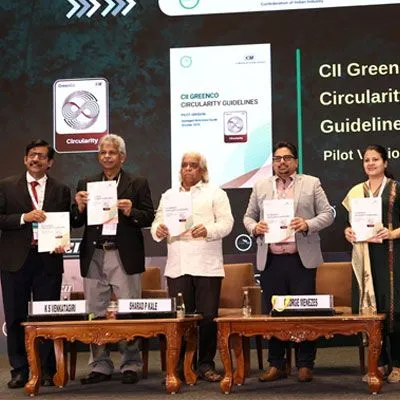
CII GreenCo Launches Circularity Guidelines for Indian Industry

The Confederation of Indian Industry (CII) GreenCo Council has launched the CII GreenCo Circularity Guidelines – Pilot Version at the 17th CII GreenCo Waste & Resource Management Summit 2026 in Chennai. The initiative aims to strengthen resource efficiency, waste reduction and circular economy practices across Indian manufacturing and process industries.The guidelines introduce a structured framework with circularity indices covering raw materials, consumables, packaging and other resource inputs. These indicators will help industries assess existing practices, identify opportunities to ..

Next Story
Infrastructure Energy

Global Electronics Association Launches IPC-1783-CO2E Standard

The Global Electronics Association has introduced IPC-1783-CO2E, a new international standard aimed at improving consistency, transparency and comparability in product carbon footprint reporting across the electronics manufacturing industry.The standard, titled International Standard for Data Collection and Reporting of CO2 Equivalent (CO2e) Emissions for the Electronics Manufacturing Supply Chain, provides industry-specific guidance for collecting, estimating and reporting carbon emissions data.With increasing regulatory requirements and customer expectations, electronics manufacturers face c..

Advertisement

Subscribe to Our Newsletter

Get daily newsletters around different themes from Construction world.

STAY CONNECTED

Advertisement

SPECIAL OFFER
QR Code