+
Prism Johnson Expands Range With Prism Chakachak Gypsum Plaster
ECONOMY & POLICY

Prism Johnson Expands Range With Prism Chakachak Gypsum Plaster

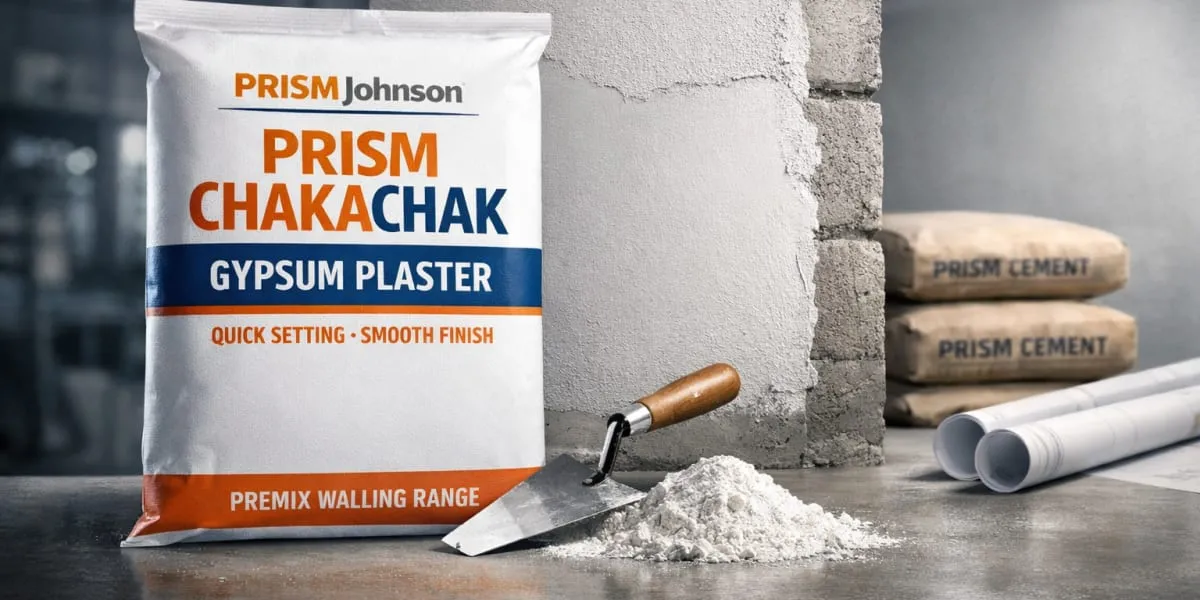
Prism Johnson Limited (Prism Johnson) has expanded its product range with the launch of Prism Chakachak Gypsum Plaster under its cement division, Prism Cement (the cement division). The move is intended to strengthen the company strategy of broadening its value added construction materials portfolio while leveraging an established distribution network. The plaster forms part of the Premix Walling Range and is presented as a lightweight, quick setting composite designed for internal wall and ceiling applications where a smooth, paint-ready finish is required.

It requires no water curing and is reported to reduce construction time and labour requirements, offering contractors time efficiencies and lower on site staffing needs. The formulation is described as having low shrinkage with minimal cracking potential, improving long term finish quality and reducing the need for remedial work. The plaster is naturally fire resistant and eco friendly and is promoted for providing thermal and acoustic insulation while adding minimal structural load, making it suitable for a range of residential and commercial projects.

Prism Cement has established a strong presence across Central India, including Uttar Pradesh, Madhya Pradesh and Bihar, supported by a dealer network of around 2,400 dealers. The company will make the plaster available across its operating regions through this distribution network, enabling local availability and supply chain continuity. The established channels are expected to facilitate market penetration and to offer builders and developers easier access to a broader set of interior finishing solutions.

The addition of gypsum plaster complements Prism Johnson product portfolio spanning cement, tiles, bathware, ready mix concrete and construction chemicals, reinforcing an integrated approach to building materials supply. The company anticipates that offering a wider range of value added products under one roof will support customer convenience and project coordination for both small scale and large scale construction work.

Prism Johnson Limited (Prism Johnson) has expanded its product range with the launch of Prism Chakachak Gypsum Plaster under its cement division, Prism Cement (the cement division). The move is intended to strengthen the company strategy of broadening its value added construction materials portfolio while leveraging an established distribution network. The plaster forms part of the Premix Walling Range and is presented as a lightweight, quick setting composite designed for internal wall and ceiling applications where a smooth, paint-ready finish is required. It requires no water curing and is reported to reduce construction time and labour requirements, offering contractors time efficiencies and lower on site staffing needs. The formulation is described as having low shrinkage with minimal cracking potential, improving long term finish quality and reducing the need for remedial work. The plaster is naturally fire resistant and eco friendly and is promoted for providing thermal and acoustic insulation while adding minimal structural load, making it suitable for a range of residential and commercial projects. Prism Cement has established a strong presence across Central India, including Uttar Pradesh, Madhya Pradesh and Bihar, supported by a dealer network of around 2,400 dealers. The company will make the plaster available across its operating regions through this distribution network, enabling local availability and supply chain continuity. The established channels are expected to facilitate market penetration and to offer builders and developers easier access to a broader set of interior finishing solutions. The addition of gypsum plaster complements Prism Johnson product portfolio spanning cement, tiles, bathware, ready mix concrete and construction chemicals, reinforcing an integrated approach to building materials supply. The company anticipates that offering a wider range of value added products under one roof will support customer convenience and project coordination for both small scale and large scale construction work.

Next Story
Infrastructure Urban

Implementation Status of Jal Jeevan Mission

Since August 2019 the Government has implemented Jal Jeevan Mission to provide assured potable water through household tap connections in rural India. At the start of the mission only 32.3 million (mn) rural households, representing 16.7 per cent, were reported to have tap water connections. States and union territories have reported that 125.8 mn additional rural households have since been provided with tap connections. As a result, of about 193.6 mn rural households roughly 158.2 mn, or 81.71 per cent, are reported to have tap water supply at home.\n\nThe State, district and village level st..

Next Story
Infrastructure Urban

Jal Jeevan Mission Reaches Eighty One Per Cent Rural Coverage

The Government reported substantial progress under the Jal Jeevan Mission, launched in August 2019 to provide tap water to every rural household. At launch only 32.3 million (mn) rural households had tap connections and states and Union territories reported provision of 125.8 mn additional households by March 2026. Consequently, out of about 193.6 mn rural households around 158.2 mn, or 81.71 per cent, are reported to have tap water at home. The Finance Minister announced extension of the mission until 2028 in the 2025-26 budget speech. The Swachh Bharat Mission Grameen, launched in October 20..

Next Story
Infrastructure Urban

Empowering Local Governance for Sustainable Rural Water Supply

The Ministry of Jal Shakti has aligned the Jal Jeevan Mission (JJM) with the 73rd Amendment to strengthen village level planning and community ownership of water supply. Gram Panchayats, village water and sanitation committees and Pani Samitis are to plan, implement, manage and maintain piped water systems, with gram sabha processes formalising handover and oversight. Implementation support agencies including non government organisations, community based organisations and self help groups have been empanelled to train local committees and promote women participation. Under JJM, the department ..

Advertisement

Subscribe to Our Newsletter

Get daily newsletters around different themes from Construction world.

STAY CONNECTED

Advertisement

Advertisement

Advertisement