Mumbai Metro 1 Plans Six-Coach Trains to Ease Peak-Hour Congestion
RAILWAYS & METRO RAIL

Mumbai Metro 1 Plans Six-Coach Trains to Ease Peak-Hour Congestion

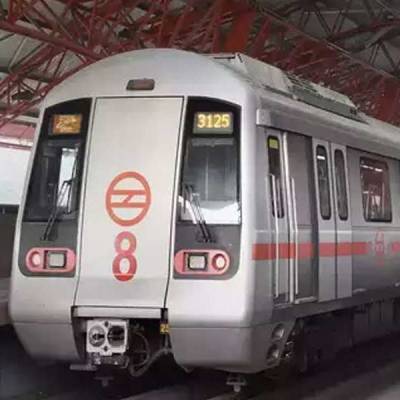
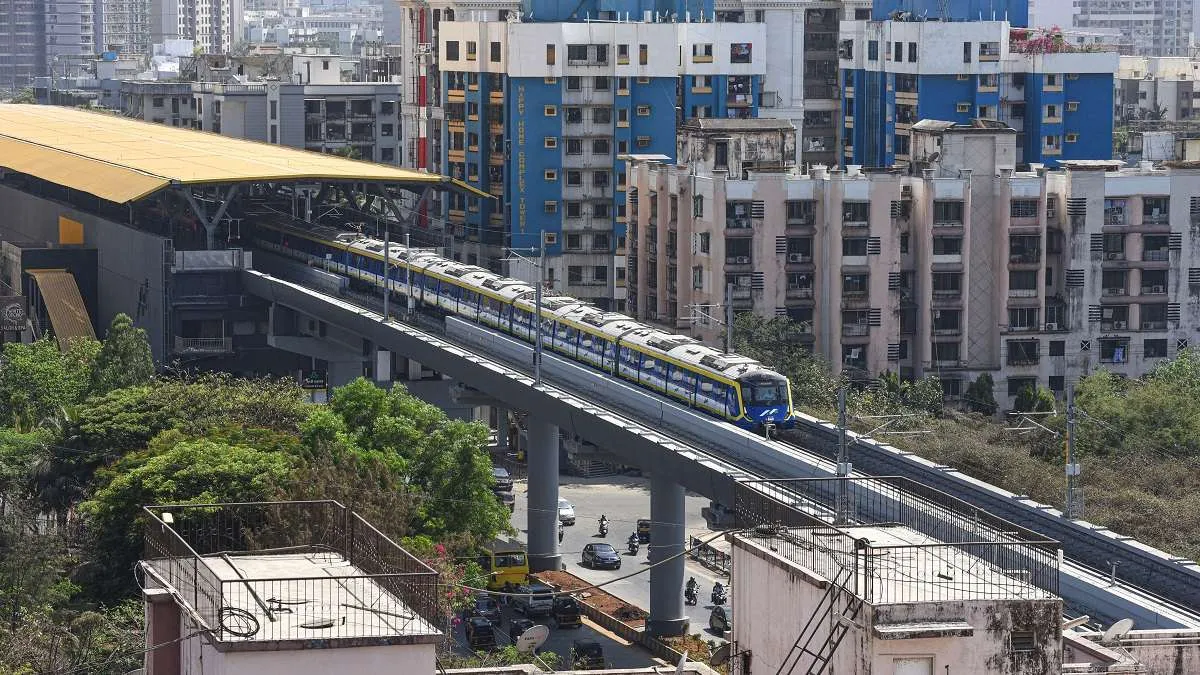
The Ghatkopar–Andheri–Versova Metro 1 corridor, one of Mumbai’s busiest transport routes, may soon see relief from peak-hour crowding as Mumbai Metro One Private Limited (MMOPL) plans to introduce six-coach trains.

With daily ridership exceeding five lakh passengers, the existing four-coach trains are struggling to accommodate commuters during rush hours, particularly at high-traffic stations such as Andheri, Western Express Highway and Ghatkopar.

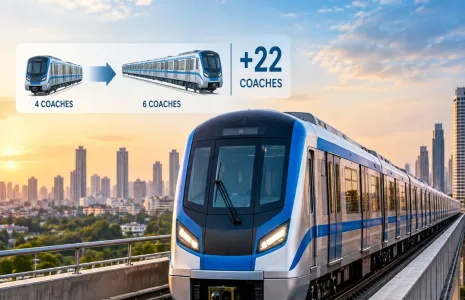
MMOPL has submitted a detailed proposal for the upgrade to the National Asset Reconstruction Company Limited (NARCL) via the India Debt Resolution Company Limited (IDRCL). Once approved, the addition of two new coaches per train will significantly enhance passenger capacity and improve comfort.

The expansion is also expected to streamline frequency and passenger flow ahead of the Mumbai Metro Line 3 launch, which will connect with Metro 1 at Marol station, further boosting footfall on the line.

Officials from MMOPL stated that the six-coach configuration will not only address long-standing commuter demands but also enhance the efficiency and reliability of Mumbai’s first metro corridor, operational since 2014.

The Ghatkopar–Andheri–Versova Metro 1 corridor, one of Mumbai’s busiest transport routes, may soon see relief from peak-hour crowding as Mumbai Metro One Private Limited (MMOPL) plans to introduce six-coach trains. With daily ridership exceeding five lakh passengers, the existing four-coach trains are struggling to accommodate commuters during rush hours, particularly at high-traffic stations such as Andheri, Western Express Highway and Ghatkopar. MMOPL has submitted a detailed proposal for the upgrade to the National Asset Reconstruction Company Limited (NARCL) via the India Debt Resolution Company Limited (IDRCL). Once approved, the addition of two new coaches per train will significantly enhance passenger capacity and improve comfort. The expansion is also expected to streamline frequency and passenger flow ahead of the Mumbai Metro Line 3 launch, which will connect with Metro 1 at Marol station, further boosting footfall on the line. Officials from MMOPL stated that the six-coach configuration will not only address long-standing commuter demands but also enhance the efficiency and reliability of Mumbai’s first metro corridor, operational since 2014.

Next Story
Real Estate

RBI Rate Cut Boosts Confidence Across Housing Market

Industry Context and Market DynamicsThe real estate industry has welcomed the RBI’s rate cut as a timely boost to affordability and demand. With home prices having risen steadily across major markets, even a marginal reduction in interest rates meaningfully strengthens purchasing power, especially for first-time and mid-income buyers.Ashish Jerath, President – Sales & Marketing, Smartworld Developers, observes:“The RBI’s 25-basis-point cut, bringing the repo rate down to 5.25%, is a timely boost for the real estate sector. Lower interest rates reduce borrowing costs, enabling homeb..

Next Story
Infrastructure Transport

BMC Resumes Rs 170 Billion Road Works, Targets 80 per cent By Jan 2026

Following the withdrawal of the southwest monsoon in October, the Brihanmumbai Municipal Corporation (BMC) has restarted work on 645 roads—covering 297.49 kilometres—under its large-scale concretisation programme. Data shows that more than 60 per cent of the resumed works are located in the western suburbs. Officials said the civic body aims to complete concretisation on 80 per cent of the roads where fresh work has begun by January 2026. Launched in 2022, the Rs 170 billion project seeks to concretise 700 kilometres of roads across Mumbai. All civil works were halted during the monsoon ..

Next Story
Infrastructure Urban

India Pushes Digital Shift In Urban Land Mapping

The Department of Land Resources (DoLR) under the Ministry of Rural Development has convened a National Symposium on NAKSHA – the National Geospatial Knowledge-based Land Survey of Urban Habitations – to advance India’s transition to modern, technology-driven land mapping. Speaking at the inaugural session, Secretary Manoj Joshi underscored the urgent need to move revenue departments away from outdated, tape-based methods and rough hand-drawn sketches. He stressed that adopting latitude–longitude-based digital mapping and GIS-linked registration systems is essential for economic stabi..

Advertisement

Subscribe to Our Newsletter

Get daily newsletters around different themes from Construction world.

STAY CONNECTED

Advertisement

Advertisement

Advertisement

Advertisement

Open In App