Railways To Decongest 76 Major Stations With New Amenities
RAILWAYS & METRO RAIL

Railways To Decongest 76 Major Stations With New Amenities

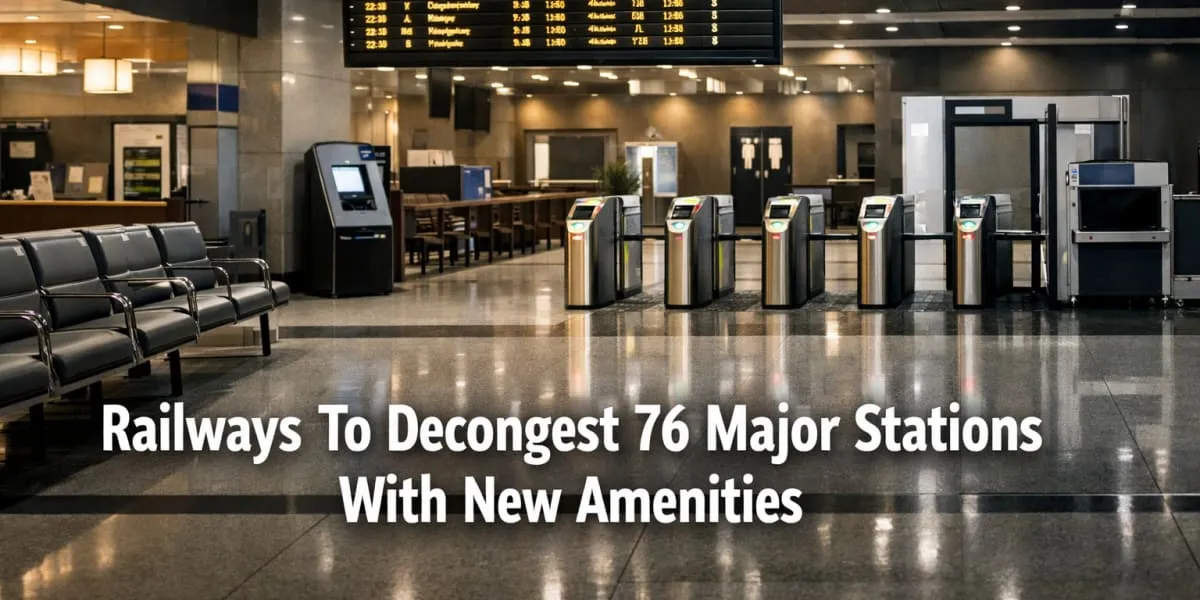
The Ministry of Railways has launched a plan to establish dedicated passenger holding areas at 76 major stations across India to tackle heavy passenger rush and decongest platforms. These zones will provide organised spaces with seating, drinking water, toilets, ticketing facilities, information displays and security checks to manage peak-hour footfall. A model holding area at New Delhi Railway Station has been commissioned and has eased congestion.

The commissioned facility has additional ticket counters, Automatic Ticket Vending Machines, public address systems and electronic information boards, and is equipped with CCTV, luggage scanners, metal detectors, uninterrupted power, improved lighting, high volume low speed fans and fire-fighting systems. Amenities also include RO drinking water and separate toilets for men, women and Divyangjans. Similar provisions are being planned or executed at other stations with timelines to be optimised.

Under a new access control protocol, passengers with confirmed reserved tickets will gain direct entry to platforms while those without a ticket or on a waiting list will be accommodated in holding areas until travel status is verified or space permits. Foot-over-bridges have been standardised in two designs of 12 metres and six metres to facilitate movement. Safety will be strengthened through installation of artificial intelligence enabled CCTV cameras for real time crowd monitoring and management.

Operational coordination will be enhanced by war rooms at major stations where officers from all departments will work together, supported by the rollout of the latest digital communication equipment including advanced walkie-talkies and announcement systems. Staff and service personnel will receive QR-based identity cards and new uniforms for easy identification during crises, and the post of Station Director will be upgraded with financial powers to take on the spot decisions and lead a unified command with authority to regulate ticket sales based on station capacity. The Union Minister for Railways, Information and Broadcasting, and Electronics and Information Technology, Ashwini Vaishnaw, provided these details in a written reply to a question in the Rajya Sabha.

The Ministry of Railways has launched a plan to establish dedicated passenger holding areas at 76 major stations across India to tackle heavy passenger rush and decongest platforms. These zones will provide organised spaces with seating, drinking water, toilets, ticketing facilities, information displays and security checks to manage peak-hour footfall. A model holding area at New Delhi Railway Station has been commissioned and has eased congestion. The commissioned facility has additional ticket counters, Automatic Ticket Vending Machines, public address systems and electronic information boards, and is equipped with CCTV, luggage scanners, metal detectors, uninterrupted power, improved lighting, high volume low speed fans and fire-fighting systems. Amenities also include RO drinking water and separate toilets for men, women and Divyangjans. Similar provisions are being planned or executed at other stations with timelines to be optimised. Under a new access control protocol, passengers with confirmed reserved tickets will gain direct entry to platforms while those without a ticket or on a waiting list will be accommodated in holding areas until travel status is verified or space permits. Foot-over-bridges have been standardised in two designs of 12 metres and six metres to facilitate movement. Safety will be strengthened through installation of artificial intelligence enabled CCTV cameras for real time crowd monitoring and management. Operational coordination will be enhanced by war rooms at major stations where officers from all departments will work together, supported by the rollout of the latest digital communication equipment including advanced walkie-talkies and announcement systems. Staff and service personnel will receive QR-based identity cards and new uniforms for easy identification during crises, and the post of Station Director will be upgraded with financial powers to take on the spot decisions and lead a unified command with authority to regulate ticket sales based on station capacity. The Union Minister for Railways, Information and Broadcasting, and Electronics and Information Technology, Ashwini Vaishnaw, provided these details in a written reply to a question in the Rajya Sabha.

Related Stories

Gold Stories

Next Story
Infrastructure Urban

KONE Opens India's First Digital Experience Centre in Pune

KONE, a global elevator and escalator manufacturer, has inaugurated its first Digital Experience Centre (DEC) in India, located in Pune. The facility aims to showcase how artificial intelligence (AI), connectivity and data-driven technologies can enhance customer experiences and improve building operations.The centre was inaugurated by Jussi Herlin, Executive Vice Chair, KONE Corporation; Philippe Delorme, President and CEO, KONE; and Nandan Nilekani, Co-founder and Chairman of the Board, Infosys.Designed as an interactive customer environment, the facility demonstrates digital solutions cover..

Next Story
Infrastructure Urban

CII GreenCo Launches Circularity Guidelines for Indian Industry

The Confederation of Indian Industry (CII) GreenCo Council has launched the CII GreenCo Circularity Guidelines – Pilot Version at the 17th CII GreenCo Waste & Resource Management Summit 2026 in Chennai. The initiative aims to strengthen resource efficiency, waste reduction and circular economy practices across Indian manufacturing and process industries.The guidelines introduce a structured framework with circularity indices covering raw materials, consumables, packaging and other resource inputs. These indicators will help industries assess existing practices, identify opportunities to ..

Next Story
Infrastructure Energy

Global Electronics Association Launches IPC-1783-CO2E Standard

The Global Electronics Association has introduced IPC-1783-CO2E, a new international standard aimed at improving consistency, transparency and comparability in product carbon footprint reporting across the electronics manufacturing industry.The standard, titled International Standard for Data Collection and Reporting of CO2 Equivalent (CO2e) Emissions for the Electronics Manufacturing Supply Chain, provides industry-specific guidance for collecting, estimating and reporting carbon emissions data.With increasing regulatory requirements and customer expectations, electronics manufacturers face c..

Advertisement

Subscribe to Our Newsletter

Get daily newsletters around different themes from Construction world.

STAY CONNECTED

Advertisement

SPECIAL OFFER
QR Code