+
Vaishnaw Flags Off Sairang-Silchar Train, Launches Guwahati Services
RAILWAYS & METRO RAIL

Vaishnaw Flags Off Sairang-Silchar Train, Launches Guwahati Services

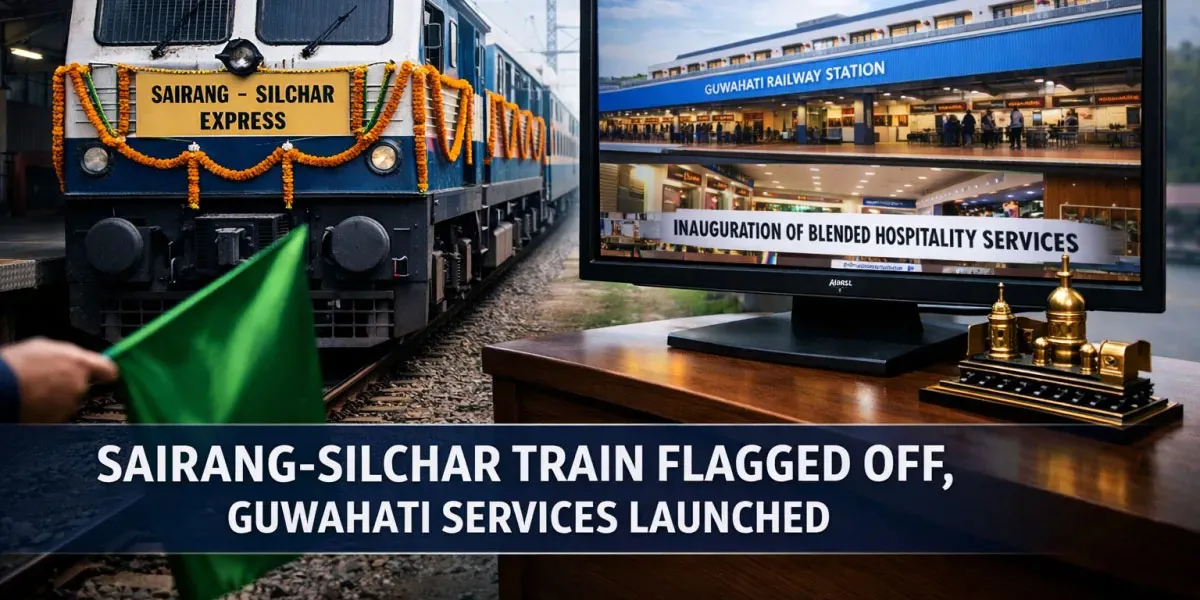
Railway Minister Ashwini Vaishnaw launched blended hospitality services at Guwahati Railway Station and flagged off a new Sairang-Silchar passenger service via video conference, as part of upgrades in the Northeast. The measures aim to improve travel experience and strengthen rail connectivity to accelerate regional development through modernised transport networks. The service will link Mizoram's capital with Assam's Barak Valley, benefiting students, commuters and patients with safer, faster journeys.

The Guwahati facilities include sleeping pods, an air conditioned lounge and multi cuisine restaurants intended to raise passenger comfort and hygiene standards. The Ministry of Railways said these amenities form part of a wider strategy to offer refined services at major junctions and to meet rising passenger expectations. The improvements are expected to support smoother transit and longer stays for travellers.

Vaishnaw noted that rail funding for the region has increased over the past decade, citing a record allocation of Rs 114,860 million (mn) in the union budget 2026-27 for the northeastern states. He said projects worth about Rs 724,680 mn are under way, signalling sustained investment in connectivity and infrastructure. The minister linked the spending to economic gains from improved freight movement, expanded trade and better market access for local products. He also described the Bairabi-Sairang rail line as a technically demanding but historic project that has integrated the state capital into the national network.

Commissioning of the 51 kilometre Bairabi-Sairang broad gauge line last year connected Aizawl to the Indian Railways network for the first time, and extension of passenger services to Silchar advances regional integration. Additional services are planned to strengthen links from Mizoram to Assam and beyond, supporting mobility and economic growth across the Northeast. Officials indicated that the twin initiatives underscore the government's continued focus on accessible rail travel and on enabling economic opportunities for the region.

Railway Minister Ashwini Vaishnaw launched blended hospitality services at Guwahati Railway Station and flagged off a new Sairang-Silchar passenger service via video conference, as part of upgrades in the Northeast. The measures aim to improve travel experience and strengthen rail connectivity to accelerate regional development through modernised transport networks. The service will link Mizoram's capital with Assam's Barak Valley, benefiting students, commuters and patients with safer, faster journeys. The Guwahati facilities include sleeping pods, an air conditioned lounge and multi cuisine restaurants intended to raise passenger comfort and hygiene standards. The Ministry of Railways said these amenities form part of a wider strategy to offer refined services at major junctions and to meet rising passenger expectations. The improvements are expected to support smoother transit and longer stays for travellers. Vaishnaw noted that rail funding for the region has increased over the past decade, citing a record allocation of Rs 114,860 million (mn) in the union budget 2026-27 for the northeastern states. He said projects worth about Rs 724,680 mn are under way, signalling sustained investment in connectivity and infrastructure. The minister linked the spending to economic gains from improved freight movement, expanded trade and better market access for local products. He also described the Bairabi-Sairang rail line as a technically demanding but historic project that has integrated the state capital into the national network. Commissioning of the 51 kilometre Bairabi-Sairang broad gauge line last year connected Aizawl to the Indian Railways network for the first time, and extension of passenger services to Silchar advances regional integration. Additional services are planned to strengthen links from Mizoram to Assam and beyond, supporting mobility and economic growth across the Northeast. Officials indicated that the twin initiatives underscore the government's continued focus on accessible rail travel and on enabling economic opportunities for the region.

Next Story
Infrastructure Urban

Implementation Status of Jal Jeevan Mission

Since August 2019 the Government has implemented Jal Jeevan Mission to provide assured potable water through household tap connections in rural India. At the start of the mission only 32.3 million (mn) rural households, representing 16.7 per cent, were reported to have tap water connections. States and union territories have reported that 125.8 mn additional rural households have since been provided with tap connections. As a result, of about 193.6 mn rural households roughly 158.2 mn, or 81.71 per cent, are reported to have tap water supply at home.\n\nThe State, district and village level st..

Next Story
Infrastructure Urban

Jal Jeevan Mission Reaches Eighty One Per Cent Rural Coverage

The Government reported substantial progress under the Jal Jeevan Mission, launched in August 2019 to provide tap water to every rural household. At launch only 32.3 million (mn) rural households had tap connections and states and Union territories reported provision of 125.8 mn additional households by March 2026. Consequently, out of about 193.6 mn rural households around 158.2 mn, or 81.71 per cent, are reported to have tap water at home. The Finance Minister announced extension of the mission until 2028 in the 2025-26 budget speech. The Swachh Bharat Mission Grameen, launched in October 20..

Next Story
Infrastructure Urban

Empowering Local Governance for Sustainable Rural Water Supply

The Ministry of Jal Shakti has aligned the Jal Jeevan Mission (JJM) with the 73rd Amendment to strengthen village level planning and community ownership of water supply. Gram Panchayats, village water and sanitation committees and Pani Samitis are to plan, implement, manage and maintain piped water systems, with gram sabha processes formalising handover and oversight. Implementation support agencies including non government organisations, community based organisations and self help groups have been empanelled to train local committees and promote women participation. Under JJM, the department ..

Advertisement

Subscribe to Our Newsletter

Get daily newsletters around different themes from Construction world.

STAY CONNECTED

Advertisement

Advertisement

Advertisement