+
Government Reports Status Of Public Electric Vehicle Charging Network
ECONOMY & POLICY

Government Reports Status Of Public Electric Vehicle Charging Network

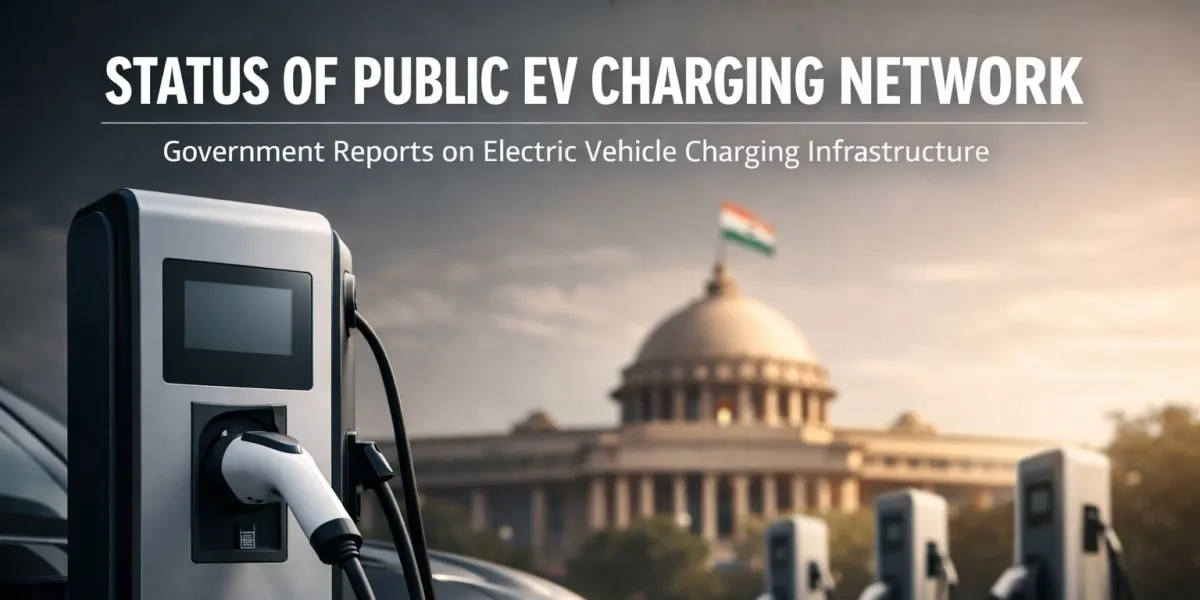
As of 1 March 2026, 6,645 electric vehicle public charging stations (EV PCS) are operational against 9,332 sanctioned under the Faster Adoption and Manufacturing of Hybrid and Electric Vehicles Phase II (FAME-II) scheme on a pan-India basis. The Ministry of Heavy Industries provided the data in a written reply to the Rajya Sabha. Oil Marketing Companies (OMCs) supplied state-wise installation details.

State details show Maharashtra with 670 approved chargers and 615 operational units, and Uttar Pradesh with 937 approved and 456 operational. The annexure lists installations by state totalling 8,932 chargers installed as on 1 March 2026, with Tamil Nadu on 957 and Karnataka on 751 among the highest. Several smaller states and union territories reported zero or single-digit installations.

The Ministry of Power issued Guidelines for Installation and Operation of Electric Vehicle Charging Infrastructure-2024 in September 2024 to outline standards and protocols for a connected and interoperable charging infrastructure network. The Bureau of Indian Standard (BIS) published Indian standards related to electric vehicle charging infrastructure that specify safety and quality parameters for connectors, communication protocols, Electric Vehicle Supply Equipment and battery swapping systems. The Ministry of Road Transport and Highways amended AIS standards to prescribe technical requirements for vehicle inlet connectors and to ensure interoperability for conductive charging systems in M and N categories except N1.

Other public sector entities including CESL, REIL, KSEB, SMC and POWERGRID reported a combined 227 public charging points, with CESL accounting for 97. The ministry indicated that installations have been driven by feasibility, demand and expected utilisation and that OMCs provided the detailed state-wise figures. The information was provided by the Minister of State for Heavy Industries, Bhupathiraju Srinivasa Varma in a written reply in the Rajya Sabha.

As of 1 March 2026, 6,645 electric vehicle public charging stations (EV PCS) are operational against 9,332 sanctioned under the Faster Adoption and Manufacturing of Hybrid and Electric Vehicles Phase II (FAME-II) scheme on a pan-India basis. The Ministry of Heavy Industries provided the data in a written reply to the Rajya Sabha. Oil Marketing Companies (OMCs) supplied state-wise installation details. State details show Maharashtra with 670 approved chargers and 615 operational units, and Uttar Pradesh with 937 approved and 456 operational. The annexure lists installations by state totalling 8,932 chargers installed as on 1 March 2026, with Tamil Nadu on 957 and Karnataka on 751 among the highest. Several smaller states and union territories reported zero or single-digit installations. The Ministry of Power issued Guidelines for Installation and Operation of Electric Vehicle Charging Infrastructure-2024 in September 2024 to outline standards and protocols for a connected and interoperable charging infrastructure network. The Bureau of Indian Standard (BIS) published Indian standards related to electric vehicle charging infrastructure that specify safety and quality parameters for connectors, communication protocols, Electric Vehicle Supply Equipment and battery swapping systems. The Ministry of Road Transport and Highways amended AIS standards to prescribe technical requirements for vehicle inlet connectors and to ensure interoperability for conductive charging systems in M and N categories except N1. Other public sector entities including CESL, REIL, KSEB, SMC and POWERGRID reported a combined 227 public charging points, with CESL accounting for 97. The ministry indicated that installations have been driven by feasibility, demand and expected utilisation and that OMCs provided the detailed state-wise figures. The information was provided by the Minister of State for Heavy Industries, Bhupathiraju Srinivasa Varma in a written reply in the Rajya Sabha.

Related Stories

Gold Stories

Next Story
Infrastructure Urban

KONE Opens India's First Digital Experience Centre in Pune

KONE, a global elevator and escalator manufacturer, has inaugurated its first Digital Experience Centre (DEC) in India, located in Pune. The facility aims to showcase how artificial intelligence (AI), connectivity and data-driven technologies can enhance customer experiences and improve building operations.The centre was inaugurated by Jussi Herlin, Executive Vice Chair, KONE Corporation; Philippe Delorme, President and CEO, KONE; and Nandan Nilekani, Co-founder and Chairman of the Board, Infosys.Designed as an interactive customer environment, the facility demonstrates digital solutions cover..

Next Story
Infrastructure Urban

CII GreenCo Launches Circularity Guidelines for Indian Industry

The Confederation of Indian Industry (CII) GreenCo Council has launched the CII GreenCo Circularity Guidelines – Pilot Version at the 17th CII GreenCo Waste & Resource Management Summit 2026 in Chennai. The initiative aims to strengthen resource efficiency, waste reduction and circular economy practices across Indian manufacturing and process industries.The guidelines introduce a structured framework with circularity indices covering raw materials, consumables, packaging and other resource inputs. These indicators will help industries assess existing practices, identify opportunities to ..

Next Story
Infrastructure Energy

Global Electronics Association Launches IPC-1783-CO2E Standard

The Global Electronics Association has introduced IPC-1783-CO2E, a new international standard aimed at improving consistency, transparency and comparability in product carbon footprint reporting across the electronics manufacturing industry.The standard, titled International Standard for Data Collection and Reporting of CO2 Equivalent (CO2e) Emissions for the Electronics Manufacturing Supply Chain, provides industry-specific guidance for collecting, estimating and reporting carbon emissions data.With increasing regulatory requirements and customer expectations, electronics manufacturers face c..

Advertisement

Subscribe to Our Newsletter

Get daily newsletters around different themes from Construction world.

STAY CONNECTED

Advertisement

SPECIAL OFFER
QR Code