Indian Railways Launches AI Sign Language System at Badshahnagar Station
ECONOMY & POLICY

Indian Railways Launches AI Sign Language System at Badshahnagar Station

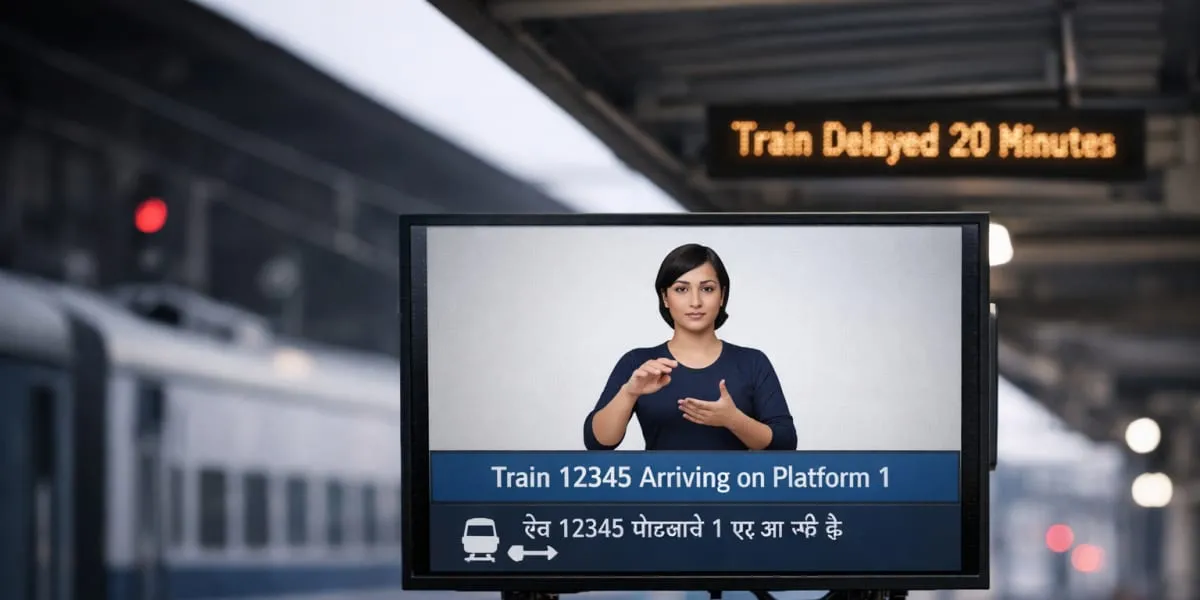
Indian Railways has launched its first AI-powered sign language announcement system at Badshahnagar station in Lucknow. The system provides live train information in Indian Sign Language on LED screens in real time. It is installed on Platform one and converts existing public address announcements into sign language, covering arrivals, departures, delays and platform allocations. The initiative aims to reduce dependence on fellow passengers or staff among hearing-impaired travellers.

The Lucknow Division of North Eastern Railway rolled out the technology, which was developed in-house by the division's Signal and Telecommunication Department and created in collaboration with Techtron Infotech. The project was overseen by senior divisional signal and telecommunication engineer Vaibhav Shrivastava, who led the development and deployment process. The system underwent a two-month trial before launch. Representatives of a Noida-based organisation that works with deaf and mute individuals and four certified sign language interpreters reviewed the system's accuracy and usability.

Railway officials said the facility could benefit zero point one million (mn) persons with disabilities who are connected to Badshahnagar through rail travel as regular commuters or occasional passengers. Badshahnagar is among stations in the Lucknow Division that have received a series of accessibility upgrades in recent years. The sign language system is presented as a step towards more inclusive railway infrastructure for passengers with disabilities. No timeline has been announced for extending the system to other stations in the division or across the North Eastern Railway network.

The rollout is intended to demonstrate the division's capacity to develop and implement assistive technologies using AI and existing public address inputs. Officials indicated that the LED displays will operate in real time and that further iterations may follow technical validation and passenger feedback. The deployment at Badshahnagar is the first operational instance within Indian Railways and may inform future accessibility initiatives elsewhere. The division plans to monitor performance and usability before any wider deployment.

Indian Railways has launched its first AI-powered sign language announcement system at Badshahnagar station in Lucknow. The system provides live train information in Indian Sign Language on LED screens in real time. It is installed on Platform one and converts existing public address announcements into sign language, covering arrivals, departures, delays and platform allocations. The initiative aims to reduce dependence on fellow passengers or staff among hearing-impaired travellers. The Lucknow Division of North Eastern Railway rolled out the technology, which was developed in-house by the division's Signal and Telecommunication Department and created in collaboration with Techtron Infotech. The project was overseen by senior divisional signal and telecommunication engineer Vaibhav Shrivastava, who led the development and deployment process. The system underwent a two-month trial before launch. Representatives of a Noida-based organisation that works with deaf and mute individuals and four certified sign language interpreters reviewed the system's accuracy and usability. Railway officials said the facility could benefit zero point one million (mn) persons with disabilities who are connected to Badshahnagar through rail travel as regular commuters or occasional passengers. Badshahnagar is among stations in the Lucknow Division that have received a series of accessibility upgrades in recent years. The sign language system is presented as a step towards more inclusive railway infrastructure for passengers with disabilities. No timeline has been announced for extending the system to other stations in the division or across the North Eastern Railway network. The rollout is intended to demonstrate the division's capacity to develop and implement assistive technologies using AI and existing public address inputs. Officials indicated that the LED displays will operate in real time and that further iterations may follow technical validation and passenger feedback. The deployment at Badshahnagar is the first operational instance within Indian Railways and may inform future accessibility initiatives elsewhere. The division plans to monitor performance and usability before any wider deployment.

Related Stories

Gold Stories

Next Story
Infrastructure Urban

KONE Opens India's First Digital Experience Centre in Pune

KONE, a global elevator and escalator manufacturer, has inaugurated its first Digital Experience Centre (DEC) in India, located in Pune. The facility aims to showcase how artificial intelligence (AI), connectivity and data-driven technologies can enhance customer experiences and improve building operations.The centre was inaugurated by Jussi Herlin, Executive Vice Chair, KONE Corporation; Philippe Delorme, President and CEO, KONE; and Nandan Nilekani, Co-founder and Chairman of the Board, Infosys.Designed as an interactive customer environment, the facility demonstrates digital solutions cover..

Next Story
Infrastructure Urban

CII GreenCo Launches Circularity Guidelines for Indian Industry

The Confederation of Indian Industry (CII) GreenCo Council has launched the CII GreenCo Circularity Guidelines – Pilot Version at the 17th CII GreenCo Waste & Resource Management Summit 2026 in Chennai. The initiative aims to strengthen resource efficiency, waste reduction and circular economy practices across Indian manufacturing and process industries.The guidelines introduce a structured framework with circularity indices covering raw materials, consumables, packaging and other resource inputs. These indicators will help industries assess existing practices, identify opportunities to ..

Next Story
Infrastructure Energy

Global Electronics Association Launches IPC-1783-CO2E Standard

The Global Electronics Association has introduced IPC-1783-CO2E, a new international standard aimed at improving consistency, transparency and comparability in product carbon footprint reporting across the electronics manufacturing industry.The standard, titled International Standard for Data Collection and Reporting of CO2 Equivalent (CO2e) Emissions for the Electronics Manufacturing Supply Chain, provides industry-specific guidance for collecting, estimating and reporting carbon emissions data.With increasing regulatory requirements and customer expectations, electronics manufacturers face c..

Advertisement

Subscribe to Our Newsletter

Get daily newsletters around different themes from Construction world.

STAY CONNECTED

Advertisement

SPECIAL OFFER
QR Code