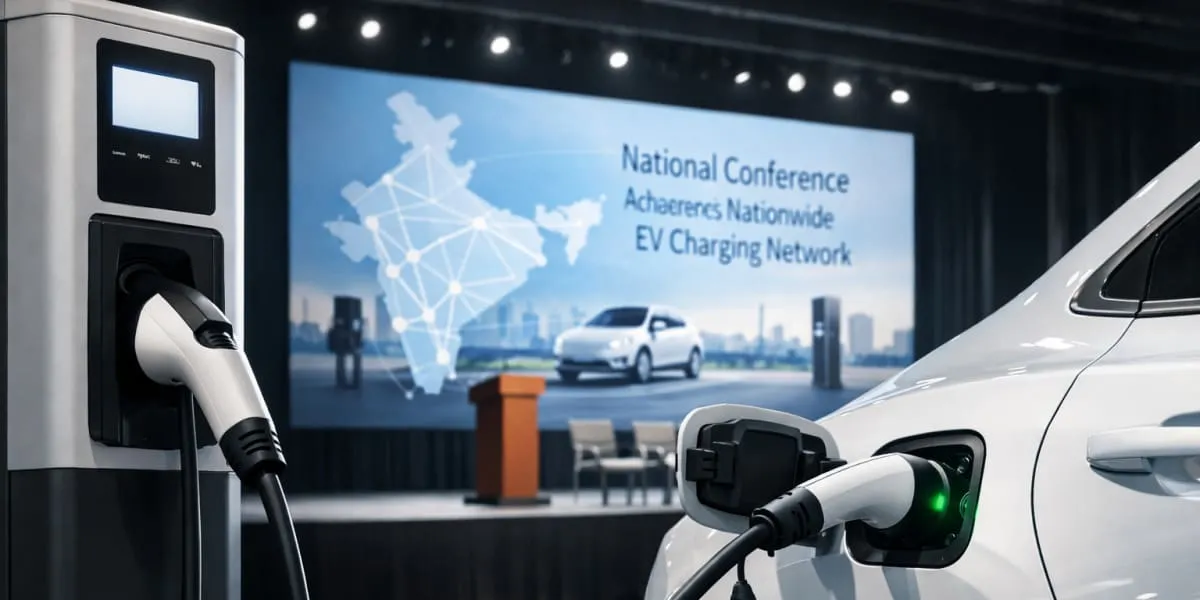
National Conference Advances Nationwide EV Charging Network
ECONOMY & POLICY

National Conference Advances Nationwide EV Charging Network

The Ministry of Heavy Industries organised a national conference in Bengaluru on 12 May 2026 to discuss enabling a nationwide electric vehicle charging infrastructure under the PM E-DRIVE scheme. The Union Minister for Heavy Industries and Steel, H.D. Kumaraswamy, said the government is committed to creating a modern and reliable charging ecosystem to support the country's clean mobility transition and to make electric mobility affordable and widely available. He emphasised that strengthening charging infrastructure is essential to accelerate large scale adoption.

The minister announced approval for Karnataka proposals for 1,243 EV chargers with an outlay of Rs1,232.6 million (mn) and said proposals with a total financial outlay of Rs5,038.6 million (mn) have been approved to cover installation of 4,874 chargers across states and central public sector enterprises. The approved proposals include central public sector enterprises such as Hindustan Petroleum Corporation Limited, Indian Oil Corporation Limited and Bharat Petroleum Corporation Limited and states including Rajasthan, Andhra Pradesh, Uttar Pradesh, Gujarat, Kerala, Telangana and Tamil Nadu. The ministry said coordinated efforts between the centre, states, charge point operators and industry stakeholders will be instrumental in creating an efficient charging ecosystem.

Under the PM E-DRIVE scheme the government has approved a total outlay of Rs109 bn to promote electric mobility across vehicle segments. The scheme proposes support for around two point five million (mn) electric two wheelers and around zero point three two million (mn) electric three wheelers including e-rickshaws and L5 category vehicles, and envisages support of Rs43.91 bn for deployment of over 14,028 electric buses. Out of the total outlay Rs36.79 bn has been earmarked for demand incentives for emerging EV categories while Rs20 bn is allocated for development of public charging infrastructure and Rs7.8 bn for modernisation of vehicle testing agencies. The ministry also cited other schemes including production linked incentive auto at Rs259.38 bn, PLI ACC at Rs181 bn and a payment security mechanism at Rs34.35 bn.

Officials urged common standards and faster deployment. Ministry reaffirmed support for net zero.

The Ministry of Heavy Industries organised a national conference in Bengaluru on 12 May 2026 to discuss enabling a nationwide electric vehicle charging infrastructure under the PM E-DRIVE scheme. The Union Minister for Heavy Industries and Steel, H.D. Kumaraswamy, said the government is committed to creating a modern and reliable charging ecosystem to support the country's clean mobility transition and to make electric mobility affordable and widely available. He emphasised that strengthening charging infrastructure is essential to accelerate large scale adoption. The minister announced approval for Karnataka proposals for 1,243 EV chargers with an outlay of Rs1,232.6 million (mn) and said proposals with a total financial outlay of Rs5,038.6 million (mn) have been approved to cover installation of 4,874 chargers across states and central public sector enterprises. The approved proposals include central public sector enterprises such as Hindustan Petroleum Corporation Limited, Indian Oil Corporation Limited and Bharat Petroleum Corporation Limited and states including Rajasthan, Andhra Pradesh, Uttar Pradesh, Gujarat, Kerala, Telangana and Tamil Nadu. The ministry said coordinated efforts between the centre, states, charge point operators and industry stakeholders will be instrumental in creating an efficient charging ecosystem. Under the PM E-DRIVE scheme the government has approved a total outlay of Rs109 bn to promote electric mobility across vehicle segments. The scheme proposes support for around two point five million (mn) electric two wheelers and around zero point three two million (mn) electric three wheelers including e-rickshaws and L5 category vehicles, and envisages support of Rs43.91 bn for deployment of over 14,028 electric buses. Out of the total outlay Rs36.79 bn has been earmarked for demand incentives for emerging EV categories while Rs20 bn is allocated for development of public charging infrastructure and Rs7.8 bn for modernisation of vehicle testing agencies. The ministry also cited other schemes including production linked incentive auto at Rs259.38 bn, PLI ACC at Rs181 bn and a payment security mechanism at Rs34.35 bn. Officials urged common standards and faster deployment. Ministry reaffirmed support for net zero.

Next Story
Technology

AI-Enabled Workflows Lift Profitability and Productivity

Organisations modernising frontline workflows with artificial intelligence, automation and real-time data are reporting stronger financial performance, higher productivity and improved employee engagement, according to a global study by Zebra Technologies and Oxford Economics.The research covered 1,000 senior leaders across retail, manufacturing, transportation and logistics in the US, Mexico, the UK, Germany, India, Japan, Australia and New Zealand.In transportation and logistics, 54 per cent of companies that improved picking and packing operations reported faster operational performance, wh..

Next Story
Real Estate

India Leads Global AI Readiness but Implementation Lags

Indian companies lead global averages across all eight artificial intelligence readiness indicators tracked by JLL, but only 19 per cent have started making changes to their workplaces, according to the JLL 2026 Future of Work Survey.The study found that 77 per cent of Indian business leaders expect AI to change their office requirements, creating a 58-percentage-point gap between awareness and implementation. The survey covered more than 2,200 CEOs, CFOs and real estate leaders across 21 countries during the first quarter of 2026.Despite concerns over automation, 58 per cent of Indian leaders..

Next Story
Equipment

Three WOLFF Cranes Build Riyadh Cable-Stayed Bridges

Three WOLFF 180 B luffing jib cranes are supporting the construction of two cable-stayed bridges alongside the existing Wadi Laban Bridge in Riyadh, Saudi Arabia. The project is being developed for the Royal Commission for Riyadh City and executed by the ICRC joint venture comprising IC Ictas and Al Rashid Trading & Contracting Company.The cranes are handling lifting operations including formwork, reinforcement, concrete placement, work platforms, surveying equipment and other construction materials. Each crane is fitted with a 40 m jib, reaches a hook height of 157 m and offers a maximum ..

Advertisement

Subscribe to Our Newsletter

Get daily newsletters around different themes from Construction world.

STAY CONNECTED

Advertisement

Advertisement

Advertisement