Railways Tightens Contractor Rules And Opens Wagon Design To Industry
ECONOMY & POLICY

Railways Tightens Contractor Rules And Opens Wagon Design To Industry

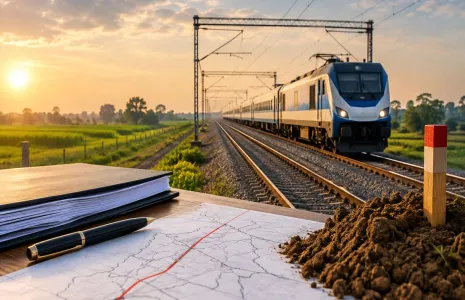
Indian Railways announced reforms to improve project execution, encourage private sector innovation in freight transportation and make logistics more efficient. Measures form part of a plan to implement 52 reforms and tighten contractor eligibility for railway projects. Contractors must provide an upfront performance security of 10 per cent before work begins rather than face deductions from running bills, and those with pending litigation exceeding 50 per cent of net worth will be barred from bidding; professional indemnity and all-risk insurance have been introduced to strengthen project management.

The ministry has opened the door for industry to develop freight wagon designs based on operational needs, with the Research Designs and Standards Organisation to evaluate proposals, run prototype tests and certify safety before induction. Reforms also promote container-based transportation of fly ash to reduce pollution in transit, storage and unloading and to ease handling through equipment such as reach stacker cranes. Closed containers are expected to offer environmental and operational benefits over open wagons.

India generates around 340 million metric tonnes (mn t) of fly ash annually, of which 96 mn t are used by the cement industry but only 13 mn t, or about four per cent of total generation, are currently moved by rail. The ministry will expand container transport for petroleum, fertilisers and agricultural produce to improve handling, reduce contamination and lower logistics costs. Rules for container train operators have been simplified with a unified all-India licence, a uniform registration fee of Rs 250 million (mn) for all routes and removal of renewal fees after 20 years.

The package includes a skill certification framework to ensure workers in trades such as welding, plumbing, masonry and concrete testing are trained, and the ministry indicated it could be implemented across projects in a maximum of 24 months. The Rail Bhoomi portal has been launched to streamline land acquisition and the ministry estimated reductions of 30-40 per cent depending on the state. Officials said the measures aim to improve construction quality and discourage bidders focused primarily on arbitration.

Indian Railways announced reforms to improve project execution, encourage private sector innovation in freight transportation and make logistics more efficient. Measures form part of a plan to implement 52 reforms and tighten contractor eligibility for railway projects. Contractors must provide an upfront performance security of 10 per cent before work begins rather than face deductions from running bills, and those with pending litigation exceeding 50 per cent of net worth will be barred from bidding; professional indemnity and all-risk insurance have been introduced to strengthen project management. The ministry has opened the door for industry to develop freight wagon designs based on operational needs, with the Research Designs and Standards Organisation to evaluate proposals, run prototype tests and certify safety before induction. Reforms also promote container-based transportation of fly ash to reduce pollution in transit, storage and unloading and to ease handling through equipment such as reach stacker cranes. Closed containers are expected to offer environmental and operational benefits over open wagons. India generates around 340 million metric tonnes (mn t) of fly ash annually, of which 96 mn t are used by the cement industry but only 13 mn t, or about four per cent of total generation, are currently moved by rail. The ministry will expand container transport for petroleum, fertilisers and agricultural produce to improve handling, reduce contamination and lower logistics costs. Rules for container train operators have been simplified with a unified all-India licence, a uniform registration fee of Rs 250 million (mn) for all routes and removal of renewal fees after 20 years. The package includes a skill certification framework to ensure workers in trades such as welding, plumbing, masonry and concrete testing are trained, and the ministry indicated it could be implemented across projects in a maximum of 24 months. The Rail Bhoomi portal has been launched to streamline land acquisition and the ministry estimated reductions of 30-40 per cent depending on the state. Officials said the measures aim to improve construction quality and discourage bidders focused primarily on arbitration.

Next Story
Infrastructure Transport

Surya Roshni delivers customised lighting for NCRTC RRTS stations

Surya Roshni has supplied customised indoor lighting solutions for 18 elevated stations on the National Capital Region Transport Corporation's (NCRTC) Rapid Rail Transit System (RRTS), strengthening its presence in India's infrastructure lighting segment.The project involved the design and deployment of lighting systems for platforms, concourses, foot overbridges (FOBs) and back-of-house (BOH) areas. According to the company, the luminaires were developed specifically to meet NCRTC's design, operational and performance requirements rather than using standard products.Surya introduced two custo..

Next Story
Real Estate

Hilton debuts Tapestry Collection brand in Vietnam

Hilton has opened NHAAN Resort & Spa Hoi An, Tapestry Collection by Hilton, marking the debut of the Tapestry Collection brand in Vietnam and expanding its lifestyle hospitality portfolio in Southeast Asia.Located along the Co Co River in Cam Thanh village, the 174-key resort provides access to Hoi An Ancient Town, Cua Dai Beach and the Cam Thanh Nipa Forest. The property has been designed by Vietnamese architect Vo Trong Nghia, incorporating biophilic architecture, locally sourced materials and riverfront landscapes.The resort offers a mix of guest rooms and suites, including family-frien..

Next Story
Building Material

Electrent expands lithium energy storage system portfolio

Electrent Energy has expanded its lithium-based energy storage portfolio with the launch of the ESS 850 and ESS 1050, targeting compact and maintenance-free power backup solutions for Indian homes.The new systems integrate a Home UPS and a LiFePO4 lithium battery into a single unit, extending the company's product range following the launch of its ESS 1350 and ESS 2500 models.Designed for apartments and smaller homes, the ESS 850 provides up to 1 hour 15 minutes of backup, while the ESS 1050 offers up to 1 hour 45 minutes on a typical 400 W household load. The systems can power essential appli..

Advertisement

Subscribe to Our Newsletter

Get daily newsletters around different themes from Construction world.

STAY CONNECTED

Advertisement

Advertisement

Advertisement