



Telangana Launches MSME Greening Portal Under RAMP
ECONOMY & POLICY

Telangana Launches MSME Greening Portal Under RAMP

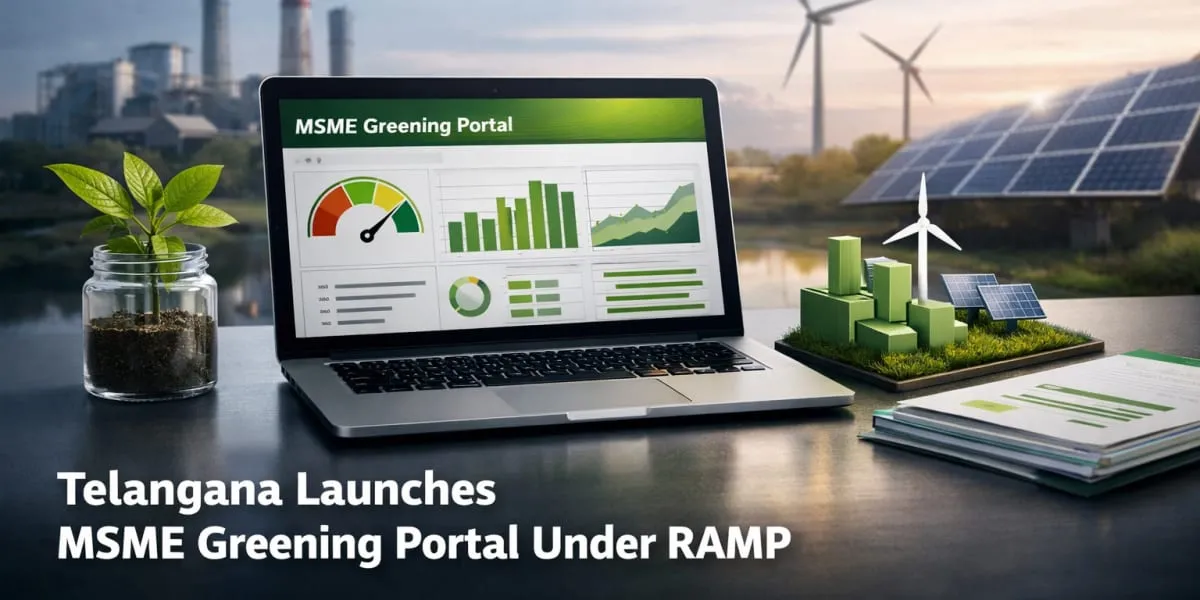
Telangana has launched a new greening portal and an assessment toolkit for micro, small and medium enterprises (MSMEs) under the RAMP initiative. The platform is designed to help MSMEs evaluate environmental performance and identify opportunities to reduce resource use and emissions. The launch is part of the state authority's drive to mainstream sustainability across small industry clusters. Officials indicated the resources are intended to assist firms in meeting regulatory expectations and market requirements effectively nationwide.

The assessment toolkit offers structured guidance and checklists to benchmark operations against recognised sustainability criteria and to generate baseline metrics for water, energy and waste. It also provides a pathway for incremental improvement and clearer documentation for buyers and regulators. By translating technical concepts into practical steps the toolkit seeks to lower the barrier to adoption for smaller firms. Complementary materials and guidance aim to build capacity among managers and technicians across the sector effectively.

The greening portal functions as a centralised resource hub and a repository for assessment outcomes, enabling aggregated analysis and trend recognition at cluster and state level. It is intended to help policymakers and industry groups to prioritise interventions and measure progress. The portal also aims to connect enterprises with technical advisory services to facilitate peer learning across value chains. Stakeholders may use the site to access tailored recommendations and to track improvements in environmental performance.

The initiative aligns with broader sustainability and circularity objectives and is expected to support competitiveness as markets give greater weight to environmental credentials. Authorities emphasise that practical, scalable measures can reduce costs and risks for small manufacturers while improving access to environmentally conscious buyers. Continued engagement with industry associations and technical partners will be important to ensure uptake and iterative refinement of tools. The state indicated monitoring would inform future enhancements and wider roll out.

Telangana has launched a new greening portal and an assessment toolkit for micro, small and medium enterprises (MSMEs) under the RAMP initiative. The platform is designed to help MSMEs evaluate environmental performance and identify opportunities to reduce resource use and emissions. The launch is part of the state authority's drive to mainstream sustainability across small industry clusters. Officials indicated the resources are intended to assist firms in meeting regulatory expectations and market requirements effectively nationwide. The assessment toolkit offers structured guidance and checklists to benchmark operations against recognised sustainability criteria and to generate baseline metrics for water, energy and waste. It also provides a pathway for incremental improvement and clearer documentation for buyers and regulators. By translating technical concepts into practical steps the toolkit seeks to lower the barrier to adoption for smaller firms. Complementary materials and guidance aim to build capacity among managers and technicians across the sector effectively. The greening portal functions as a centralised resource hub and a repository for assessment outcomes, enabling aggregated analysis and trend recognition at cluster and state level. It is intended to help policymakers and industry groups to prioritise interventions and measure progress. The portal also aims to connect enterprises with technical advisory services to facilitate peer learning across value chains. Stakeholders may use the site to access tailored recommendations and to track improvements in environmental performance. The initiative aligns with broader sustainability and circularity objectives and is expected to support competitiveness as markets give greater weight to environmental credentials. Authorities emphasise that practical, scalable measures can reduce costs and risks for small manufacturers while improving access to environmentally conscious buyers. Continued engagement with industry associations and technical partners will be important to ensure uptake and iterative refinement of tools. The state indicated monitoring would inform future enhancements and wider roll out.

Related Stories

Gold Stories
Next Story
Infrastructure Urban

KONE Opens India's First Digital Experience Centre in Pune

KONE, a global elevator and escalator manufacturer, has inaugurated its first Digital Experience Centre (DEC) in India, located in Pune. The facility aims to showcase how artificial intelligence (AI), connectivity and data-driven technologies can enhance customer experiences and improve building operations.The centre was inaugurated by Jussi Herlin, Executive Vice Chair, KONE Corporation; Philippe Delorme, President and CEO, KONE; and Nandan Nilekani, Co-founder and Chairman of the Board, Infosys.Designed as an interactive customer environment, the facility demonstrates digital solutions cover..

Next Story
Infrastructure Urban

CII GreenCo Launches Circularity Guidelines for Indian Industry

The Confederation of Indian Industry (CII) GreenCo Council has launched the CII GreenCo Circularity Guidelines – Pilot Version at the 17th CII GreenCo Waste & Resource Management Summit 2026 in Chennai. The initiative aims to strengthen resource efficiency, waste reduction and circular economy practices across Indian manufacturing and process industries.The guidelines introduce a structured framework with circularity indices covering raw materials, consumables, packaging and other resource inputs. These indicators will help industries assess existing practices, identify opportunities to ..

Next Story
Infrastructure Energy

Global Electronics Association Launches IPC-1783-CO2E Standard

The Global Electronics Association has introduced IPC-1783-CO2E, a new international standard aimed at improving consistency, transparency and comparability in product carbon footprint reporting across the electronics manufacturing industry.The standard, titled International Standard for Data Collection and Reporting of CO2 Equivalent (CO2e) Emissions for the Electronics Manufacturing Supply Chain, provides industry-specific guidance for collecting, estimating and reporting carbon emissions data.With increasing regulatory requirements and customer expectations, electronics manufacturers face c..

Advertisement

Subscribe to Our Newsletter

Get daily newsletters around different themes from Construction world.

STAY CONNECTED

Advertisement

SPECIAL OFFER
QR Code