+
TRAI Reviews Mobile Network Performance in Nashik Area
ECONOMY & POLICY

TRAI Reviews Mobile Network Performance in Nashik Area

The Telecom Regulatory Authority of India (TRAI) has released findings from its Independent Drive Test (IDT) covering Nashik and surrounding areas under the Nashik Licensed Service Area. The assessment, conducted recently, evaluated real-world mobile network performance across urban zones, transport hubs, institutional hotspots and highway corridors.

The tests were carried out between 18 and 21 November 2025 across 487.2 km, including city drives, highway routes, hotspot locations and walk tests. Network performance of 2G, 3G, 4G and 5G services was analysed to reflect user experience across different device capabilities. The findings have been shared with all concerned telecom service providers for necessary action.

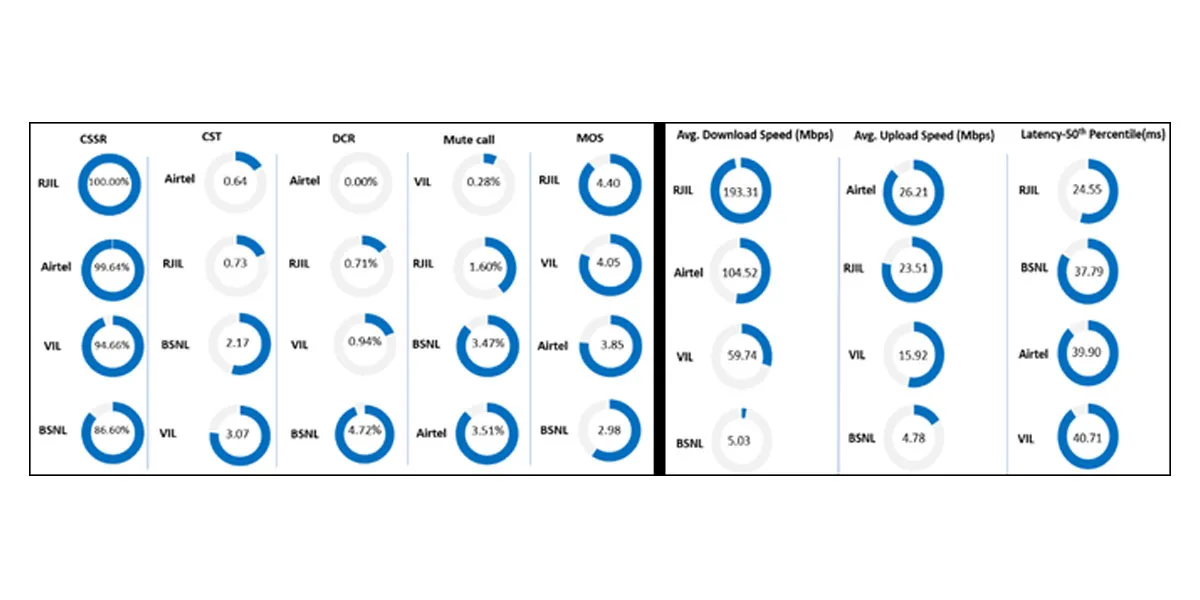
For voice services, Airtel and RJIL recorded high call setup success rates, while RJIL also reported the lowest call drop rate among operators. Mean Opinion Scores indicated comparatively stronger voice quality on 4G and 5G networks. Call setup time and silence rates varied across operators.

Data performance showed significant variation, with 5G networks delivering substantially higher download speeds. RJIL recorded the highest overall average download speed, followed by Airtel and VIL, while BSNL’s performance reflected its limited 4G footprint. Latency levels remained within acceptable ranges across operators.

The assessment covered key locations including Nashik Airport, major residential and commercial areas, hospitals, temples, bus stands, railway stations and forested highway stretches. Walk tests captured network behaviour in crowded pedestrian environments, while highway drives evaluated continuity of service along intercity routes.

TRAI stated that all tests were conducted using calibrated equipment and standardised protocols. The detailed report is available on the TRAI website.

The Telecom Regulatory Authority of India (TRAI) has released findings from its Independent Drive Test (IDT) covering Nashik and surrounding areas under the Nashik Licensed Service Area. The assessment, conducted recently, evaluated real-world mobile network performance across urban zones, transport hubs, institutional hotspots and highway corridors. The tests were carried out between 18 and 21 November 2025 across 487.2 km, including city drives, highway routes, hotspot locations and walk tests. Network performance of 2G, 3G, 4G and 5G services was analysed to reflect user experience across different device capabilities. The findings have been shared with all concerned telecom service providers for necessary action. For voice services, Airtel and RJIL recorded high call setup success rates, while RJIL also reported the lowest call drop rate among operators. Mean Opinion Scores indicated comparatively stronger voice quality on 4G and 5G networks. Call setup time and silence rates varied across operators. Data performance showed significant variation, with 5G networks delivering substantially higher download speeds. RJIL recorded the highest overall average download speed, followed by Airtel and VIL, while BSNL’s performance reflected its limited 4G footprint. Latency levels remained within acceptable ranges across operators. The assessment covered key locations including Nashik Airport, major residential and commercial areas, hospitals, temples, bus stands, railway stations and forested highway stretches. Walk tests captured network behaviour in crowded pedestrian environments, while highway drives evaluated continuity of service along intercity routes. TRAI stated that all tests were conducted using calibrated equipment and standardised protocols. The detailed report is available on the TRAI website.

Next Story
Infrastructure Transport

MMRDA Installs 325-Tonne Steel Spans on Mumbai Metro Line 4

The Mumbai Metropolitan Region Development Authority (MMRDA) has achieved a key construction milestone on Metro Line 4 with the successful installation of three large steel spans at Bhandup West during overnight operations.The spans, together weighing 325 metric tonnes, were launched using eight heavy-duty cranes and 12 multi-axle vehicles. The operation required precise engineering and meticulous planning to minimise disruption in the densely populated suburban area.Due to effective inter-agency coordination, the work—originally scheduled across four nights—was completed within just two n..

Next Story
Infrastructure Transport

CMRL Targets March 2027 Opening for Vadapalani–Panagal Park

Chennai Metro Rail Limited (CMRL) is progressing as scheduled to open the Vadapalani–Panagal Park section of Phase II’s Corridor 4 by March 2027. The 3.5 km underground stretch is part of the 26.1 km Corridor 4 connecting Lighthouse with Poonamallee Bypass.Construction activities are advancing steadily, with tunnelling works between Vadapalani and Panagal Park already completed. Track-laying operations are expected to commence shortly. At Panagal Park station, structural works have reached the concourse and platform levels, while excavation continues at the lowest level.CMRL is also consid..

Next Story
Infrastructure Transport

Maha-Metro Invites Pune Metro Civil Maintenance Bids

Maharashtra Metro Rail Corporation Limited (Maha-Metro) has invited bids for the annual civil maintenance contract of the Pune Metro Rail Project. The tender, bearing ID and number P1-O&M-20/2025, is scheduled to close on 23 February 2026, with a pre-bid meeting slated for 10 February 2026. The earnest money deposit (EMD) for the contract is Rs 3,50,500, and the duration of the contract is one year.The scope of work includes annual civil maintenance of 28 elevated and underground stations, 28.079 km of elevated viaduct including steel bridges, 12.15 km of tunnels, and two depots under the ..

Advertisement

Subscribe to Our Newsletter

Get daily newsletters around different themes from Construction world.

STAY CONNECTED

Advertisement

Advertisement

Advertisement

Advertisement

Open In App