TRAI Assesses Network Quality In Jammu City And Highway Route
ROADS & HIGHWAYS

TRAI Assesses Network Quality In Jammu City And Highway Route

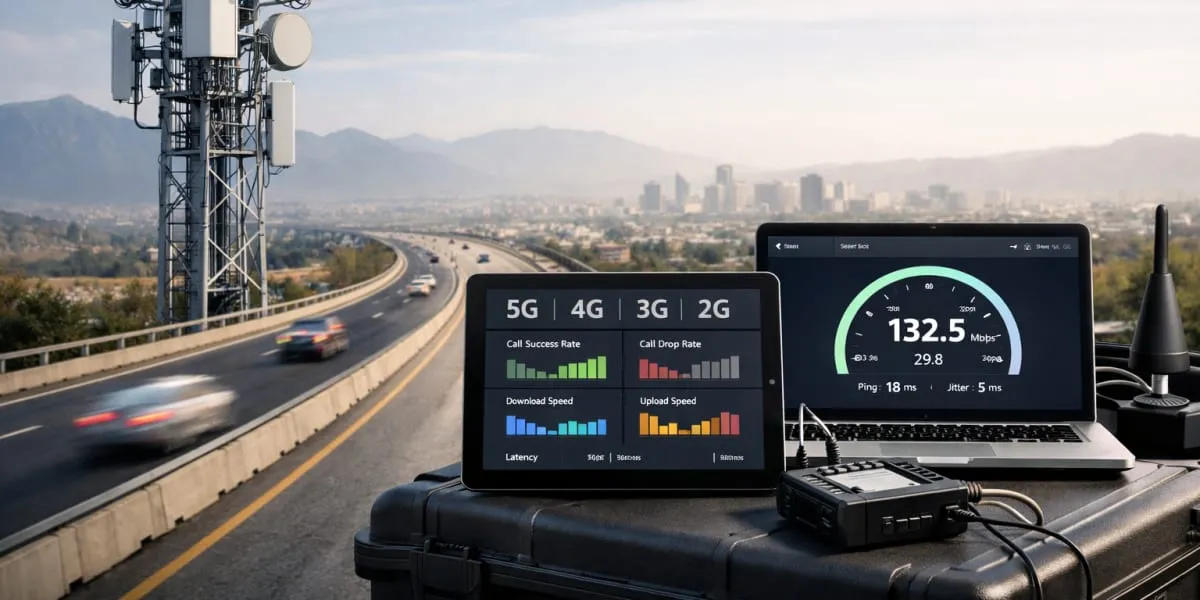
The Telecom Regulatory Authority of India assessed mobile network quality across Jammu city and along the highway route from Delhi to Jammu. The assessment measured voice quality parameters such as call setup success rate, call setup time, drop call rate and mean opinion score and data metrics including download and upload speeds and latency. The tests were conducted in real-time environments on fifth generation (5G), fourth generation (4G), third generation (3G) and second generation (2G) networks using TRAI suggested equipment and standardised protocols.

In auto-selection mode, one operator recorded a call setup success rate of 99.26 per cent while another recorded 99.12 per cent and one operator recorded 98.83 per cent; a public sector operator recorded 81.62 per cent. Call setup time ranged from 0.66 seconds to 4.05 seconds across operators and drop call rate varied from 0.60 per cent to 7.87 per cent. Packet switched network silence or mute rates were reported between 0.53 per cent and 6.83 per cent and mean opinion scores ranged from 3.07 to 4.43.

Data download performance showed average download speeds of 295.90 Mbps, 179.53 Mbps, 25.34 Mbps and 11.30 Mbps while average upload speeds were 30.50 Mbps, 30.09 Mbps, 16.39 Mbps and 3.86 Mbps. Hotspot measurements indicated that fifth generation download speeds reached 298.52 Mbps and 178.53 Mbps for two operators and fourth generation hotspot downloads ranged from 41.57 Mbps to 13.08 Mbps. Latency at the fiftieth percentile ranged from 22.84 ms to 43.38 ms across operators. The report noted variations between network types and locations that affected user experience.

The field assessment covered high density neighbourhoods and public locations in Jammu city including hospital, bus stand, railway station, temples and markets and included a walk test in Gole Market and Hari Market on the fifth of February 2026 to capture crowded pedestrian behaviour. Highway measurements were recorded on routes from Delhi to Jammu via Ambala and Jalandhar to assess performance in high speed transit. The detailed report is available on the TRAI website with contact details for the regional advisor provided.

The Telecom Regulatory Authority of India assessed mobile network quality across Jammu city and along the highway route from Delhi to Jammu. The assessment measured voice quality parameters such as call setup success rate, call setup time, drop call rate and mean opinion score and data metrics including download and upload speeds and latency. The tests were conducted in real-time environments on fifth generation (5G), fourth generation (4G), third generation (3G) and second generation (2G) networks using TRAI suggested equipment and standardised protocols. In auto-selection mode, one operator recorded a call setup success rate of 99.26 per cent while another recorded 99.12 per cent and one operator recorded 98.83 per cent; a public sector operator recorded 81.62 per cent. Call setup time ranged from 0.66 seconds to 4.05 seconds across operators and drop call rate varied from 0.60 per cent to 7.87 per cent. Packet switched network silence or mute rates were reported between 0.53 per cent and 6.83 per cent and mean opinion scores ranged from 3.07 to 4.43. Data download performance showed average download speeds of 295.90 Mbps, 179.53 Mbps, 25.34 Mbps and 11.30 Mbps while average upload speeds were 30.50 Mbps, 30.09 Mbps, 16.39 Mbps and 3.86 Mbps. Hotspot measurements indicated that fifth generation download speeds reached 298.52 Mbps and 178.53 Mbps for two operators and fourth generation hotspot downloads ranged from 41.57 Mbps to 13.08 Mbps. Latency at the fiftieth percentile ranged from 22.84 ms to 43.38 ms across operators. The report noted variations between network types and locations that affected user experience. The field assessment covered high density neighbourhoods and public locations in Jammu city including hospital, bus stand, railway station, temples and markets and included a walk test in Gole Market and Hari Market on the fifth of February 2026 to capture crowded pedestrian behaviour. Highway measurements were recorded on routes from Delhi to Jammu via Ambala and Jalandhar to assess performance in high speed transit. The detailed report is available on the TRAI website with contact details for the regional advisor provided.

Related Stories

Gold Stories
Next Story
Infrastructure Transport

UP Cabinet Approves Renaming Jewar Airport After PM Modi

The Uttar Pradesh Cabinet has approved a proposal to rename Noida International Airport at Jewar as Narendra Modi International Airport, Noida-Jewar. Chief Minister Yogi Adityanath announced the decision after a Cabinet meeting, saying the airport represented a major contribution to the state and would become Uttar Pradesh’s largest airport and a significant aviation hub. The greenfield airport’s foundation stone was laid by Prime Minister Narendra Modi on November 25, 2021. He inaugurated Phase 1 on March 28, 2026, and commercial flights began on June 15. The facility is being developed a..

Next Story
Infrastructure Energy

Rolls-Royce Seeks Deeper Strategic Role in India

Rolls-Royce has described India as central to its long-term ambitions and said it wants to deepen its role as a strategic partner supporting the country’s energy security, infrastructure growth, national security and connectivity. The British aero-engine maker said its future expansion would build on decades of operations, industrial partnerships, engineering capabilities and a growing manufacturing and supply-chain ecosystem. The company held a board meeting in India for the first time this week. During a three-day visit, Rolls-Royce chief executive Tufan Erginbilgic met Prime Minister Nare..

Next Story
Building Material

JSW Cement Commissions 1 MTPA Grinding Unit at Nagaur

JSW Cement has commissioned an additional 1 MTPA grinding unit at Nagaur in Rajasthan. MTPA refers to million tonnes per annum. The commissioning has increased the company’s total cement grinding capacity to 25.10 MTPA, while its total clinker manufacturing capacity, including capacity at its joint venture JSW Cement FZC, stands at 9.74 MTPA. The company began operations in North India in March 2026 with the Nagaur Integrated Plant, which comprised a 3.30 MTPA clinkerisation unit and a 2.50 MTPA cement grinding unit. Following the latest commissioning, the plant’s total cement grinding cap..

Advertisement

Subscribe to Our Newsletter

Get daily newsletters around different themes from Construction world.

STAY CONNECTED

Advertisement

SPECIAL OFFER
QR Code