+
Indian Railways Sanctions Rs 7,653.4 Million for Traction and Digital Upgrades
RAILWAYS & METRO RAIL

Indian Railways Sanctions Rs 7,653.4 Million for Traction and Digital Upgrades

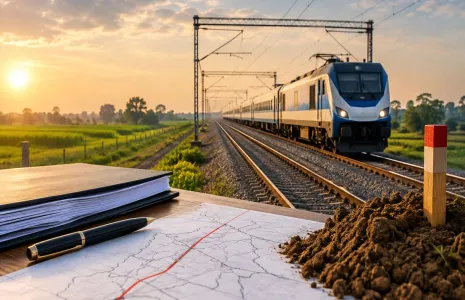
Indian Railways has sanctioned projects totalling Rs 7,653.4 million (mn) to strengthen traction, expand line capacity and modernise communication systems across several key corridors. The approvals form part of the 2024–25 Railway Budget programme for modernising electric traction and digital infrastructure. The works are intended to support higher freight loading and improved passenger services across busy freight and passenger routes.

Rs 3,180.7 mn has been allocated for the traction upgradation on the 106-km Duvvada–Visakhapatnam–Vizianagaram section of East Coast Railway. The section will be converted from the existing one-by-25 kV system to a two-by-25 kV system to enable increased freight loading, higher speed potential and enhanced reliability on this dense corridor. The route serves mineral and industrial traffic towards Visakhapatnam Port and the upgrade is expected to smooth freight movement.

Rs 2,593.9 mn has been approved for the 126-km Raichur–Guntakal section under Guntakal Division of South Central Railway. The works will convert the existing one-by-25 kV arrangement to a two-by-25 kV arrangement to improve power supply capacity, allow heavier train loads and increase operational reliability on the Mumbai–Chennai corridor. The upgrade is aligned with the aim to achieve 3,000 MT freight loading and to support faster passenger services including high speed trainsets.

Rs 1,878.8 mn has been sanctioned for strengthening the optical fibre communication backbone in Vadodara and Mumbai Central Divisions of Western Railway. The project provides for installation of a four-by-48 core optical fibre backbone and will see cables laid over 1,000 route kilometres, with 692 km in Vadodara Division and 308 km in Mumbai Division. The enhanced bandwidth and redundancy will provide reliable support for LTE-based Kavach and other critical railway communication systems.

The measures are expected to improve line capacity, operational reliability and the performance of freight and passenger services while supporting the rollout of modern train operations and digital signalling. The projects have been prioritised under the national modernisation programme and will be implemented by the respective zonal divisions. Implementation timelines and detailed project plans will be managed by Indian Railways to ensure integration with existing network operations.

Indian Railways has sanctioned projects totalling Rs 7,653.4 million (mn) to strengthen traction, expand line capacity and modernise communication systems across several key corridors. The approvals form part of the 2024–25 Railway Budget programme for modernising electric traction and digital infrastructure. The works are intended to support higher freight loading and improved passenger services across busy freight and passenger routes. Rs 3,180.7 mn has been allocated for the traction upgradation on the 106-km Duvvada–Visakhapatnam–Vizianagaram section of East Coast Railway. The section will be converted from the existing one-by-25 kV system to a two-by-25 kV system to enable increased freight loading, higher speed potential and enhanced reliability on this dense corridor. The route serves mineral and industrial traffic towards Visakhapatnam Port and the upgrade is expected to smooth freight movement. Rs 2,593.9 mn has been approved for the 126-km Raichur–Guntakal section under Guntakal Division of South Central Railway. The works will convert the existing one-by-25 kV arrangement to a two-by-25 kV arrangement to improve power supply capacity, allow heavier train loads and increase operational reliability on the Mumbai–Chennai corridor. The upgrade is aligned with the aim to achieve 3,000 MT freight loading and to support faster passenger services including high speed trainsets. Rs 1,878.8 mn has been sanctioned for strengthening the optical fibre communication backbone in Vadodara and Mumbai Central Divisions of Western Railway. The project provides for installation of a four-by-48 core optical fibre backbone and will see cables laid over 1,000 route kilometres, with 692 km in Vadodara Division and 308 km in Mumbai Division. The enhanced bandwidth and redundancy will provide reliable support for LTE-based Kavach and other critical railway communication systems. The measures are expected to improve line capacity, operational reliability and the performance of freight and passenger services while supporting the rollout of modern train operations and digital signalling. The projects have been prioritised under the national modernisation programme and will be implemented by the respective zonal divisions. Implementation timelines and detailed project plans will be managed by Indian Railways to ensure integration with existing network operations.

Next Story
Infrastructure Urban

Implementation Status of Jal Jeevan Mission

Since August 2019 the Government has implemented Jal Jeevan Mission to provide assured potable water through household tap connections in rural India. At the start of the mission only 32.3 million (mn) rural households, representing 16.7 per cent, were reported to have tap water connections. States and union territories have reported that 125.8 mn additional rural households have since been provided with tap connections. As a result, of about 193.6 mn rural households roughly 158.2 mn, or 81.71 per cent, are reported to have tap water supply at home.\n\nThe State, district and village level st..

Next Story
Infrastructure Urban

Jal Jeevan Mission Reaches Eighty One Per Cent Rural Coverage

The Government reported substantial progress under the Jal Jeevan Mission, launched in August 2019 to provide tap water to every rural household. At launch only 32.3 million (mn) rural households had tap connections and states and Union territories reported provision of 125.8 mn additional households by March 2026. Consequently, out of about 193.6 mn rural households around 158.2 mn, or 81.71 per cent, are reported to have tap water at home. The Finance Minister announced extension of the mission until 2028 in the 2025-26 budget speech. The Swachh Bharat Mission Grameen, launched in October 20..

Next Story
Infrastructure Urban

Empowering Local Governance for Sustainable Rural Water Supply

The Ministry of Jal Shakti has aligned the Jal Jeevan Mission (JJM) with the 73rd Amendment to strengthen village level planning and community ownership of water supply. Gram Panchayats, village water and sanitation committees and Pani Samitis are to plan, implement, manage and maintain piped water systems, with gram sabha processes formalising handover and oversight. Implementation support agencies including non government organisations, community based organisations and self help groups have been empanelled to train local committees and promote women participation. Under JJM, the department ..

Advertisement

Subscribe to Our Newsletter

Get daily newsletters around different themes from Construction world.

STAY CONNECTED

Advertisement

Advertisement

Advertisement